How AI Suggests Gluten-Free Substitutions in Recipes
• Updated
AI simplifies gluten-free cooking by identifying gluten in recipes and recommending ingredient swaps. It uses text analysis to flag gluten-containing items like wheat, barley, and rye, even spotting hidden sources in soy sauce or thickeners. Advanced tools analyze ingredient roles and suggest alternatives, such as almond flour for wheat flour or tamari for soy sauce, while adjusting recipes to maintain taste and texture. Apps like Honeydew Recipe Manager streamline this process, converting recipes into gluten-free versions with just a few clicks. Always double-check labels for accuracy, especially for hidden gluten in processed foods. AI helps save time, but your input ensures the best results.
How AI Converts Recipes to Gluten-Free: Detection to Substitution Process
How AI Detects Gluten in Recipes
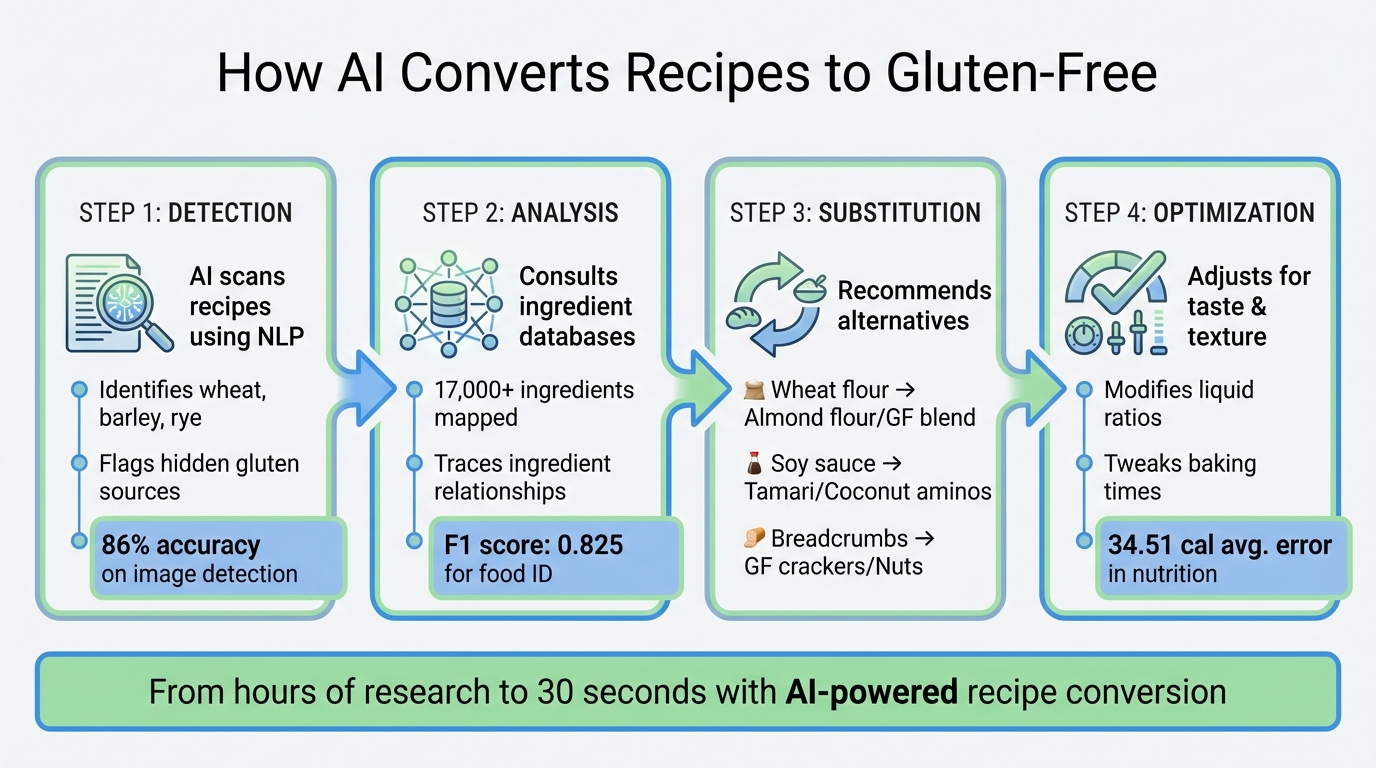
AI uses a mix of text analysis and image recognition to identify gluten in recipes. Through natural language processing (NLP), it categorizes ingredients as either "Contains Gluten" or "Gluten Free", assigning each a confidence score. This approach is particularly effective at flagging hidden gluten sources - like soy sauce, barley malt, or bread crumbs - that might not be immediately obvious.
For visual detection, convolutional neural networks (CNNs) analyze images to spot signs of gluten. For instance, CNNs can identify irregular air bubbles in gluten-free bread, a common visual marker. In fact, one deep learning model reached an accuracy rate of 86% when detecting gluten in bread images. By combining these methods, AI ensures thorough gluten detection across both text-based and image-based recipe formats.
Common Gluten-Containing Ingredients
AI systems are trained to recognize key gluten sources like wheat, barley, and rye, as well as specific wheat varieties such as spelt, durum, and semolina, which might not always be labeled as gluten-containing. Beyond these staples, the technology is adept at identifying hidden gluten in processed foods and condiments. It scans for items like wheat-based soy sauce, barley-based miso, malt vinegar, seitan, and various thickeners or additives that often conceal gluten in packaged goods.
How AI Uses Ingredient Databases
AI goes a step further by consulting extensive ingredient databases to refine its analysis. Tools tap into resources like FoodOn and FoodKG, which connect over 17,000 ingredients to nutritional databases and food classifications. These databases allow the AI to trace ingredient relationships - such as identifying that soy sauce often contains wheat, even when wheat isn't explicitly mentioned. For ambiguous ingredient labels, the system maps them to standardized categories, ensuring consistent and accurate identification.
AI's image recognition capabilities are also bolstered by advanced models like Dino V2, which achieved an F1 score of 0.825 in accurately identifying food ingredients from photos. This combination of text analysis, database integration, and image recognition makes AI a powerful tool for detecting gluten in recipes.
How AI Recommends Gluten-Free Substitutions
When gluten is detected in a recipe, AI steps in to evaluate the role of each ingredient and suggests substitutes that align with the dish's overall context. This isn't just a simple swap - it’s a thoughtful process that ensures the recipe still works as intended.
AI leverages tools like knowledge graphs and word embeddings to analyze ingredient roles and recommend precise gluten-free alternatives. For example, systems like FoodKG connect thousands of ingredients to detailed nutritional data, helping the AI pinpoint suitable options. Word embeddings, on the other hand, analyze ingredient similarities across millions of recipes. A practical application of this can be seen in the Diet-Improvement Ingredient Substitutability Heuristic (DIISH), which successfully identified watercress and radicchio as ideal substitutes for arugula. It also ranked vegetable shortening, butter, and oil as effective replacements for lard.
"Substituting individual ingredients rather than strictly following a new meal plan allows people to eat familiar meals while maintaining their dietary goals." - Sola S. Shirai et al., Researchers, Rensselaer Polytechnic Institute
Large Language Models like ChatGPT act as virtual culinary experts, drawing from vast pre-trained knowledge to recommend gluten-free alternatives. In a February 2025 Healthline test, ChatGPT provided six gluten-free flour options, each tailored with specific flavor profiles and substitution ratios. These AI-driven suggestions aim to preserve the integrity of the dish while accommodating dietary needs.
Examples of AI-Recommended Substitutions
AI doesn’t just replace ingredients - it ensures that the substitutions maintain the recipe’s structure and flavor. For instance, if a recipe calls for wheat flour, AI might recommend almond flour or a 1:1 gluten-free blend, noting that adjustments to liquid ratios may be necessary due to differences in moisture absorption. Similarly, tamari or coconut aminos are suggested as alternatives to soy sauce, while crushed gluten-free crackers or finely chopped nuts can replace breadcrumbs without sacrificing texture. In the Healthline test, ChatGPT even suggested swapping kimchi for pickles in a rice dish to better complement the dish's flavor profile. These tailored recommendations make gluten-free cooking both effective and approachable.
Maintaining Taste and Texture with Gluten-Free Swaps
AI goes beyond basic substitutions by fine-tuning recipes to retain their culinary appeal. To ensure both taste and texture are preserved, AI analyzes flavor networks and volatile compound libraries, predicting how a substitute will affect the dish’s overall aroma and taste. It also evaluates properties like viscosity and elasticity to ensure baked goods rise properly or sauces achieve the desired consistency. When functional differences between ingredients are significant, AI suggests adjustments, such as altering baking times or tweaking liquid-to-dry ratios.
"Ingredient substitution refers to replacing one or more components in a formulation while preserving sensory quality, technological functionality, nutritional value, and cultural or regulatory compliance must be satisfied simultaneously." - Emel Oz and Fatih Oz, Department of Food Engineering, Ataturk University
This method treats substitution as a balancing act, weighing factors like mouthfeel, structural integrity, and nutritional content. Impressively, AI-driven nutritional calculations have demonstrated an average per-serving error of just 34.51 calories compared to verified recipe data. By addressing these challenges, AI simplifies gluten-free cooking while maintaining the high standards home cooks expect from their meals.
Using Honeydew Recipe Manager for Gluten-Free Recipes

Honeydew Recipe Manager takes AI's knack for recommending gluten-free swaps and brings it straight to your kitchen. With its AI-powered Smart Substitutions tool, the app simplifies converting traditional recipes into gluten-free versions. It identifies wheat-based ingredients and suggests suitable alternatives, making the process seamless. With a 4.8-star rating and over 270,000 recipes saved monthly, it’s clear that users are loving it.
Importing Recipes for Gluten-Free Conversion
Honeydew Recipe Manager makes importing recipes incredibly easy. Whether it’s from social media, websites, screenshots, or even handwritten cards, you can quickly bring recipes into the app. Just tap the Share button, and Honeydew’s AI gets to work analyzing the recipe instantly. Free users can import up to 10 recipes per month, but if you upgrade to Honeydew Plus for $4.17/month, you’ll unlock unlimited imports.
"Say you want to convert a recipe to gluten free? Ask Honeydew and our AI accurately makes all the changes, and still saves the original." - Honeydew Release Notes
Once imported, you can tweak and save your new gluten-free recipes with ease.
Editing and Saving Gluten-Free Recipes
After importing a recipe, simply type "make this gluten-free" into the app’s AI assistant. Honeydew will handle the rest, converting ingredients and directions while keeping the original version intact. You can also make manual adjustments or request alternative substitutions, like swapping almond flour for a nut-free option. The app even recalculates calories and macros for the revised recipe. All saved versions are accessible offline, so you’ll always have them handy.
"The ingredient substitution feature makes adapting recipes effortless!" - Emily C.
Verifying and Adjusting AI Suggestions
AI tools can be incredibly helpful for finding gluten-free alternatives, but they’re not foolproof. Hidden sources of gluten - like malt flavoring or modified starches - can still sneak into your meals, so it’s always a good idea to double-check. On January 6, 2025, the FDA issued updated guidance (Edition 5) on food allergen labeling, requiring clear identification of major allergens, including wheat. Their gluten-free labeling rules, first introduced in August 2013 and revised in August 2020, set strict criteria for products to be labeled as "gluten-free".
Checking Ingredient Labels
Look for "certified gluten-free" labels when shopping for ingredients. For instance, while AI might suggest tamari as a substitute for soy sauce, not all tamari brands are gluten-free - some still contain wheat. Similarly, oats can often be cross-contaminated during processing unless specifically labeled as gluten-free. Always read ingredient lists carefully, especially for processed foods where gluten can be hiding in additives or flavorings. Once you’ve confirmed the ingredients are safe, tweak recipes as needed to suit your dietary requirements.
Adjusting Recipes for Personal Preferences
If an AI suggestion doesn’t quite fit your needs - maybe almond flour isn’t an option for you - ask for a nut-free substitute. If your gluten-free bread turns out too crumbly, consider adjusting liquid ratios or adding binders like xanthan gum to improve texture. You can also tailor recipes to meet multiple dietary restrictions, such as making them both gluten-free and dairy-free or gluten-free and vegan.
Conclusion
AI has made gluten-free cooking easier and faster than ever. What used to take hours of research can now be done in just 30 seconds. With the ability to convert standard recipes into gluten-free versions, AI takes care of ingredient swaps, adjusts ratios, and fine-tunes cooking times and techniques to work with gluten-free flours and binders - all without the guesswork.
Taking this a step further, the Honeydew Recipe Manager combines these recipe conversion tools with practical meal planning features. It allows users to import recipes directly from social media, provides AI-suggested gluten-free substitutions, and even creates detailed grocery lists. These lists sync with Instacart, making one-click ingredient ordering a breeze. With 270,000 recipes saved by users each month, Honeydew shows how AI can simplify the many moving parts of a gluten-free lifestyle, from meal prep to grocery shopping.
For families or shared households, the platform offers collaborative tools that enable up to six members to share meal plans and grocery lists in real time. This ensures everyone stays on the same page about gluten-free needs. As one user, Emily C., shared, "The ingredient substitution feature is a game-changer for my dietary restrictions. I can adapt any recipe easily!"
While AI handles much of the heavy lifting, you’re still in control. It offers smart suggestions based on flavor profiles and cooking properties, but it’s always wise to double-check ingredient labels and fine-tune recipes to suit your taste. This balance between automation and personal input makes AI an invaluable partner in the kitchen.
FAQs
How does AI choose gluten-free substitutes without sacrificing taste or texture?
AI takes the guesswork out of finding gluten-free substitutes by analyzing what each ingredient does in a recipe - like binding, adding moisture, or boosting flavor. By leveraging advanced algorithms, it identifies alternatives that closely replicate the taste and texture of the original ingredients.
For instance, if a recipe calls for wheat flour, AI might recommend almond flour or rice flour as replacements, ensuring the dish still has the right consistency and flavor. This method makes it easier to craft gluten-free recipes that don’t compromise on taste or satisfaction.
Can AI identify hidden sources of gluten in processed foods?
AI-powered tools are making it easier to spot hidden gluten in processed foods by analyzing ingredient labels. Using advanced algorithms and extensive databases, these tools can flag ingredients that might contain gluten - even if it’s not clearly stated. This is a game-changer for people with celiac disease or anyone avoiding gluten for dietary reasons.
By streamlining the process of identifying gluten, these tools provide an added layer of confidence and safety when choosing packaged foods.
What challenges does AI face when suggesting gluten-free ingredient substitutions?
AI tools designed for gluten-free substitutions can be helpful, but they come with certain challenges. One major hurdle is replicating the texture, elasticity, and binding properties that gluten brings to recipes. This is especially tricky in baked goods, where gluten plays a key role in structure and flavor. For instance, while gluten-free options like rice flour or almond flour can be used, they often don’t deliver the same results as wheat flour.
Another limitation lies in the data these tools rely on. If the database lacks detailed nutritional or regional information, the substitutions might not be as healthy or might clash with specific cuisines. Additionally, AI cannot ensure compliance with gluten-free standards, such as the FDA's requirement of less than 20 parts per million (ppm) of gluten. It also doesn’t account for cross-contamination risks in home kitchens. Ultimately, users need to exercise their own judgment to ensure the substitutions meet their dietary and safety needs.