Top AI Tools For Reducing Food Waste
• Updated
Food waste is a huge problem in U.S. households, costing families over $1,800 annually and contributing to 8–10% of greenhouse gas emissions. The good news? AI tools are helping tackle this issue by improving meal planning, tracking pantry inventory, and suggesting recipes to use up leftovers. These tools can save money, reduce waste, and simplify kitchen management.
Here’s what AI can do for you:
- Meal Planning: AI suggests recipes based on what’s in your fridge, helping you use up ingredients before they expire.
- Inventory Tracking: Apps monitor pantry and fridge contents, notify you of expiring items, and prevent duplicate purchases.
- Leftover Recipes: AI transforms random leftovers into meals, reducing waste and saving money.
One standout tool, Honeydew Recipe Manager, combines meal planning, inventory tracking, and grocery list generation with features like household sharing and Instacart integration. It’s designed to help families stay organized, save money, and cut down on waste.
AI-powered tools like Honeydew, Nosh, Samsung Food, and Plant Jammer make it easier to manage your kitchen, reduce waste, and repurpose ingredients effectively. Whether you’re planning meals, tracking inventory, or finding ways to use leftovers, these tools can make a big difference.
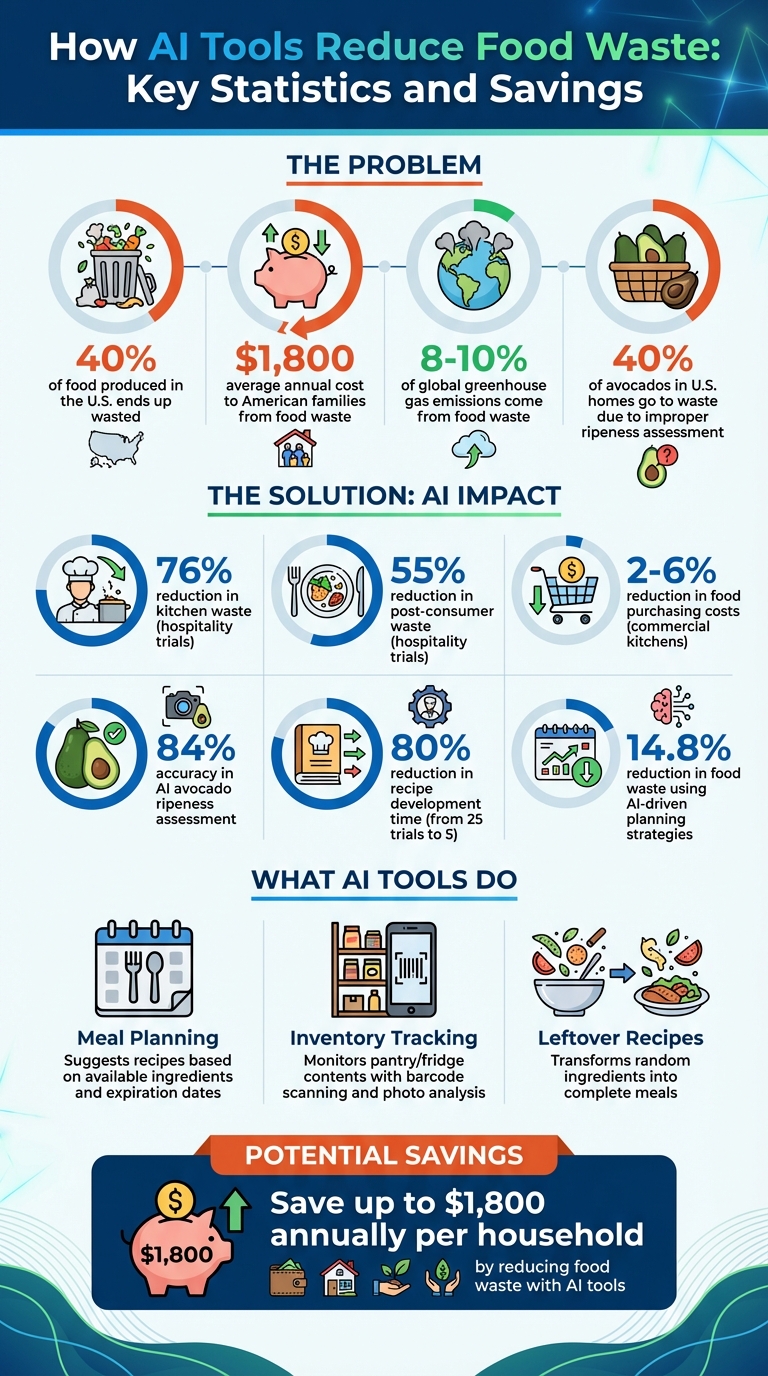
How AI Tools Reduce Food Waste: Key Statistics and Savings
How AI Tools Reduce Food Waste at Home
Meal Planning Based on Available Ingredients
AI-powered meal planners take stock of what’s already in your kitchen and craft weekly menus tailored to those ingredients, helping you avoid unnecessary waste. For instance, some apps use Vision AI to scan your fridge, identify items nearing their expiration dates, and suggest meals that fit your dietary preferences - whether you’re into low-carb, vegan, or family-friendly options. This not only helps you make the most of what you have but also curbs those spur-of-the-moment grocery purchases that often lead to spoilage.
These tools can even suggest ingredient swaps based on what’s in your pantry. If a recipe calls for fresh basil but you only have dried oregano, the AI adjusts the recipe seamlessly. This flexibility makes it easier for busy households to stick to meal plans without wasting food - or money. Plus, these systems often integrate inventory management features to keep your kitchen running efficiently.
Tracking Pantry and Refrigerator Inventory
AI inventory trackers bring organization to your kitchen by using barcode scanning and photo analysis to log everything you’ve got. They monitor quantities and expiration dates, creating real-time dashboards that notify you when items are close to expiring. For example, AI can assess avocado ripeness with over 84% accuracy by analyzing visual details like color and texture. This matters because nearly 40% of avocados in U.S. homes go to waste due to improper ripeness assessment.
Some tools even send reminders about expiring items. In hospitality trials, AI-driven tracking systems reduced kitchen waste by 76% and post-consumer waste by 55%. Imagine applying that same precision at home - less food wasted and more money saved. With accurate tracking in place, these tools also ensure your ingredients are used effectively through smart recipe suggestions.
Recipe Suggestions for Leftovers and Extra Ingredients
Got leftovers or random ingredients lying around? AI recipe generators can help. Whether you upload a photo or enter ingredients manually, these tools come up with creative ways to use them before they go bad. Overripe bananas could become smoothies, wilted veggies might turn into soups, and extra proteins could end up in casseroles. These systems even scale recipes to suit your household size, simplifying the process.
This technology eliminates much of the guesswork in repurposing leftovers. Research from the University of Leeds shows that AI can cut recipe development time from 25 trials to just 5. By transforming what might have been wasted into planned meals, households can save around $1,800 annually - the average amount American families lose due to discarded food. It’s a smart way to turn potential waste into something delicious and valuable.
How AI is being used to tackle food waste
Honeydew Recipe Manager: AI-Powered Meal Planning to Cut Waste
Honeydew Recipe Manager brings together smart tools designed to tackle food waste by syncing meal planning with your pantry inventory.
AI-Generated Grocery Lists and Meal Plans
Honeydew Recipe Manager takes the guesswork out of grocery shopping. By analyzing what’s already in your pantry, the app creates detailed grocery lists tailored to your needs. Using AI, it calculates exact ingredient quantities for your recipes, helping you buy only what you’ll use.
Measurements are displayed in familiar imperial units (cups, pounds, ounces), and prices are shown in U.S. dollars through its Instacart integration. For example, if you’ve got a half-bag of rice and milk nearing expiration, the app might suggest making rice pudding right away to use up the milk. This kind of targeted planning reflects strategies proven to reduce food waste by 14.8% in retail settings.
"The smart grocery lists save me hundreds of dollars a month. I love how it suggests recipes based on what I already have!"
– James L., User
With a 4.8-star rating and 270,000 recipes saved monthly, Honeydew’s AI-driven features are helping households cut down on waste and save money. This precision also supports seamless meal scheduling.
Drag-and-Drop Weekly Meal Calendar
Honeydew’s drag-and-drop meal calendar makes weekly planning effortless. Using the U.S. date format (MM/DD/YYYY), you can easily assign recipes to specific days and plan for leftovers. Simply drag a recipe to a day on the calendar, and the app adjusts your grocery list accordingly.
This flexible tool is perfect for busy families who need to tweak their plans throughout the week. Whether you’re planning fresh meals or repurposing leftovers, the AI ensures your grocery list always matches your schedule.
"I used to waste so much food. Now with Honeydew's meal planning, I buy exactly what I need and save money!"
– Mark T., User
The calendar’s functionality is further enhanced by features designed for families and shared households.
Household Sharing and Instacart Integration
Honeydew makes meal planning a team effort with its household sharing capabilities. Up to six family members can collaborate by sharing calendars, grocery lists, and pantry inventories. If one person adds “buy milk” while another notes there’s already a gallon in the fridge, the AI flags the duplication.
The app’s Instacart integration simplifies grocery shopping even further. With one tap, you can order everything on your AI-generated list. You’ll see U.S. pricing, available delivery slots in your local time zone (like 12:00 PM EST), and receive smart substitution suggestions if an item is out of stock. This level of precision helps you avoid overbuying - like ordering just 3 apples instead of a 6-pack - while cutting down on impulse purchases.
"My family of five uses Honeydew for all our meal planning. The household sharing feature keeps everyone organized."
– Alex P., User
Other AI Tools for Reducing Food Waste
Beyond smart meal planners, there are several AI-driven tools designed to tackle food waste in unique ways. These tools focus on keeping track of what you have, understanding waste habits, and finding creative uses for leftovers.
AI Apps for Pantry and Refrigerator Tracking
Apps like Nosh and Samsung Food take pantry management to the next level. Using your phone's camera, they track your inventory and even notify you when items are about to expire. Samsung Food’s Vision AI goes a step further by scanning your fridge, identifying ingredients, and suggesting recipes using items that are close to their expiration date. This means fewer trips to the store and more meals made from what’s already on hand. These tools not only help you stay organized but also set the stage for understanding and reducing waste.
AI Tools for Waste Pattern Analysis
Some AI systems go beyond tracking and dive into analyzing waste patterns. Tools like Orbisk and Leanpath, designed for commercial kitchens, log discarded food and highlight inefficiencies. These systems can save businesses up to $75,000 a year and cut down 45 tons of CO₂ emissions annually. While primarily used in professional settings, the same approach can be applied at home. Keeping tabs on what you throw away can reveal patterns - like overbuying certain items or cooking portions that are too large - so you can adjust your shopping and meal prep habits accordingly.
AI Tools for Repurposing Leftovers
Dealing with random leftovers? Apps like Plant Jammer turn those odds and ends into brand-new meals. Whether it’s half a rotisserie chicken or some wilted spinach, these tools suggest recipes based on what you have, your dietary preferences, and even your kitchen gadgets. You might end up with a frittata, stir-fry, or grain bowl - all while cutting down on waste and saving money. These apps make it easier to see leftovers not as scraps, but as opportunities for something delicious.
Conclusion
In the United States, a staggering 40% of food produced ends up wasted. This not only costs families over $1,800 each year but also contributes to 8–10% of global greenhouse gas emissions. Thankfully, AI-powered tools are stepping in to tackle this issue by streamlining meal planning, keeping tabs on fridge and pantry contents, and turning leftovers into delicious meals.
By linking your grocery purchases, meal plans, and available ingredients, AI tools create smarter systems. Features like automated grocery lists, inventory tracking, and recipe suggestions help prevent overbuying and food spoilage. In fact, commercial kitchens using these technologies have seen food waste drop significantly, with food purchasing costs reduced by 2–6%. These results show that AI-driven solutions aren’t just useful - they work on a large scale.
One standout in this space is the Honeydew Recipe Manager. This app takes waste reduction to a personal level by offering AI-generated meal plans, an intuitive drag-and-drop weekly calendar, smart grocery lists, and Instacart integration for quick and easy online ordering. Many users report buying only what they need and saving hundreds of dollars every month. As Mark T., a Honeydew user, shared:
"I used to waste so much food. Now with Honeydew's meal planning, I buy exactly what I need and save money!"
Honeydew also includes a household sharing feature, ensuring everyone in the family stays on the same page. This not only reduces miscommunication and unnecessary trips to the store but also helps families save money while contributing to a more sustainable future.
FAQs
How can AI tools help reduce food waste at home?
AI tools are changing the way we handle food waste by helping us plan better and shop smarter. They can generate personalized grocery lists, recommend alternative ingredients, and even suggest meals using items you already have in your pantry. By tailoring their suggestions to your specific needs, these tools help prevent overbuying and cut down on spoilage.
Features like meal planning and ingredient tracking make it easier to use up what you’ve got before it expires, saving not just food but money too.
How does Honeydew Recipe Manager help reduce food waste?
Honeydew Recipe Manager is designed to cut down on food waste with its AI-powered grocery lists. These lists provide exact quantities and even recommend substitutes, so you’re only buying what’s necessary. Plus, it offers personalized weekly meal plans based on your preferences, helping you avoid overbuying and unnecessary spoilage.
Packed with features like smart meal planning, recipe storage, and collaborative tools, Honeydew helps you stay organized while reducing waste in your kitchen.
Can AI tools help you find recipes using ingredients you already have?
AI tools such as Honeydew Recipe Manager are great for getting creative with the ingredients you already have on hand. By scanning the contents of your pantry or fridge, these tools can recommend recipes that match what’s available. This not only makes meal planning easier but also helps cut down on food waste. It’s a practical way to transform leftovers into tasty dishes!