5 Common Problems AI Grocery Lists Solve
• Updated
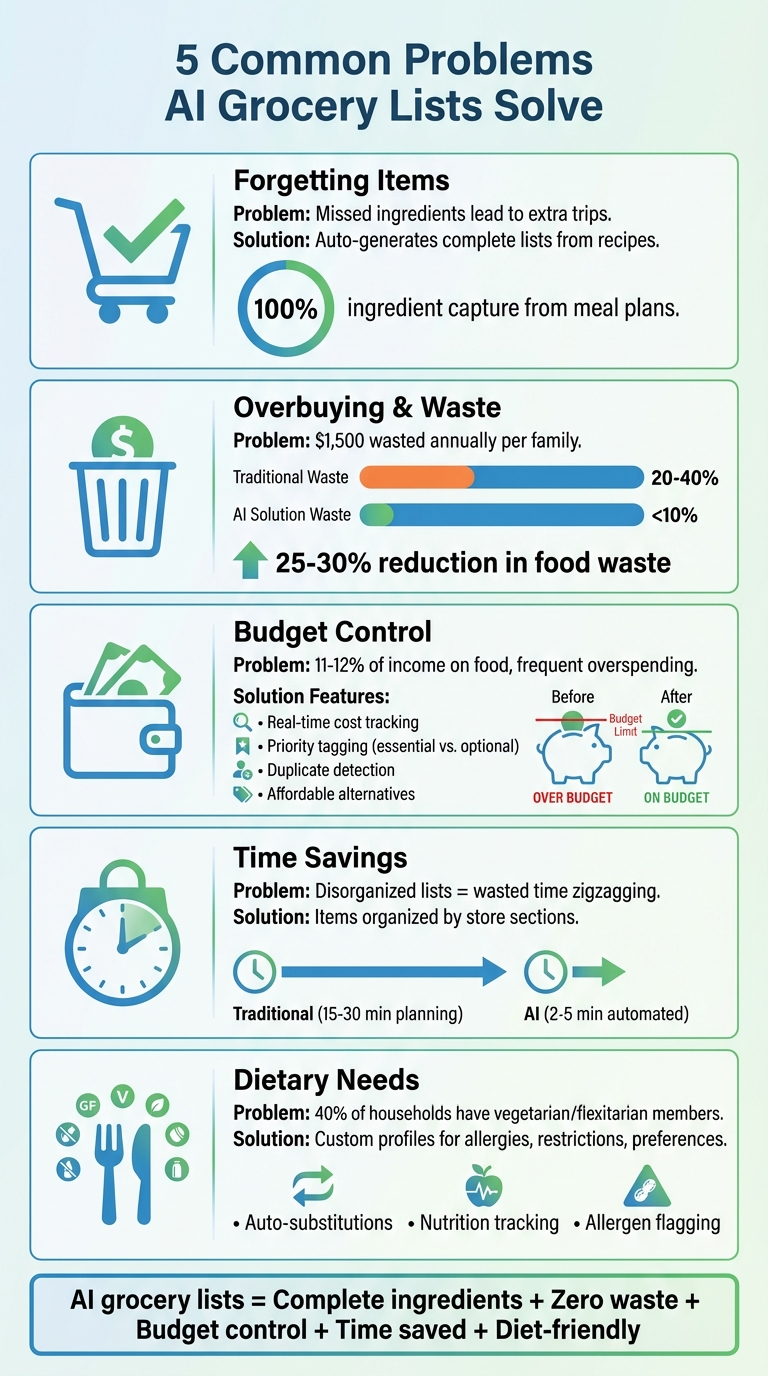
AI grocery lists simplify shopping, save money, and reduce waste. They tackle frequent issues like forgotten items, overbuying, budgeting challenges, wasted time, and catering to dietary needs. By generating precise, recipe-based lists, these tools streamline meal planning and shopping. Here's how they help:
- Forgetful shopping: Automatically include all ingredients from recipes, reducing missed items.
- Overbuying and waste: Calculate exact quantities to avoid duplicates and spoilage.
- Budgeting: Track costs in real time and suggest affordable alternatives.
- Store navigation: Organize lists by store sections to save time.
- Dietary needs: Adjust lists for allergies, restrictions, and preferences.
AI tools like Honeydew Recipe Manager integrate meal planning, recipe imports, and grocery lists, making shopping more efficient and stress-free.
5 Problems AI Grocery Lists Solve: Benefits and Solutions Overview
5 AI prompts to make meal planning and grocery shopping easier
1. Forgetting Items at the Store
There's nothing more frustrating than getting home, ready to cook, only to realize you're missing a key ingredient. Forgetting your shopping list - or worse, trying to wing it without one - often leads to extra trips and unexpected expenses.
Why does this happen? Many of us rely on memory or hastily written notes that don't align with our meal plans. Sure, you might remember the chicken breast, but what about the garlic, paprika, or lime juice the recipe calls for? And if you decide on tacos while you're already at the store, trying to mentally juggle all the ingredients is a recipe for forgetting something.
How AI Creates Complete Lists
This is where AI steps in to save the day. AI-powered grocery lists eliminate the guesswork by automatically pulling every ingredient from your recipes and meal plans. No more manually jotting down every item - AI scans your recipes and generates a detailed list for you. Tools like Honeydew Recipe Manager make this even easier by letting you import recipes from websites, social media, or even photos. The AI extracts ingredients, quantities, and cooking instructions, building your recipe collection without the hassle of data entry.
Ingredient aggregation and unit conversions make shopping smoother, too. For example, if your spaghetti recipe calls for 1 lb of ground beef and your taco recipe needs 0.5 lb, the AI combines them into a single line item - 1.5 lbs total. It even converts measurements (like 250g to approximately 9 oz) to match U.S. standards, so you're not left scratching your head in the store.
"As someone who meal preps weekly, Honeydew's grocery list feature is indispensable. It's saved me countless trips to the store."
The system doesn’t stop there - it also flags commonly overlooked basics, like salt, pepper, and cooking oil, ensuring you’re fully stocked and ready to cook without any last-minute scrambles.
2. Buying Too Much and Wasting Food
Overbuying not only puts unnecessary strain on your wallet but also contributes to a staggering amount of food waste. On average, a U.S. family of four throws away about $1,500 worth of food annually, with households discarding an estimated 30–40% of their food supply every year. This often happens when we buy more than we need, forget what’s already in the pantry, or make impulsive purchases without a clear plan.
Traditional grocery lists don’t always help either. They often include vague entries like "milk" or "apples" without specifying quantities. Without checking your pantry beforehand, you might end up buying duplicates. This lack of planning leads to food spoilage, increasing household food loss by 20–25% as items expire before they’re used. By using AI for precise calculations, you can address these issues and shop smarter, reducing waste and saving money.
Calculating Exact Quantities
AI takes grocery planning to the next level by calculating exact quantities based on your meal plans. For example, if your recipes call for 1 lb of chicken for stir-fry and 0.5 lb for tacos, tools like Honeydew Recipe Manager consolidate the total to 1.5 lbs. It even adjusts for pantry inventory - if you already have half a cup of rice, it only adds the extra amount you need. This level of detail helps prevent overbuying and reduces food waste. In fact, users report cutting food waste by 25–30% thanks to these precise calculations.
"I used to waste so much food. Now with Honeydew's meal planning, I buy exactly what I need and save money!" - Mark T., Honeydew User
Table: Traditional Lists vs. AI Grocery Lists
| Aspect | Traditional Lists | AI Grocery Lists |
|---|---|---|
| Quantity Accuracy | Vague estimates (e.g., "some milk") | Precise amounts (e.g., "1/2 gallon for 4 servings") |
| Food Waste Risk | High (20–40% waste from duplicates and spoilage) | Low (<10% waste with recipe-based planning) |
| Time Required | 15–30 minutes of manual work | 2–5 minutes automated from meal plans |
3. Staying Within Budget
In the U.S., households typically allocate 11–12% of their income to food, but grocery expenses can quickly climb if shoppers hit the aisles without a plan or a way to keep tabs on costs. Impulse buys are a common culprit, often leading to surprise totals at checkout - sometimes $30 or $40 over what you intended to spend. Without a system to track spending in real time, staying within budget can feel like a guessing game.
This is where AI can step in, not just to help you pick the right ingredients, but also to keep your grocery budget on track. By providing a projected total based on average prices or past receipts, AI-powered lists help you make informed decisions. Instead of vague intentions, you’ll have clear numbers to guide your choices, making it easier to steer clear of unnecessary splurges.
Budget Features in AI Lists
AI shopping lists go beyond simple cost estimates - they actively help you manage your spending. For instance, they can update a running total as you add items, while priority tagging allows you to distinguish between essentials and extras. You can mark staples like vegetables, proteins, and pantry items as "essential" and desserts or snacks as "optional." This way, when you need to trim costs, you can quickly filter out non-essentials and see how much you’ll save by removing them.
Tools like Honeydew Recipe Manager take budgeting to the next level. Honeydew creates grocery lists directly from your meal plans, tailored to your budget. For example, if you aim to feed a family of four with five dinners for under $125, Honeydew’s AI prioritizes recipes that maximize ingredients across multiple meals. Think buying a large pack of chicken to use for fajitas, salads, and a sheet-pan dinner. Its integration with Instacart even pulls real-time prices from local stores, closing the gap between your estimated and actual costs. Users frequently praise its cost-saving features:
"The smart grocery lists save me hundreds of dollars a month. I love how it suggests recipes based on what I already have!" - James L., Honeydew User
Here’s a quick look at common budgeting challenges and how AI-driven tools address them:
Table: Budget Problems vs. AI List Solutions
| Budget Problem | AI List Solution |
|---|---|
| No running total | Real-time projected total in USD with color-coded budget alerts |
| Impulse purchases | Meal-based lists that flag items threatening your budget |
| Buying duplicates | Automatic detection of duplicates across pantry inventory and list |
| Unsure what to cut | Priority tagging (essential vs. optional) with savings shown for removed items |
| Defaulting to pricey brands | Suggestions for more affordable alternatives |
4. Saving Time at the Store
Even with a shopping list, it’s easy to lose time zigzagging through the aisles. Picture this: you grab bananas in the produce section, head to the back for milk, and then realize you forgot lettuce, forcing you to retrace your steps. A disorganized approach like this can stretch a quick errand into a frustratingly long outing.
The problem? Traditional lists are often written in the order you remember items, not based on the store’s layout. This means you might find yourself walking the same path multiple times. AI-powered lists solve this problem by grouping items according to their location in the store.
Organizing Items by Store Section
AI-generated grocery lists take the guesswork out of shopping by automatically categorizing items into common supermarket sections like produce, dairy, frozen foods, pantry staples, and household goods. This simple but effective organization helps you navigate the store efficiently.
For example, Honeydew Recipe Manager doesn’t just compile your ingredients - it organizes them by department. When you plan meals for the week, Honeydew gathers all the necessary items and sorts them into sections, so you can move through the store without backtracking.
With an AI-organized list, grocery shopping becomes less of a hassle and more of a streamlined, predictable task.
5. Shopping for Different Diets
Grocery shopping gets tricky when you're catering to a household with diverse dietary needs. One person might be vegetarian, another avoids gluten, and someone else watches their sodium intake. It’s easy to grab regular pasta instead of gluten-free or miss that a sauce exceeds sodium limits. According to Pew Research, 40% of U.S. households include at least one vegetarian or flexitarian member, which only adds to the complexity and increases the chances of buying items that don't work for everyone.
Standard shopping lists don’t help much here. You’re left checking labels manually or buying duplicate products to meet different needs. But AI-generated grocery lists simplify this process by creating individual dietary profiles for each household member. These profiles account for allergies, dietary restrictions, and nutrition goals, then combine everything into a single, streamlined list.
Customizing Lists for Each Person
AI takes the guesswork out of shopping by tailoring your list to meet everyone’s needs. It filters recipes and ingredients based on individual profiles. For instance, if someone is dairy-free, the AI automatically excludes milk, cheese, and butter, offering alternatives like oat milk or cashew cream. Similarly, if a recipe calls for soy sauce but someone in the house is gluten-sensitive, the AI suggests tamari or coconut aminos instead.
Tools like Honeydew Recipe Manager make this even easier. You can set up dietary profiles, mark allergens, and define nutrition goals for up to six family members. As Emily C., a Honeydew user, explains:
"The ingredient substitution feature is a game-changer for my dietary restrictions. I can adapt any recipe easily!"
Honeydew also tracks nutrition, estimating calories, protein, fat, carbs, and fiber for each person. This ensures everyone’s dietary needs are met without overcomplicating your shopping. When planning meals for the week, the app consolidates overlapping ingredients - like vegetables or grains - and clearly labels items for specific family members. Whether you’re shopping in-store or using a service like Instacart, it reduces confusion and saves time.
Table: Household Diet Scenarios and AI Solutions
| Household Diet Scenario | Challenge | AI Grocery List Solution |
|---|---|---|
| Vegetarian + Omnivore | Forgetting meat substitutes; duplicate produce | Combines lists, assigning tofu for vegetarians and chicken for omnivores, while scaling shared items like rice |
| Gluten-Free + Standard | Cross-contamination risks; missing labels | Automatically excludes gluten and suggests certified alternatives like quinoa instead of wheat |
| Nut Allergy + No Restrictions | Hidden allergens in shared items | Flags allergens and replaces ingredients like peanut butter with sunflower butter |
| Keto + Low-Calorie | High-carb fillers for one, excess fats for another | Adjusts quantities - using avocados for keto needs and salads for low-calorie diets, with detailed nutrition info |
Conclusion
AI-powered grocery lists tackle everyday shopping headaches by pulling together your meal plans and saved recipes to create thorough lists. Forget the frustration of missing essentials when you get home - these tools ensure you’ve got everything covered. By calculating precise quantities based on household size and servings, they help you buy just the right amount, cutting down on food waste.
These tools also make budgeting easier by estimating your total cost in U.S. dollars, flagging expensive items, and suggesting cheaper alternatives. Plus, they sort your list by store sections, saving you time and avoiding unnecessary backtracking. For households juggling multiple diets, they can tag and filter ingredients, making meal prep seamless for everyone.
Take Honeydew Recipe Manager, for example. It combines all these features into one app: importing recipes from social media, generating grocery lists automatically, scheduling meals with a drag-and-drop calendar, and even syncing with Instacart for home delivery. Users often find they buy just what they need, save money, and avoid extra trips to the store.
The benefits are undeniable: fewer forgotten items, less wasted food, lower bills, quicker shopping trips, and the reassurance that every dietary preference is accounted for. Whether it’s avoiding forgotten ingredients or managing complex dietary needs, AI grocery lists are transforming shopping into a stress-free, efficient experience - saving you time, money, and hassle every week.
FAQs
How can AI-generated grocery lists help reduce food waste?
AI-created grocery lists can help cut down on food waste by customizing the amount of each item to fit your exact requirements. This way, you’re only purchasing what you truly need, reducing the chances of overbuying and food going bad. Plus, these lists can recommend alternatives for out-of-stock items, ensuring you’re covered without leaving extra ingredients to sit unused.
Can AI-generated grocery lists handle different dietary needs?
AI-generated grocery lists are a game-changer for accommodating different dietary needs. They can customize ingredient suggestions, offer suitable substitutions, and craft meal plans specifically designed for restrictions like gluten-free, vegan, or low-carb diets. This simplifies meal planning and makes shopping much easier, especially for households juggling a variety of dietary preferences or requirements.
How can AI tools help you stick to your grocery budget?
AI tools can help you stick to your grocery budget by generating detailed shopping lists customized to your preferences. These lists specify exact quantities and even recommend budget-friendly alternatives, ensuring you purchase only what you need. This not only keeps overspending in check but also cuts down on food waste.
Some tools take it a step further by incorporating current prices or promotions, giving you a better idea of your total costs before you even step into the store.