How AI Predicts Grocery Needs
• Updated
AI is transforming how we shop for groceries by using your shopping habits, meal plans, and pantry inventory to predict what you’ll need next. This means fewer duplicate purchases, less food waste, and faster shopping experiences. Tools like Honeydew Recipe Manager take it a step further by turning recipes into grocery lists and syncing them with platforms like Instacart for easy ordering. By 2030, AI in grocery retail is expected to generate $153 billion in value, improving efficiency for both consumers and retailers.
Key Points:
- Personalized Predictions: AI analyzes your purchase history, meal preferences, and inventory to suggest items you’ll need.
- Time-Saving Features: Automated grocery lists and one-click checkout options streamline shopping.
- Reduced Waste: AI-driven systems help cut food waste by up to 15% in pilot programs.
- Healthier Choices: Nutrition data and substitution suggestions support dietary goals.
- Future Trends: Integration with smart appliances and voice assistants will make grocery planning even more convenient.
AI is already simplifying grocery shopping - try tools like Honeydew Recipe Manager to experience the benefits firsthand.
The Future of Grocery Retail: AI, Smart Stores, Scan & Go
What Data AI Uses to Predict Grocery Needs
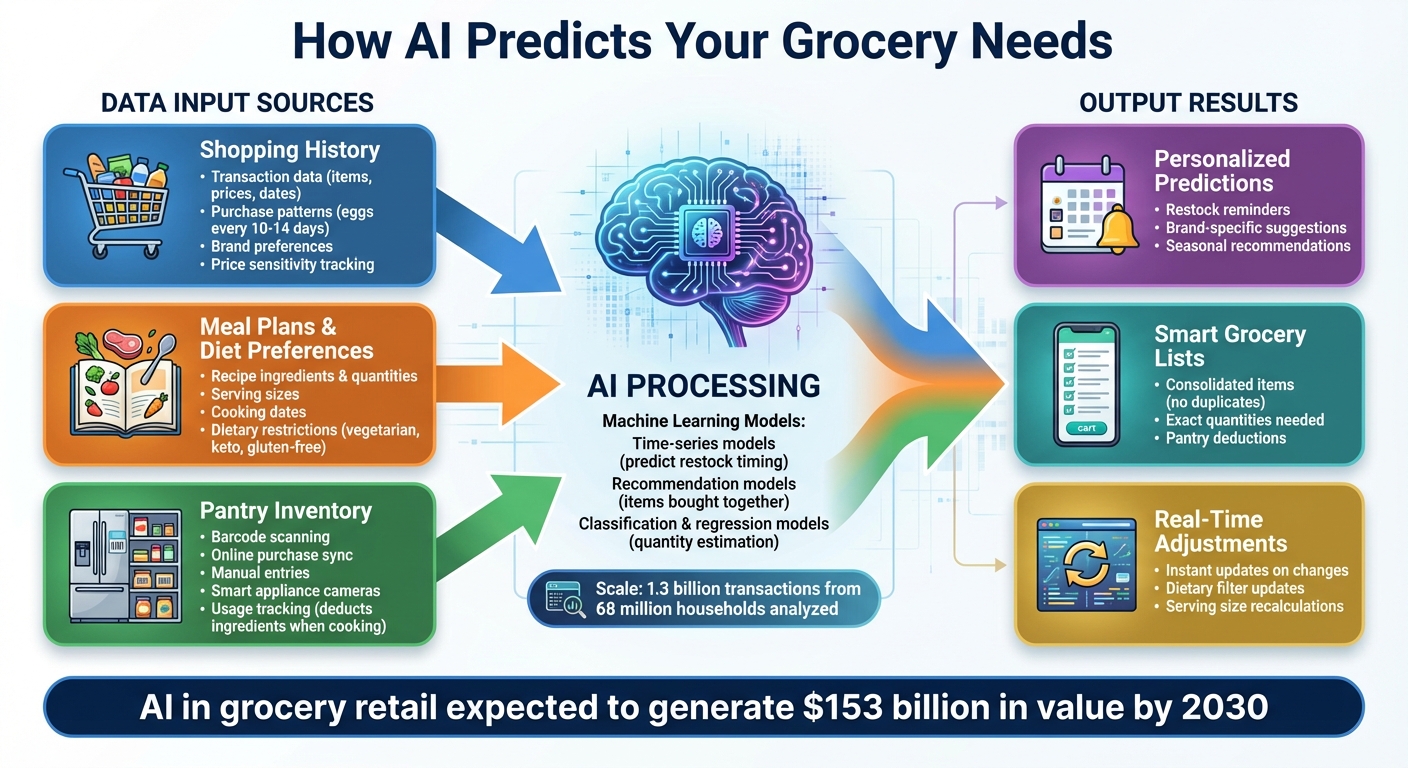
How AI Predicts Your Grocery Needs: Data Sources and Process Flow
AI-powered grocery predictions rely on three main data sources: your shopping history, your meal plans and dietary preferences, and the inventory you have at home. By combining these inputs, the system builds a detailed understanding of your future grocery needs, ensuring its recommendations are as personalized as possible.
Shopping Habits and Purchase History
Every time you shop - whether using a loyalty card in-store or placing an online order - AI collects detailed transaction data. This includes what you bought, how much you paid, and any discounts or promotions you used, along with the date and time of the purchase. Over time, the system identifies patterns in your buying habits. For instance, if you tend to buy a dozen eggs every 10–14 days or restock coffee about once a month, the AI learns these cycles and can remind you to restock before you run out.
It doesn’t stop there. The system also tracks your preferences for specific brands and package sizes. If you always pick a particular yogurt brand or prefer the 32 oz carton of chicken broth over smaller options, the AI prioritizes these choices in your suggestions. Even if you switch brands during sales, the system adapts, recognizing your sensitivity to price changes.
Meal Plans and Diet Preferences
When you use a meal-planning app to add recipes or schedule meals, AI captures all the relevant details - ingredient names, quantities (in cups, ounces, pounds, or tablespoons), serving sizes, and the planned cooking dates. Apps like Honeydew Recipe Manager even allow you to import recipes from social media, adjust serving sizes, and tag dietary restrictions like vegetarian, keto, or gluten-free. The AI aggregates this data, standardizes measurements to U.S. units, and matches the ingredients to specific store products, ensuring your grocery list aligns with your planned meals.
Pantry Inventory and Usage Patterns
AI also keeps tabs on what’s already in your pantry. This can be done through barcode scanning on your phone, syncing with your online purchase history, manual app entries, or even smart appliances like refrigerators with built-in cameras. When you cook a meal, the system can automatically deduct used ingredients from your virtual inventory, helping it learn how long staples like flour, oil, or rice last in your household.
How AI Recognizes Patterns and Makes Predictions
After gathering your shopping history, meal plans, and pantry data, AI gets to work deciphering the patterns hidden within. It identifies recurring purchase habits and spots emerging trends, using this information to predict your future grocery needs with impressive precision. This is where machine learning models shine, transforming raw data into actionable insights.
Machine Learning Models for Prediction
AI grocery systems rely on several types of machine learning models to make predictions. For instance, time-series models analyze your purchase history over weeks or months to detect patterns in how often you buy essentials like milk, eggs, or coffee. If you typically grab a carton of milk every 10–14 days, the system can remind you just in time. Meanwhile, recommendation models - similar to those used by e-commerce platforms - identify items you frequently buy together. For example, if you consistently purchase taco shells alongside ground beef and salsa, the AI will suggest adding shells to your cart, even if you overlook them.
Additionally, classification and regression models estimate both the likelihood and quantity of items you’ll need. These models combine signals from your past behaviors, current promotions, and even seasonal trends. For example, they might suggest grilling supplies as the Fourth of July approaches or recommend baking essentials in the lead-up to Thanksgiving.
To grasp the scale of these operations, consider this: one leading retail AI platform processes 1.3 billion transactions from 68 million households to track shifting shopping patterns and fine-tune predictions. Experts predict that AI integration in the grocery sector could generate around $153 billion in value by 2030, spanning merchandising, operations, and personalized shopping experiences.
Take a meal-planning app like Honeydew Recipe Manager as an example. It aggregates your planned recipes for the week, calculates the exact ingredients you’ll need (while factoring in what’s already in your pantry), and adjusts quantities based on your household’s actual consumption habits. If your family typically uses 1.5 pounds of chicken for a "4-serving" recipe, the app will account for that in future lists, ensuring accuracy.
These advanced insights allow for real-time adaptability in your grocery planning.
Real-Time Updates and Adjustments
Every time you make a purchase, update a recipe, or tweak your meal plan, the AI recalibrates your grocery list on the spot. Whether you skip a suggested item, add a new dish, or make a dietary change - like going vegetarian or cutting out gluten - the system instantly adjusts its recommendations. It filters out incompatible items and prioritizes alternatives that match your new preferences, seamlessly overriding older patterns within seconds.
In apps like Honeydew Recipe Manager, these real-time updates happen instantly. For example, if you drag a new recipe onto your Friday meal plan, the app recalculates your ingredient needs for the week, checks them against your pantry, and updates your shopping list accordingly. If you suddenly add a big dinner for guests, the AI detects the increased servings and might suggest bulk sizes or multi-packs to accommodate the extra demand.
This constant refinement eliminates the need for manual tracking, keeping your grocery planning accurate and perfectly aligned with your changing needs.
How AI Improves Your Grocery Lists
AI takes the guesswork out of grocery shopping by learning your habits and predicting what you need. It transforms this knowledge into a practical, streamlined shopping list that makes your trips to the store faster and more efficient.
Streamlined Lists Without Duplicates
AI simplifies your list by merging similar items from different sources - recipes, past orders, or pantry scans - into one clear entry. For example, instead of seeing multiple variations like "2% milk" and "milk 2 percent", you'll get a single line item such as "Flour – 5 lb total." This consolidation eliminates clutter and confusion.
When similar items are detected, the system uses natural language processing to group them together (e.g., "roma tomatoes" and "tomatoes for salad"). It cross-references historical data and retailer product codes to pick the most suitable option - fresh or canned, organic or conventional - and combines them into one entry with the correct total quantity.
If something isn’t available, AI steps in with substitution suggestions that align with your dietary needs, budget, or preferences. It considers factors like flavor, recipe function (e.g., thickener, protein source), and nutrition. For instance, if you avoid dairy, it might recommend Greek yogurt instead of sour cream or offer plant-based alternatives. In Honeydew Recipe Manager, these substitutions appear directly on your list, allowing you to approve or reject them before placing an order through Instacart. As one user, Emily C., shared:
"The ingredient substitution feature is a game-changer for my dietary restrictions. I can adapt any recipe easily!"
Nutrition Information and Less Food Waste
AI doesn’t just organize your list - it also improves your health and reduces waste. By linking items to standardized nutrition databases like USDA data, it provides key metrics such as calories, protein, added sugar, and sodium for the quantities you're buying. If an item exceeds your personal limits - like a high-sodium canned soup - the system flags it and suggests healthier alternatives. Honeydew Recipe Manager even estimates nutrition per serving for your weekly recipes, showing which ingredients contribute most to things like saturated fat or added sugar, so you can make smarter choices before checkout.
The same technology that prevents duplicates also helps cut down on food waste. AI analyzes your meal plans, pantry inventory, and usage patterns to ensure you only buy what you’ll actually use. For example, if you already have three eggs but your recipes require eight, it adds just a half-dozen to your list instead of a full dozen. It also tracks which foods you tend to throw away and might suggest smaller portions, frozen alternatives, or fewer recipes using that ingredient. As user Mark T. noted:
"I used to waste so much food. Now with Honeydew's meal planning, I buy exactly what I need and save money!"
Honeydew Recipe Manager: AI Features for Grocery Planning

Honeydew Recipe Manager brings AI-powered meal planning and grocery organization to U.S. households. By combining natural language processing and machine learning, the platform transforms recipe ideas into structured shopping lists, which can then be sent directly to Instacart for easy ordering. With users saving over 270,000 recipes each month, the app streamlines everything from discovering a recipe online to having the ingredients delivered to your doorstep.
AI‑Generated Grocery Lists
Honeydew's AI takes the hassle out of grocery planning by automatically analyzing recipes from various sources like TikTok, Instagram, food blogs, or even screenshots. It deciphers informal recipe formats and matches the ingredients to a standardized U.S. grocery catalog. For instance, if a recipe calls for "1 can black beans", the AI identifies the product and aligns it with options available at your local store, factoring in your preferences like organic versus conventional items.
When you choose recipes, the AI consolidates ingredient lists, converts units, and merges duplicates. For example, "scallions" and "green onions" are combined into one entry, and multiple mentions of flour are grouped together. It also adjusts quantities to match realistic package sizes found in U.S. stores - rounding up 13.5 oz of chicken breast to a 1 lb package or combining small yogurt servings into a single larger container. Pantry staples like salt, pepper, and oil are flagged as items you likely already have, letting you toggle them off to avoid unnecessary purchases.
Weekly Meal Planning with Drag‑and‑Drop Calendar
The drag-and-drop calendar makes meal planning flexible and efficient. Any changes - like moving a recipe to a different day, adding a new dish, or adjusting serving sizes - trigger real-time updates to your grocery list. For example, increasing serving sizes from 2 to 4 people recalculates ingredient quantities instantly. If you track pantry inventory manually, via barcode scans, or through integrations, the system checks what you already have, subtracts those amounts, and adjusts the list accordingly. It even tracks leftover quantities for future planning.
Shared accounts make Honeydew perfect for families or roommates. Everyone can view, edit, and update the same calendar and grocery lists. If one person adds a dinner while another removes a lunch, the AI reconciles these changes and updates the ingredient requirements. Grocery lists sync in real time, so if someone checks off "milk" during an Instacart order or in-store shopping, everyone sees the update instantly - cutting down on duplicate purchases and miscommunication.
Once your grocery list is finalized, the app makes shopping a breeze.
Instacart Integration for One‑Click Shopping
With the grocery list ready, you can use the Instacart integration to send all items - complete with ingredient names, preferred brands, sizes, and quantities - directly to Instacart. Honeydew ensures that each ingredient is matched to the best available product in stock. If an item is unavailable, the system suggests suitable substitutes. This integration lands you in Instacart with a pre-filled cart, where you can review or tweak items, select delivery or pickup, and complete your order with standard U.S. payment options. It’s a seamless way to turn your meal plan into groceries with just a few clicks.
As user James L. put it:
"The smart grocery lists save me hundreds of dollars a month. I love how it suggests recipes based on what I already have!"
Benefits and Future Trends in AI Grocery Prediction
Time and Cost Savings
AI is transforming the way we shop and plan meals by automating tedious tasks like creating grocery lists and comparing prices. For instance, Instacart's "Ask Instacart" tool simplifies decision-making by providing personalized meal suggestions, answering questions like, "What's for dinner?" in seconds. Similarly, BRdata's Ask Ada app uses natural language processing to deliver instant sales and inventory insights, saving grocery staff from spending hours on manual reports.
Shoppers and stores both benefit financially. Independent grocers are leveraging AI to analyze past sales, current market trends, and competitor pricing, allowing them to make smarter stocking decisions and remain competitive without overstocking. For households, AI helps avoid duplicate purchases and impulse buys, ensuring families stick to their budgets while buying only what they need.
And it’s not just about saving time and money - AI is also nudging consumers toward healthier choices and helping reduce food waste.
Better Food Choices and Less Waste
AI is making it easier to eat healthier by tailoring recommendations to individual preferences and habits. Thrive Market, for example, introduced an AI-powered cart in late 2023 that builds a shopper's first order based on onboarding quizzes. This system matches users with options favored by similar customers, and over half of purchases are driven by these AI suggestions, often promoting healthier food choices. Meanwhile, Giant Eagle's app integrates an AI recipe generator that adds ingredients directly to shopping carts, helping users align their meals with specific nutritional goals.
AI’s impact extends to reducing food waste. In the U.S., where 30–40% of the food supply goes to waste, AI-powered purchasing systems have shown promise. A pilot program led by the World Wildlife Fund, Pacific Coast Food Waste Commitment, Afresh, and Shelf Engine demonstrated that AI could cut food waste by nearly 15% per store. By analyzing shopping patterns and forecasting demand, AI minimizes overstocking and spoilage. Personalized shopping lists also encourage more sustainable habits, such as choosing local products or healthier options, while reducing unnecessary trips to multiple stores.
Integration with Smart Appliances and Voice Assistants
AI is poised to redefine home connectivity by seamlessly integrating with smart devices. Current tools like BRdata's Ask Ada enable real-time inventory checks in stores, while Instacart’s voice-enabled shopping assistance makes hands-free grocery planning a reality. Looking ahead, AI is projected to unlock $153 billion in value across supply chains by 2030, with deeper connections to smart appliances and voice assistants.
Imagine a future where your smart fridge tracks pantry inventory and updates your grocery list automatically. AI could sync with devices like Alexa to create voice-activated shopping lists or suggest recipes based on what you already have at home. These systems might even connect with appliances to predict what you’ll need for upcoming meals. On a larger scale, AI could optimize store layouts using data on shopper behavior and support "black stores" - facilities designed exclusively for efficient delivery pickups.
The possibilities are endless, and AI is already paving the way for a more efficient, cost-effective, and sustainable grocery shopping experience.
Conclusion
AI is changing the way American households approach grocery planning, making the process more efficient and tailored to individual needs. Instead of manually creating shopping lists, AI uses data like past purchases, meal plans, and pantry stock to predict what you’ll need - helping to simplify grocery planning, reduce waste, and encourage healthier eating habits.
Honeydew Recipe Manager takes this concept further by automating recipe imports, generating grocery lists, and connecting directly with Instacart for seamless ordering. With the AI-powered features discussed earlier, Honeydew turns meal planning into a hassle-free, budget-friendly routine. If your plans change, the tool updates your list instantly - no duplicates, no missing ingredients. The Instacart integration allows you to go from planning meals to ordering groceries in just a few clicks, bridging the gap between AI insights and practical action. This smooth integration is paving the way for smarter, more intuitive meal planning.
Looking ahead, AI will likely integrate even more deeply with smart home devices, such as appliances and voice assistants, to track pantry levels and suggest recipes based on what you already have. The potential is enormous, with AI expected to generate $153 billion in value across the grocery supply chain by 2030. But you don’t need to wait for the future - these tools are already here.
Want to simplify your grocery planning? Try Honeydew Recipe Manager today. Import your favorite recipes, let the AI handle your grocery list, and see how effortless meal prep can be when technology takes care of the details. Visit honeydewcook.com to get started - no special skills required, just smarter and easier meal planning.
FAQs
How does AI figure out what groceries I need?
AI employs sophisticated algorithms to study your shopping patterns, past purchases, and meal choices. By spotting trends in what you buy and how frequently, it can anticipate your future needs and highlight items you might be running low on. Beyond that, it can suggest alternative options or complementary ingredients based on your usual preferences, helping you craft a grocery list that's precise and perfectly aligned with your daily habits.
How can AI help me make healthier meal choices?
AI is like having a personal nutritionist in your pocket, helping you make smarter meal choices tailored to your needs. Whether you're aiming for specific health goals, managing food allergies, or sticking to a particular diet, it can create meal plans that fit your lifestyle. Plus, it can recommend recipes packed with balanced nutrition, suggest healthier ingredient swaps, and even keep tabs on your eating habits over time.
By diving into details like your past grocery purchases, favorite meals, and nutritional requirements, AI takes the guesswork out of meal planning. It simplifies the process, making it easier to choose foods that support a healthier way of living.
How does AI help reduce food waste and avoid buying duplicates when grocery shopping?
AI takes the hassle out of grocery shopping by generating personalized lists tailored to your meal plans, past purchases, and eating preferences. It even calculates precise quantities, making it easier to avoid overbuying and reducing food waste.
On top of that, AI flags potential duplicates and offers alternatives for any missing ingredients, ensuring your shopping list matches your actual needs. This efficient system helps you stay organized, cut down on unnecessary spending, and minimize waste.