AI BBQ Temperature Control: How It Works
• Updated
AI BBQ temperature control makes grilling easier and more consistent by automating heat management. Here's how it works:
- Precision Heat Control: AI systems use sensors and a PID controller to monitor and adjust temperature in real-time. This keeps fluctuations minimal, usually within ±5°F.
- Automated Adjustments: Components like auger motors, blower fans, and igniters work together to manage fuel and airflow.
- Real-Time Monitoring: Wi-Fi and Bluetooth connectivity let you control and monitor your grill remotely, even from your phone.
- Cooking Assistance: Features like guided recipes, predictive algorithms, and multi-probe tracking help ensure perfect results without constant supervision.
- Grill Compatibility: Works with pellet and charcoal grills, automating processes like pellet feeding or vent adjustments.
AI BBQ systems simplify grilling, allowing you to focus on enjoying the experience while delivering consistent, high-quality results.
This Smart Grill Comes With a Generative AI Assistant!
How AI Controls BBQ Temperature
How AI BBQ Temperature Control Systems Work: PID Controller Feedback Loop
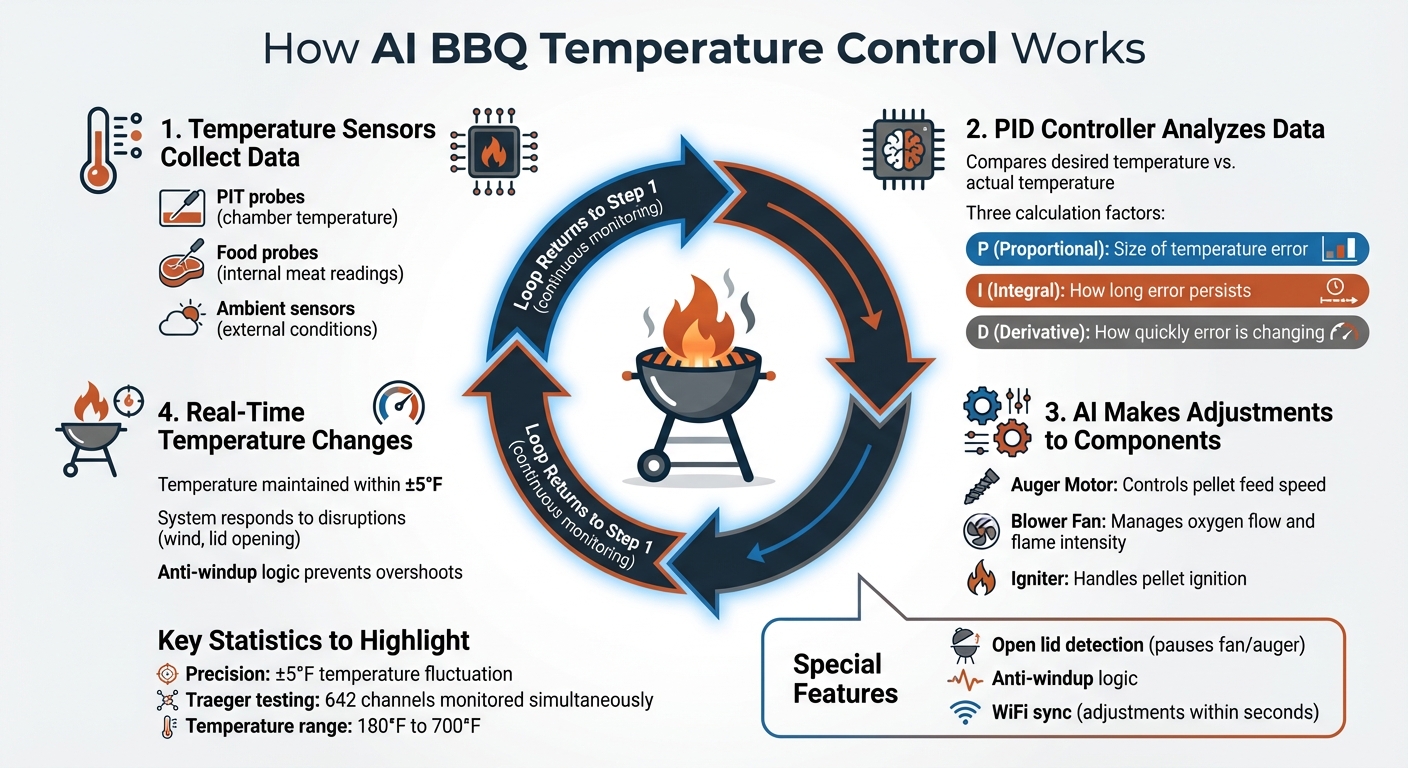
AI-powered BBQ systems operate using a feedback loop that constantly compares the desired temperature with real-time sensor readings inside the grill. By analyzing the current heat, calculating any differences, and adjusting fuel and airflow, the system ensures precise temperature control - all happening in real time.
At the heart of this process lies the PID (Proportional-Integral-Derivative) controller. Unlike basic systems that simply toggle components on and off, PID controllers use complex calculations to make fine-tuned adjustments. As John Miller from Traeger Grills explains:
The PID controller takes the "wanted" temperature and compares it to the "feedback", which is gathered from sensors in the grill.
The PID controller operates by addressing three factors: the size of the temperature error (Proportional), how long the error persists (Integral), and how quickly the error is changing (Derivative).
Core Technologies in AI BBQ Controllers
This precise control system is enhanced by advanced sensor networks. AI BBQ systems use multiple sensors, such as PIT probes for monitoring the chamber temperature, food probes for internal meat readings, and ambient sensors to track external conditions. Together, these sensors provide the data needed for fine control.
Based on this data, the AI adjusts three main components:
- The auger motor, which controls how quickly wood pellets are fed into the firepot.
- The blower fan, which manages oxygen flow to regulate flame intensity.
- The igniter, which handles pellet ignition.
These components work in sync with the PID algorithm, ensuring precise, calculated adjustments.
In early 2023, Traeger Grills fine-tuned their PID control loops using advanced data acquisition tools. John Miller and his team collected data from 642 channels simultaneously, including fan speeds, auger timing, and thermocouple readings. This testing simulated real-world conditions like wind and lid openings, ensuring the system could maintain a steady cooking environment.
Real-Time Temperature Adjustments
AI BBQ systems aren't just reactive - they also anticipate and manage unexpected disruptions. For example, Pit Boss Grills highlights that their PID controller adjusts to temperature changes caused by external factors like wind or heat.
When the system detects a lid opening and the resulting temperature drop, it temporarily pauses the fan or auger to prevent an oxygen surge that could stoke the fire. This open lid detection prevents dramatic temperature spikes once the lid is closed again. Additionally, advanced controllers use anti-windup logic to stop the Integral term from overcompensating when the grill can't immediately reach the target temperature, avoiding overshoots.
The result? Precision grilling with temperature fluctuations as small as +/- 5°F. WiFi-enabled systems take it a step further by syncing real-time data between the grill, the cloud, and your smartphone. This allows you to make remote adjustments that take effect within seconds. These real-time capabilities ensure the grill maintains consistent temperatures, delivering reliable results through AI-driven precision.
Main Features of AI BBQ Systems
Remote Monitoring and Control
Wi‑Fi and Bluetooth connectivity have completely transformed how we interact with grills. With modern AI BBQ systems, you can sync your grill to smartphone apps for both iOS and Android, giving you the power to monitor and adjust temperatures from practically anywhere.
Take the WEBER CONNECT Smart Grilling 2.0 App, for example. Weber‑Stephen Products LLC designed this app as a "mission‑control dashboard" that tracks multiple recipes and timers. It even offers looping instructional videos for added guidance. As Nikhil Bhogal put it:
"When we set out to improve our App, we knew we wanted to elevate the look and feel of it along with deepening its functionality and usability to speak to outdoor cooks of all skill levels."
These systems also feature real-time dashboards that display live temperature graphs and continuously log data, making it easy to keep tabs on your grill remotely. The Weber Connect Smart Grilling Hub goes a step further with multi-probe tracking and push notifications to alert you when your food hits the perfect temperature.
Voice control integration takes convenience to another level. With Amazon Alexa and Google Assistant, you can manage your grill hands-free. Traeger's WiFIRE system even works with the Apple Watch, so you can toggle the "Keep Warm" mode or fine-tune the temperature - all from your wrist.
And these remote controls are just the beginning. AI BBQ systems also provide step-by-step cooking assistance to help you achieve flawless results.
Built‑In Cooking Assistance
AI doesn't just let you monitor your grill - it actively helps you cook better. These systems incorporate advanced cooking guidance to ensure precision and consistency.
One standout feature is generative recipe creation. By simply snapping a photo of your ingredients, systems like Brisk It's Vera™ can generate a custom recipe with automated settings tailored to your meal. This smart image recognition technology creates recipes via text, voice, or photos in seconds.
Weber's app also offers a treasure trove of guided recipes, complete with step-by-step video instructions. What’s more, these smart recipes adapt their guidance in real time as your cooking progresses.
For precise cooking, predictive algorithms are a game changer. Tools like the Combustion Predictive Thermometer use eight sensors to estimate when your meat will reach the perfect doneness. Similarly, the ChefLab AI-powered thermometer, with triple sensors, boasts an impressive accuracy of ±1.8°F.
Some systems even take over entirely when needed. Brisk It's "Full-self Cooking" mode automatically adjusts temperatures if you miss a cooking cue, ensuring your food turns out just right. This is especially useful for overnight smokes - no more middle-of-the-night alarms to check your grill. You can sleep soundly knowing the system will maintain the optimal conditions for your cook.
AI Temperature Control for Different Grill Types
Pellet Grills
Pellet grills operate using automated auger systems, which feed wood pellets from the hopper to the fire pot, allowing for a steady and consistent burn. AI controllers take this process a step further by adjusting the auger speed based on real-time temperature data, ensuring even heat distribution throughout the cooking chamber.
Another critical component is precision fan control. By regulating the oxygen flow to the fire pot, the AI directly influences combustion intensity and the amount of smoke produced. For instance, Traeger's advanced systems use AI to pulse the fan at specific intervals when cooking between 165°F and 225°F, enhancing smoke flavor without snuffing out the fire. As Traeger Support puts it:
"This breakthrough in grilling technology revolves around precision fan control, enabling the grill to get the maximum delivery of smoke at temperatures from 165°F to 225°F."
To fine-tune these adjustments, many pellet grills incorporate PID technology. This system provides precise temperature control across a wide range - from low-and-slow smoking at 180°F to high-heat searing at 700°F. For example, Brisk It's "Vera" system adapts dynamically to factors like outdoor temperature, wind, and even the specific characteristics of the meat being cooked. Memphis Wood Fire Grills explains:
"The ITC, a proprietary two-way logic information system, measures grill temperature continuously and adds pellets as needed."
Additionally, AI systems monitor pellet levels and send notifications to your smartphone when it’s time to refill the hopper or clean out ash buildup. While pellet grills excel in automation, charcoal grills demand a different AI-driven approach to ensure optimal performance.
Charcoal Grills
Charcoal grills, known for their traditional cooking style, have historically relied on manual vent adjustments to regulate oxygen flow - a skill that requires significant expertise. AI technology now steps in to simplify this process.
Modern systems, like Zafill's FIRETECH, automate vent control using IoT-enabled sensors placed on the grates. These sensors adjust the grate height relative to the fire to maintain precise temperatures. Unveiled at the National Restaurant Association Show in May 2022, the FIRETECH system includes a touchscreen interface called "FIREPAD", which interprets sensor data to make real-time adjustments. Zafill describes its innovation:
"The FIRETECH system is a milestone for steakhouses and restaurants that work with grills... it will contribute to a complete temperature control, improving processes, saving time, raw material and human labor."
This system, developed over 1.5 years, tackles the inherent inconsistencies of charcoal and wood-fired cooking. By automating ignition and continuously monitoring temperatures, these AI controllers eliminate the need for constant fire management. Despite this hands-free convenience, charcoal grills retain their hallmark high-heat searing capabilities, often exceeding 600°F and reaching up to 700°F - something that continues to appeal to grilling enthusiasts.
Benefits of AI BBQ Temperature Control
AI-powered BBQ temperature control is changing the game for grilling enthusiasts by offering unmatched precision, ease of use, and consistently excellent results.
Consistency and Precision
Say goodbye to the unpredictable temperature swings common with traditional grilling methods. AI systems take the guesswork out of maintaining the ideal heat, keeping temperatures steady between 180°F and 700°F. For example, the BBQ Guru system boasts an impressive accuracy margin of ±1.8°F, ensuring your food cooks evenly every time.
Features like Ramp Mode add another layer of control by automatically lowering the grill's temperature as your meat nears its target internal temperature. This prevents overcooking and minimizes the need for constant monitoring. Essentially, the system does the heavy lifting, so you don’t have to.
Convenience and Time-Saving
One of the standout perks of AI-driven BBQ systems is the freedom they offer. With automated temperature management, you can step away from the grill without worrying. As Domenico Elicio, the 2022 Italian BBQ Champion, explains:
In long cooking times, the bbq allows us moments of relaxation, drinking a good beer, and being certain that everything is going well.
Remote Wi-Fi monitoring takes convenience up a notch, letting you check on your grill from anywhere. Plus, voice commands via Amazon Alexa or Google Assistant make it even easier to stay updated on cooking progress. Intelligent features like open-lid detection adjust recovery times automatically, ensuring your grill returns to the perfect temperature after the lid is lifted.
This hands-off approach not only saves you time but also enhances the overall grilling experience.
Better Cooking Results
AI systems excel at delivering results that are hard to achieve manually. By using up to 8 sensors, these controllers can pinpoint the exact moment your meat reaches ideal doneness, eliminating the need for guesswork or outdated methods like the "finger poke" test. For instance, ChefLab’s AI thermometer updates in just 1 second, giving you real-time precision for perfect results.
The outcome? BBQ that rivals professional kitchens. As BBQ Guru puts it:
Achieving that kind of perfection is only possible when you can precisely control your cooking time and temperature... the tough, chewy protein fibers in meat called collagen transform into the tender, tantalizing and amazingly delectable BBQ we all crave.
Conclusion
AI-powered BBQ temperature control takes the uncertainty out of outdoor cooking, turning it into a precise and automated process. These systems excel at maintaining steady heat, automatically adjusting fuel flow and airflow to counteract fluctuations caused by wind or cold weather. With modern AI thermometers offering updates accurate to ±1.8°F and operating within a temperature range of 180°F to 700°F, you can achieve the consistency of an indoor oven - right in your backyard. This level of precision allows for better monitoring and dynamic adjustments throughout the cooking process.
Convenience is another standout feature of AI systems. With Wi-Fi and Bluetooth remote monitoring, combined with predictive algorithms, these tools can tell you exactly when your meat is ready. A review of ThermoWorks Signals highlights this benefit:
Being able to get more sleep, more work done, etc. without having to sit right there and babysit the smoker alone is worth the cost of the product.
AI systems also simplify real-time adjustments for all types of grills. Whether you're smoking brisket on a pellet grill or fine-tuning charcoal temperatures, these systems handle complex changes seamlessly. Features like automatic warm modes prevent overcooking if you miss a notification, and voice command compatibility with Alexa or Google Assistant keeps you hands-free and informed. These advancements not only elevate your grilling experience but also integrate effortlessly with other smart kitchen tools.
To complement your AI BBQ setup, the Honeydew Recipe Manager helps streamline meal planning around your grilling sessions. You can easily import BBQ recipes from social media, generate grocery lists instantly, and use its AI meal planner to organize weekly cookouts. With features like ingredient substitution and nutrition tracking, the app makes it simple to adjust recipes on the fly while keeping an eye on your BBQ-inspired diet.
FAQs
How does AI help maintain consistent BBQ temperatures?
AI brings a modern twist to BBQ cooking by tracking temperatures in real-time and fine-tuning heat levels automatically. This keeps the heat consistent, ensuring your food cooks evenly and avoids mishaps like overcooking or undercooking.
What's more, AI can handle surprises - like sudden weather changes or the grill lid being opened - and even learns your cooking preferences over time. The result? Every BBQ session becomes personalized and perfectly cooked to your liking.
Are AI BBQ temperature control systems compatible with all types of grills?
AI BBQ temperature control systems are usually tailored for specific grill types, particularly smart or IoT-enabled models. These systems depend on advanced sensors and connectivity features that older or non-automated grills typically lack.
If you're thinking about upgrading your BBQ setup, it's essential to confirm whether your grill can work with AI-powered tools. Most manufacturers offer detailed compatibility guides to ensure you make the right choice.
What are the advantages of using remote monitoring in AI-powered BBQ systems?
Remote monitoring in AI BBQ systems takes the guesswork out of grilling by letting you keep tabs on the cooking process from virtually anywhere. These systems allow you to track both internal and ambient temperatures in real time, so you don’t have to stand by the grill constantly. This means you’re free to relax, chat with friends, or focus on other tasks without worrying about your food. Plus, if the temperatures drift outside your set range, the system will alert you, helping you avoid undercooked or overcooked meals while keeping food safety in check.
What makes these AI-powered systems even more impressive is their ability to analyze data and make real-time adjustments. They can automatically tweak the temperature, control airflow, or manage fuel levels to ensure the cooking process stays on track. This reduces the chance of human error and delivers consistently delicious results. With these tools, grilling becomes less of a chore and more of an enjoyable, stress-free experience.