AI in Cooking: Smarter Energy Use
• Updated
AI is transforming cooking by saving energy, reducing waste, and improving precision. Smart appliances now use real-time data and machine learning to adjust temperatures, cooking times, and energy consumption automatically. Here's how:
- Energy Efficiency: AI-powered tools like ovens and sous vide machines optimize heat settings, cutting energy use by up to 20%. Slow cookers, for example, cost just $0.10 per meal to run.
- Food Waste Reduction: AI meal planners help households cut waste by up to 76%, saving $100–$125 per month.
- Advanced Sensors: Real-time adjustments using thermal and moisture sensors ensure precise cooking without wasting power.
- Predictive Models: AI anticipates energy needs, reducing unnecessary power use by 12–15%.
- Smart Meal Planning: Apps like Honeydew suggest recipes based on pantry items, minimizing shopping trips and food spoilage.
AI is reshaping kitchens into efficient, cost-saving spaces while simplifying meal prep for home cooks.
How AI Is Powering Smarter, More Efficient Kitchen Appliances | GearBrain
How AI Reduces Energy Use in Low-Temperature Cooking
AI is revolutionizing low-temperature cooking by using real-time adjustments, predictive models, and advanced thermal sensors to optimize energy consumption without sacrificing food quality.
Real-Time Temperature Adjustment Algorithms
AI-powered appliances excel at making split-second decisions to maintain optimal cooking conditions. Instead of relying on fixed settings, these systems use algorithms to adjust temperature, time, and power based on the size and consistency of the food. For instance, smart ovens equipped with sensors can detect portion sizes - like a 1.5-pound chicken versus a 3-pound one - and adapt heating intensity and duration accordingly. This eliminates guesswork, reduces preheating errors, and cuts down on unnecessary energy use .
"AI-driven appliances adjust cooking parameters on the fly - whether it's temperature, cooking time or ingredient consistency"
These systems also account for ingredient variations and make adjustments without manual intervention, preventing heat loss from frequent checks. As a result, they ensure consistent results while operating at peak efficiency.
"The iCombi Pro continuously compares the condition of the food to the temperature, delivering uniform results every single time"
By continuously fine-tuning cooking conditions, AI minimizes energy waste while maintaining precision.
Predictive Heating and Cooling Models
Machine learning takes energy savings a step further by predicting heating and cooling needs before they happen. These predictive models analyze factors like thermal properties, ingredient variations, and user habits to anticipate energy demands. Instead of maintaining a constant temperature, they optimize energy use to meet specific goals - such as lowering electricity costs . For example, these models consider thermal inertia, predicting when a target temperature will be reached and reducing power usage in advance to avoid overshooting.
Studies show that predictive models can lower energy consumption by 12% to 15% by capping excessive power draw. They also recognize that scaling recipes isn’t always straightforward; doubling a recipe might require lower temperatures and longer cooking times to ensure even heat distribution.
"It doesn't just model temperatures - it helps users decide how to run HVAC systems to meet their goals, whether that be a lower level of emissions or a lower electricity bill, by taking the downstream effects into account"
By integrating these anticipatory adjustments with real-time sensor feedback, AI achieves even greater efficiency and precision.
Thermal Sensor Integration for Precision
Thermal sensors play a crucial role in AI-driven cooking by providing real-time feedback on temperature, moisture, and texture. Using tools like multi-point sensors and infrared spectroscopy, these systems make dynamic adjustments to heat output without relying on static timers. This not only reduces the need for manual checks but also shortens cooking cycles, avoiding wasted energy.
For example, Philips introduced a system in 2025 that uses infrared spectroscopy to monitor moisture and texture, ensuring precise searing and baking while minimizing energy use. Similarly, McDonald’s Japan tested an AI-powered fryer that adjusts oil temperature and heating cycles based on batch size and load, reducing energy consumption while maintaining consistency. Advanced designs even incorporate sensors into lids sealed with food-grade silicon, allowing them to analyze vapors and temperature without piercing the food.
Once the desired doneness is reached, AI systems trigger automatic shut-off or switch to lower power states, preventing overcooking and unnecessary energy use . These innovations are driving growth in the AI-powered cooking machine market, which was valued at $59.2 million in 2024 and is projected to reach $101 million by 2031, growing at a CAGR of 8.2%.
Practical Applications of AI in Energy-Efficient Cooking
AI-Powered Ovens and Sous Vide Machines
AI-powered kitchen appliances are making home cooking more energy-efficient by combining precision and automation. For instance, in April 2024, Samsung introduced the Bespoke Slide-in Induction Range, featuring a 7-inch AI Home LCD Display and an "AI Energy Mode." This model became Samsung's first induction range in the U.S. to earn an ENERGY STAR rating, thanks to its ability to optimize power usage. The AI Energy Mode adjusts heating elements and compressor cycles based on real-time usage patterns, conserving energy without compromising performance.
"AI Energy Mode... can switch all of your compatible smart appliances to Energy Saving mode either automatically or if your estimated monthly electricity bill exceeds your preset target." - Samsung Electronics
Bosch, on the other hand, introduced the Series 8 accent line sensor oven in 2025, equipped with a lambda probe - a technology adapted from automotive catalytic converters. This probe measures oxygen levels inside the oven to precisely detect food doneness. The oven recalculates the cooking time every 30 seconds and shuts off automatically when the desired temperature is reached, avoiding energy waste from overcooking. Food YouTuber Sally Özcan highlighted how this eliminates the need to open the oven door for manual checks, which often leads to significant heat loss.
Smart sous vide machines and multi-cookers are also stepping up with PID (Proportional-Integral-Derivative) control systems. These systems maintain water temperatures within a narrow ±0.5°F range, avoiding the energy surges typical of traditional thermostats. This level of control ensures consistent cooking while minimizing power usage - especially useful for sous vide's long, low-temperature cooking sessions.
Energy-Efficient Recipes and Meal Planning with Honeydew Recipe Manager
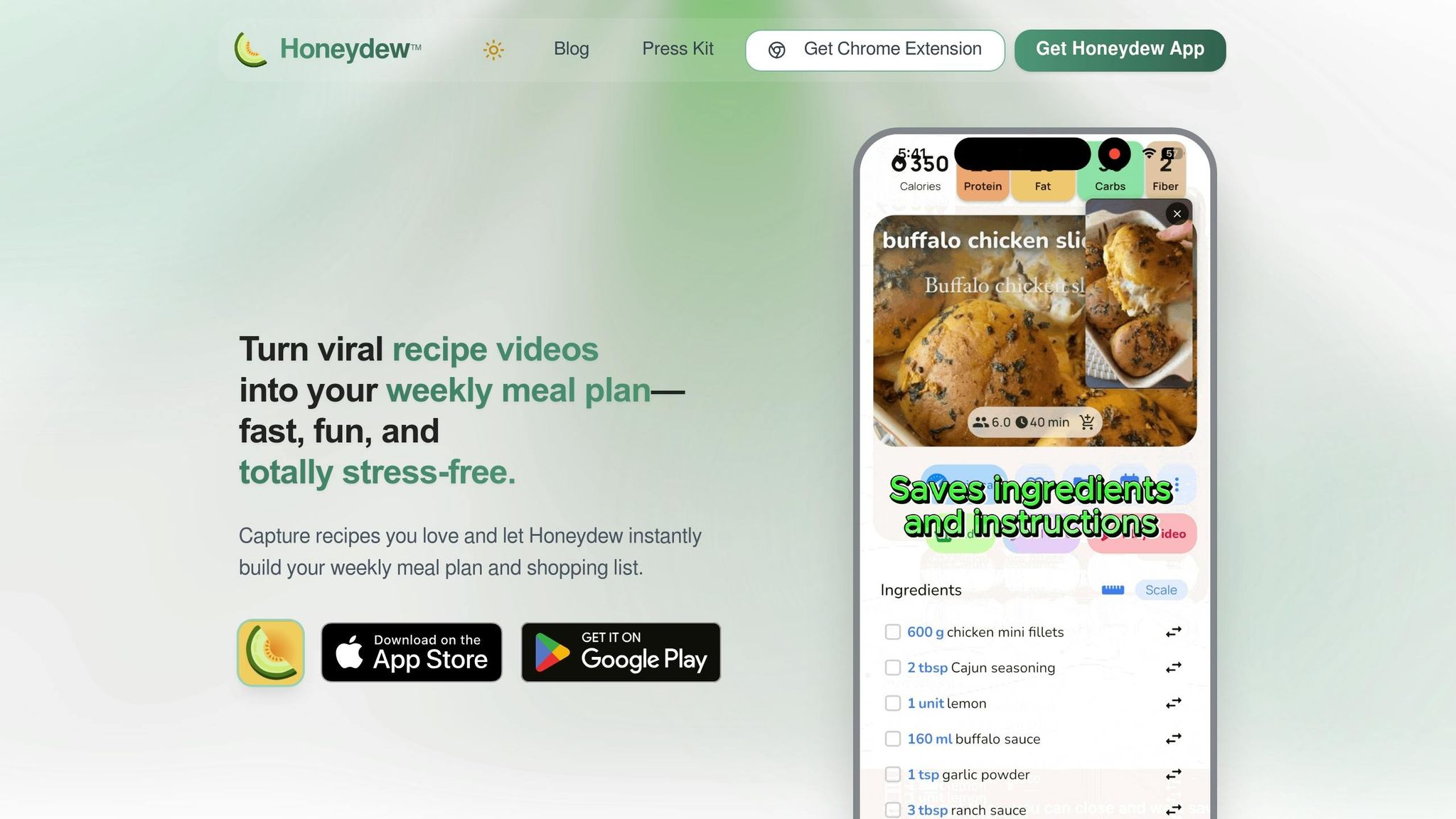
AI isn't just improving appliances - it’s also reshaping how we plan meals to cut down on energy usage. The Honeydew Recipe Manager app uses AI to suggest recipes based on ingredients you already have at home. Its Pantry Mode feature allows users to snap photos of their pantry or fridge, helping reduce the need for additional shopping and the energy-intensive process of food production and waste.
The app's "Ask Honey" AI assistant takes efficiency a step further by converting traditional recipes into energy-saving methods. For example, it can adapt oven recipes for pressure cookers, which consume far less energy. Honeydew also encourages batch cooking, letting users prepare multiple meals in one session. This reduces the need for repeated preheating and maximizes the energy used in each appliance cycle.
Comparing Energy Efficiency in AI Cooking Tools
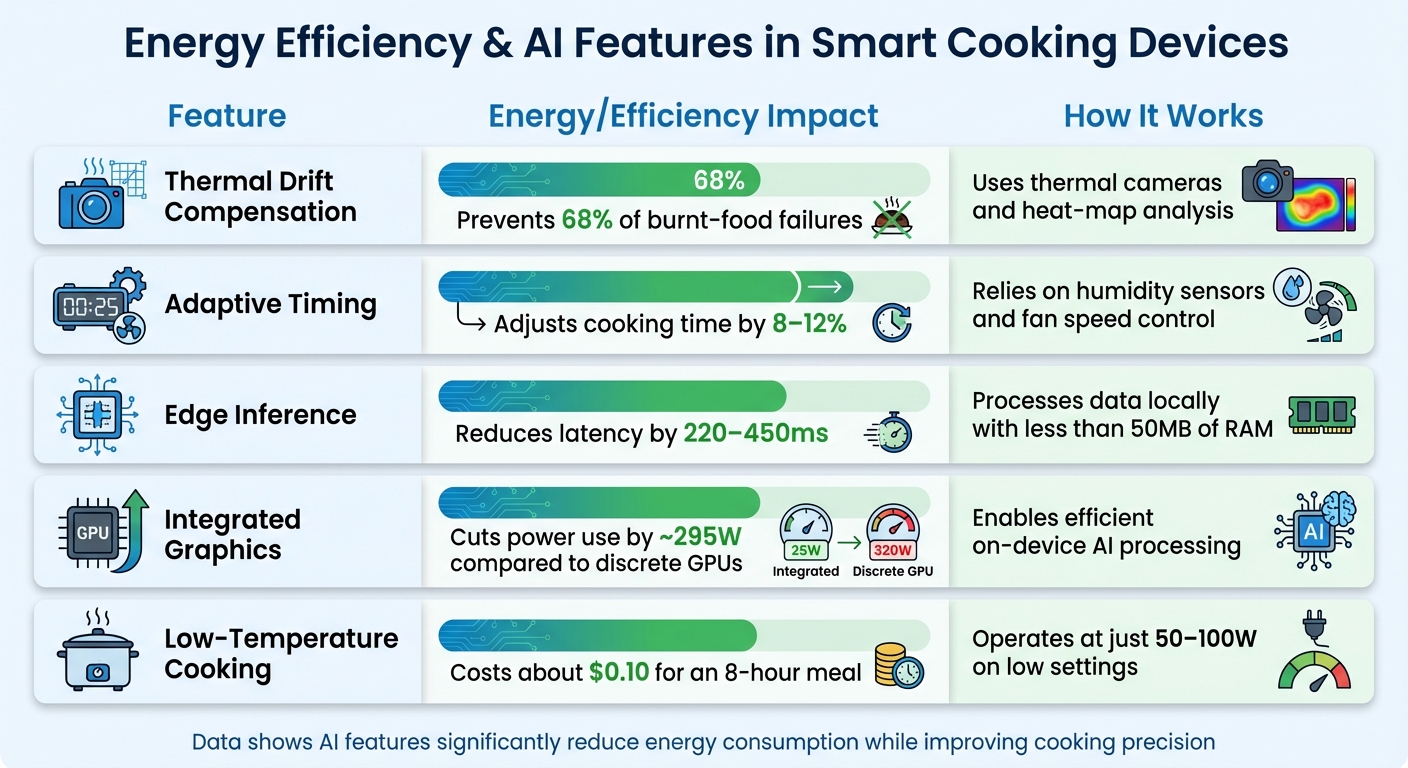
AI Cooking Tools Energy Efficiency Comparison Chart
Energy Savings and AI Features Across Devices
AI-driven cooking tools combine energy-efficient hardware with smart features that help cut down on power consumption even further. For example, slow cookers are a standout choice for low-temperature cooking, using very little energy when set to low. Their design, tailored to maintain consistent low heat, makes them an ideal option for energy-conscious cooking. Additionally, proper appliance sizing plays a big role in reducing energy waste. These inherent efficiencies are amplified by advanced AI capabilities, as outlined below.
AI features such as thermal drift compensation - which can detect oil's smoking point 3.2 seconds earlier - and adaptive timing, which adjusts baking times and fan speeds based on humidity levels, help reduce unnecessary energy use significantly.
The way these devices process data also matters. Tools using local "edge" models process information directly on the device, avoiding the 220–450ms latency and higher energy demands of cloud-based systems. For instance, devices with built-in displays use integrated graphics that require just 25 watts of power - far less than the 320 watts needed for discrete GPUs - while still delivering comparable performance in tasks like food segmentation.
Here’s a quick breakdown of the key features and their energy-saving impacts:
| Feature | Energy/Efficiency Impact | How It Works |
|---|---|---|
| Thermal Drift Compensation | Prevents 68% of burnt-food failures | Uses thermal cameras and heat-map analysis |
| Adaptive Timing | Adjusts cooking time by 8–12% | Relies on humidity sensors and fan speed control |
| Edge Inference | Reduces latency by 220–450ms | Processes data locally with less than 50MB of RAM |
| Integrated Graphics | Cuts power use by ~295W compared to discrete GPUs | Enables efficient on-device AI processing |
| Low-Temperature Cooking | Costs about $0.10 for an 8-hour meal | Operates at just 50–100W on low settings |
These smart features, combined with efficient hardware, make AI cooking tools a practical choice for those looking to save energy without sacrificing performance. By blending technology and thoughtful design, these devices deliver both convenience and cost savings.
Future Trends in AI for Energy-Efficient Cooking
Advancements in AI-Driven Cooking Systems
AI-powered cooking technology is advancing rapidly, moving beyond basic automation to offer smarter, more energy-efficient solutions. For example, Electrolux Group is set to launch ovens under its AEG and Electrolux brands in mid-2026 featuring CamCook® and AI TasteAssist. These systems use built-in cameras and AI to recognize food and adjust settings based on online recipes, ensuring optimal energy usage. Erik Rise, Product Manager Connected Experience at Electrolux Group, explains:
"Many home cooks underuse their ovens because online recipes rarely match specific models or newer features like steam. With AI TasteAssist and CamCook, we translate recipes into the right settings".
Future appliances will rely on local AI processing, cutting down on cloud dependency to reduce both latency and energy consumption. This edge computing approach uses less than 50MB of RAM and integrated graphics that consume only 25 watts, compared to the 320 watts required by discrete GPUs.
Additionally, these AI systems are integrating with home energy management setups to shift energy-intensive tasks away from peak hours, helping users save on utility bills. The global market for AI-powered cooking machines is reflecting this shift, with projections showing growth from $59.2 million in 2024 to $101 million by 2031. Beyond individual appliances, kitchens are evolving into interconnected ecosystems where ovens, fridges, and dishwashers communicate to balance energy loads. These innovations are not just about improving appliance performance - they’re also encouraging more energy-conscious cooking habits at home.
How AI Promotes Energy-Conscious Cooking Practices
AI isn't just changing how appliances function - it’s reshaping how households approach food and energy management. Enhanced predictive analytics are at the heart of this transformation. In a trial conducted by the University of California Davis, AI-powered pantry scanning and grocery integration reduced unused food in households by 38% over six months. These systems can now analyze purchase dates and fridge temperature logs to predict spoilage, cutting herb waste by 41%.
Advanced computer vision tools are also making a difference by scanning available ingredients and suggesting recipes that minimize the need for extra grocery trips. This not only reduces food waste but also lowers fuel costs from frequent shopping. Over time, these systems learn a household's eating habits, allowing them to suggest portion sizes that align with actual consumption. By integrating AI into daily routines, energy-efficient and waste-conscious cooking becomes second nature.
Conclusion: The Benefits of AI for Reducing Energy Use in Cooking
With tools like real-time adjustments, predictive models, and precise sensors, AI is transforming how energy is used in kitchens. These systems take the guesswork out of cooking, cutting down on wasted energy and ensuring food is cooked just right. Low-energy cooking methods, such as slow cookers that use only 50–100 watts, become even more efficient when combined with AI-driven meal planning, amplifying energy savings across a family's weekly routine.
The financial benefits are hard to ignore. AI meal planning can slash household food waste by up to 40%, saving a family of four around $100 each week. Considering that food waste typically costs U.S. households an average of $125 per month, these tools offer a clear path to both savings and smarter consumption.
AI also simplifies meal management while reducing waste. Features like "Pantry Mode" scan your fridge, suggesting recipes that make the most of what you already have. This not only cuts down on waste but also saves on fuel costs by reducing unnecessary trips to the store. Tools like Honeydew Recipe Manager (available for $4.17/month for unlimited recipes) provide exact, aisle-organized shopping lists and suggest ingredient swaps to ensure you only buy - and use - what’s needed.
Time savings are another major advantage. AI can reduce the time spent on meal planning apps vs manual planning can reduce the time spent from 5–6 hours per week to under 1.5 hours, all while maintaining an impressive 84.19% macronutrient accuracy compared to the 35–40% achieved through manual planning. This level of precision extends to energy use, with AI-equipped appliances optimizing heating and cooling cycles to run only when necessary. Some systems even achieve up to 50% energy savings by integrating heat pump technology.
As kitchens become more connected and efficient, AI is revolutionizing how households handle food preparation, shopping, and resource use. The result? A smarter kitchen that costs less to run, reduces waste, and supports energy-efficient cooking - all while making life easier for home cooks. AI is shaping the future of sustainable and efficient cooking, one meal at a time.
FAQs
Do AI ovens really save energy at low temperatures?
AI ovens are designed to save energy, especially at lower temperatures, by automatically fine-tuning essential cooking settings such as temperature, humidity, and timing. These real-time adjustments not only optimize energy consumption but also ensure accurate and consistent cooking results.
How do sensors reduce energy waste while cooking?
Sensors play a key role in reducing energy waste by keeping tabs on real-time factors like temperature and moisture. With this data, AI can fine-tune cooking times and temperatures with pinpoint accuracy, avoiding overcooking and cutting down on excess energy use. This smart adjustment makes the cooking process more efficient while reducing unnecessary energy consumption.
Can AI meal planning cut food waste and energy use?
AI meal planning offers a practical way to cut down on food waste and make better use of energy in the kitchen. By analyzing what you already have at home, suggesting recipes, and creating accurate grocery lists, these tools help avoid overbuying and ensure ingredients are used before they expire. For example, tools like Honeydew Recipe Manager simplify the entire meal planning process. They not only help reduce waste but also improve kitchen efficiency by cutting down on unnecessary grocery runs and making cooking more organized.