How AI Optimizes Stage-Specific Cooking Transitions
• Updated
Cooking complex recipes often feels overwhelming, especially when managing multiple stages like searing, roasting, or baking. Minor timing or temperature mistakes can ruin a dish. AI-powered cooking systems solve this by using sensors, cameras, and algorithms to monitor food in real-time, ensuring precise control over temperature (±0.5°F to ±1.8°F) and timing. These systems adjust settings automatically, improving consistency, reducing energy use, and making even intricate recipes manageable for home cooks.
Key Takeaways:
- Precision: AI minimizes temperature swings and adjusts settings in real-time for perfect results.
- Efficiency: Cuts cooking time by up to 50% and reduces energy use by 23%.
- Ease of Use: Tools like Honeydew Recipe Manager guide you step-by-step and sync with smart devices.
AI makes cooking more predictable and stress-free, letting you focus on enjoying the process and achieving consistent, restaurant-quality meals every time.
Common Problems in Multi-Stage Cooking
Multi-stage cooking might seem simple when you read a recipe, but in practice, it often comes with challenges that can derail even the best-laid plans.
Timing Mistakes Between Cooking Stages
One of the trickiest issues is managing residual heat. After food is removed from a heat source, carryover cooking can raise its internal temperature, leading to overcooked results if not handled carefully.
"Resting is best understood as a method of temperature control, not juice retention." – Daniel, Editorial Director, Serious Eats
Take chicken, for instance. Standard advice recommends cooking it to 165°F for safety, but this often sacrifices texture, leaving the meat dry. A more nuanced approach to temperature and timing could help retain its natural juiciness. These timing challenges become even more pronounced when kitchen equipment behaves unpredictably.
Temperature Control Issues
Inconsistent oven temperatures are another common hurdle. Temperature swings can make it hard to transition smoothly between stages of cooking. For example, moving from a slow roast to a quick, high-heat sear becomes a headache if the oven doesn’t stabilize properly.
Manual adjustments can sometimes make things worse. Achieving the perfect browning or sear requires precise control, and any fluctuation can throw off the entire process. This is especially problematic for recipes that demand careful timing across multiple steps.
Difficulty Managing Multiple Cooking Steps
Beyond timing and temperature, the sheer complexity of juggling multiple stages can be overwhelming. Recipes like braising or bread baking are prime examples. Bread, for instance, needs steam during the initial "oven spring" phase to help it rise properly, followed by dry heat to create a crisp crust. Missing this critical transition can leave you with a loaf that’s either pale and soft or poorly risen.
Prolonged cooking adds another layer of difficulty, as it can dry out food and alter its protein structure. Knowing exactly when to stop or transition is key to preserving moisture and texture. Even seasoned cooks can struggle to balance these elements when working with recipes that involve extended cooking times or intricate steps.
How AI Monitors and Analyzes Cooking Stages
AI has revolutionized the way we cook by monitoring, measuring, and interpreting food in real time. Using a combination of advanced sensors and machine learning, these systems can pinpoint the exact moment to flip, baste, or adjust the heat. This real-time feedback allows for precise adjustments tailored to each stage of the cooking process.
Real-Time Data Collection with Sensors
Modern AI cooking systems rely on a variety of sensors, including RGB, thermal, and advanced thermal technologies, to keep a close watch on your food and its environment. Internal thermometers with an accuracy of ±1°C provide continuous updates, enabling automatic mode adjustments. Infrared scanners further enhance this process by detecting changes in moisture and texture, dynamically modifying heat output as needed.
In February 2024, GE Profile introduced a software upgrade for its wall ovens, featuring Cookcam™ AI. Overseen by Rachael Schwartz, Executive Director of Built-in Cooking, this system incorporates in-oven cameras and machine learning to recognize foods like turkey, cookies, and pizza. Once identified, the oven tracks progress and adjusts temperatures through "Precision Cooking Modes", which were rigorously tested by food scientists to deliver consistent results without the need for manual timers. Similarly, the June Oven processes data from its heating elements and sensors every second to maintain precise cavity temperature and ensure perfect doneness.
Visual Analysis and Pattern Recognition
Beyond sensor data, AI employs visual analysis to identify critical milestones in cooking, such as crust formation, butter foaming, oil smoking, or browning. These visual cues help trigger transitions like flipping or basting at just the right moment. The system can even estimate doneness as a percentage of the target, providing real-time guidance for manual adjustments.
In November 2024, Gambit Robotics launched "Steak AI", a vision system that uses RGB and thermal cameras to analyze activity in the pan. Trained on an extensive dataset of steak images, the system recognizes key indicators like crust formation and butter foaming. It then offers real-time feedback, signaling when to "Flip", "Baste", or "Rest" the meat based on a combination of visual and thermal data.
"We learned quickly that lighting makes visual-only detection unreliable, so Gambit evolved to combine what it sees with thermal data and timing - mimicking how experienced cooks use multiple cues to judge doneness." – Nicole Maffeo, Gambit Robotics
Predictive Models for Stage Transitions
AI takes cooking precision a step further by merging sensor feedback with visual analysis to predict optimal stage transitions. Machine learning algorithms process this data to recommend temperature changes and timing adjustments, imitating the instincts of seasoned chefs. Neural networks analyze visual and thermal cues to fine-tune cooking modes.
At Grand Hyatt Singapore, a digital food safety platform demonstrated the power of real-time monitoring by reducing compliance time by 84%. This system, utilized by Area Executive Chef Lucas Glanville, detects breaches instantly and sends alerts through WhatsApp and email, ensuring swift action.
AI Methods for Optimizing Cooking Transitions
AI systems analyze cooking data to fine-tune transitions between different stages of the cooking process. By adjusting heat levels, predicting timing, and refining settings in real time, these systems ensure better outcomes with minimal intervention. Using real-time monitoring, AI continuously improves cooking stages for precision and efficiency.
Automatic Temperature Adjustments
AI-powered neural networks are revolutionizing how temperature is controlled during cooking. For instance, in February 2025, researchers Zhenxuan Zhang and Daehan Won from the State University of New York at Binghamton introduced a stage-based Backpropagation Neural Network (BPNN). This system divides cooking into distinct phases - ramp (preheating), soak, and reflow - allowing for precise control. Their approach improved alignment with target profiles by 4.2%, achieving 99% accuracy, while also reducing energy consumption by 23%. Even more impressively, the optimization process took just 10 minutes from the experiment's start.
The system simulates heat distribution to predict peak temperatures and determine the exact duration needed for each phase. This ensures food reaches its target temperature at precisely the right time, enhancing both efficiency and accuracy.
"The generated optimal recipe improved the fitness to the targeted profile by 4.2%, which resulted in 99% and, meanwhile, lowered the energy cost by 23%." – Zhenxuan Zhang, State University of New York at Binghamton
Feedback Systems for Better Accuracy
AI thrives on closed-loop control systems, which continuously monitor food temperatures and make real-time adjustments. A great example is the June Oven, which processes sensor data every second to maintain exact cavity temperatures. Its glass bead food thermometer tracks doneness with an impressive accuracy of ±1°C.
In February 2020, Tareq Khan from Eastern Michigan University developed an intelligent microwave prototype using a Raspberry Pi paired with a FLIR thermal camera. This system utilized a Convolutional Neural Network (CNN) to classify food items and employed a closed-loop control mechanism to stop heating automatically once the food reached its target temperature. The prototype achieved 93% accuracy in both temperature recommendation and classification.
"The microwave automatically stops the heating when the temperature of the food hits the target temperature using closed-loop control." – Tareq Khan, Eastern Michigan University
These systems also rely on thermal imaging with contouring algorithms, which isolate the food's temperature from its surroundings, such as the plate or oven cavity. This ensures the feedback is focused solely on the food itself, effectively preventing overcooking or undercooking.
Preheating and Cooling Time Predictions
AI systems predict preheating and cooling requirements by breaking the process into distinct phases. Stage-based algorithms evaluate the thermal mass and heat transfer properties of various food components. This allows the system to anticipate how temperatures will shift across different zones over time.
This physics-based approach ensures that larger or denser items reach safe internal temperatures without overheating their surfaces. The result? Reduced preheating times, lower energy consumption, and perfectly cooked food every time.
Using Honeydew Recipe Manager for Better Cooking Transitions
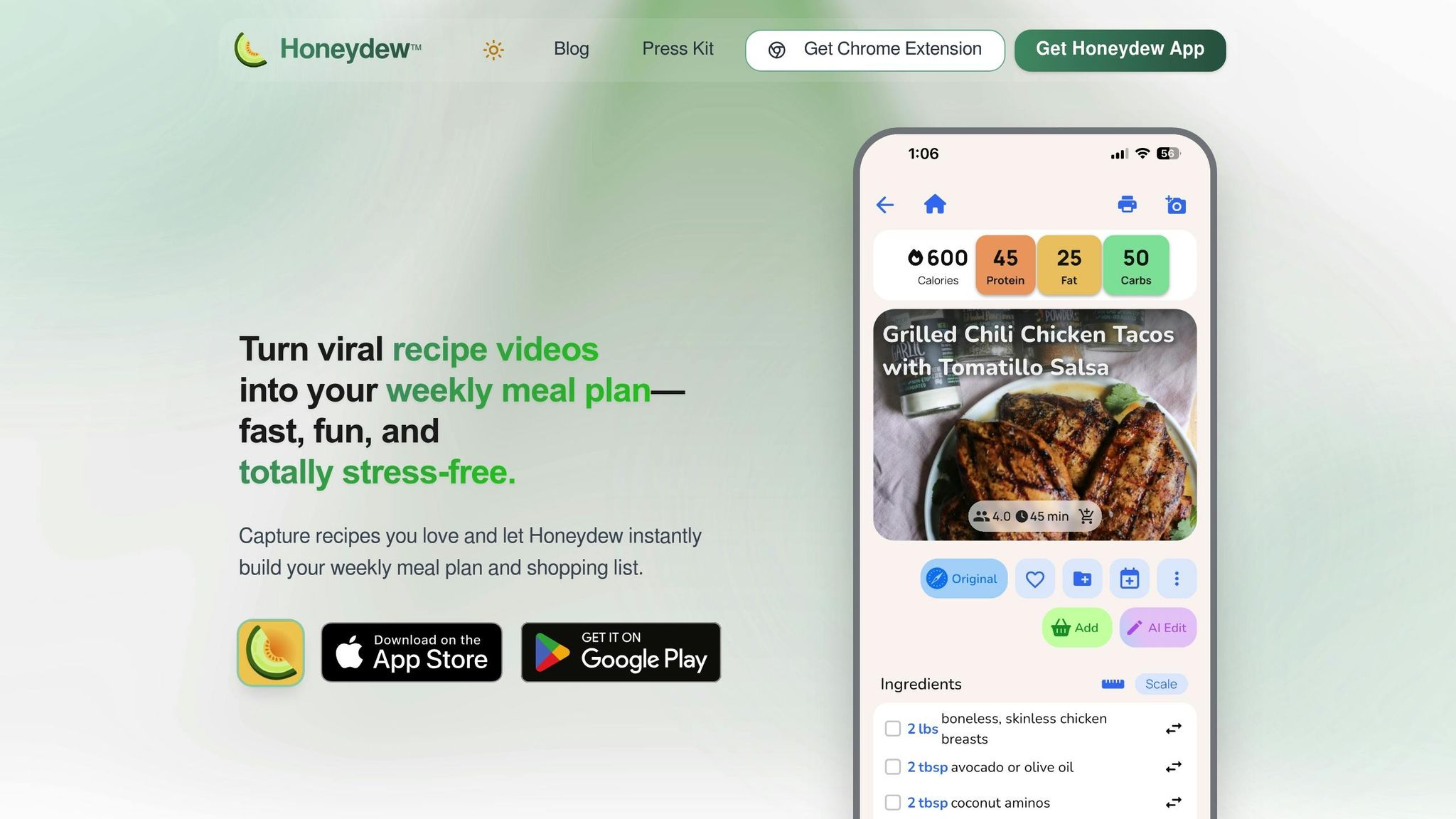
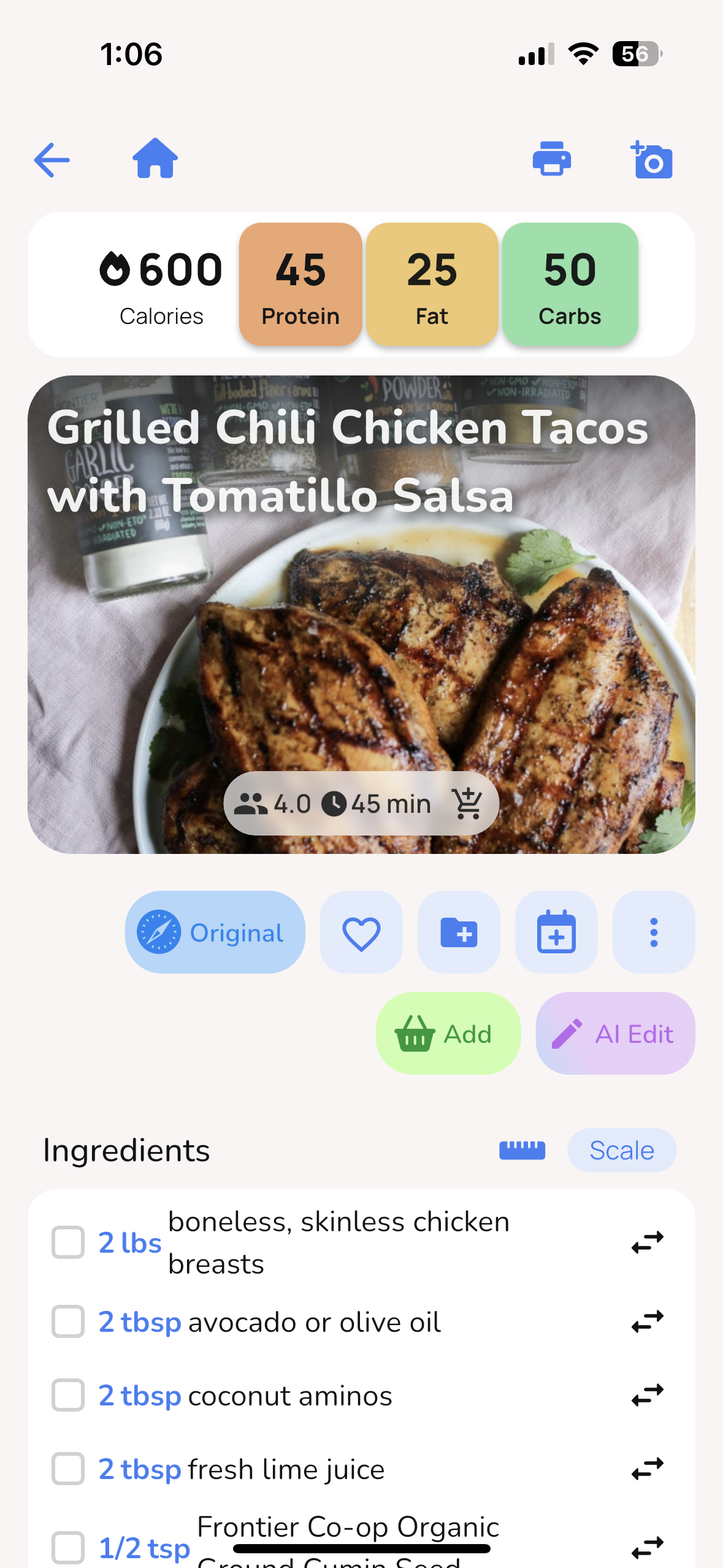
Honeydew Recipe Manager takes cooking to the next level by combining AI-driven precision with smart device integration. This app simplifies every stage of the cooking process, from timing to temperature adjustments, making even complex recipes more manageable.
AI Cooking Assistant Tools
Honeydew's AI assistant offers real-time guidance, ensuring each step of your cooking process is perfectly timed. For example, if a recipe calls for switching from slow braising to high-heat searing, the assistant tracks your progress and notifies you exactly when to make the change. No more juggling your phone or recipe card - just follow the prompts.
This feature delivers precise temperature control, minimizing errors compared to manual methods. It's no surprise that users have rated the app 4.8 out of 5 stars on mobile platforms. The real-time guidance pairs seamlessly with Honeydew's other smart features, making it a trusted companion in the kitchen.
Recipe Import and Adaptation Features
Honeydew makes adapting recipes from social media effortless. The app’s AI extracts clear, step-by-step instructions from popular platforms like TikTok, Instagram, and YouTube. Just paste a recipe URL, and Honeydew breaks down each stage - whether it’s prepping, roasting, or resting - into easy-to-follow steps with optimized timing. This feature is a favorite among users, who save around 90,000 recipes monthly.
The app also includes a handy ingredient substitution tool. If you're missing an ingredient, Honeydew suggests alternatives and adjusts cooking times to keep everything on track. This feature is especially helpful for maintaining smooth transitions between recipe stages.
Smart Kitchen Device Compatibility
Honeydew’s integration with smart kitchen devices ensures a seamless cooking experience. The app connects with Wi-Fi-enabled ovens and sous-vide machines to automate multi-stage cooking. Once synced, Honeydew handles temperature adjustments automatically, keeping appliances within an impressive ±0.5°F range.
For added convenience, Honeydew works with Alexa, allowing for voice-guided cooking. You can set timers, receive alerts for specific stages, and manage tasks without ever touching your devices. This hands-free approach is perfect for multitasking, like proofing dough while preparing for high-heat baking.
Benefits of AI-Optimized Cooking Transitions
More Accurate Cooking Results
AI technology brings a new level of consistency to your cooking. Traditional ovens often struggle with temperature swings - sometimes as much as 60°F. But AI-powered systems use advanced sensors and food probes to monitor and adjust temperatures in real time, keeping them steady and accurate. This precision is especially important during cooking transitions, like moving from slow braising to high-heat searing. AI doesn’t just rely on temperature - it even uses vision-based systems to detect the perfect level of browning, stopping the process at just the right moment. The result? Consistently perfect dishes that rival restaurant quality, every single time.
Reduced Cooking Time and Energy Use
AI doesn’t just make cooking more precise - it also makes it faster and more efficient. By tightly controlling temperature, AI can cut cooking times by up to 50%. Features like "Sous Vide Express" use food probes to maintain higher temperatures, delivering evenly cooked meals in half the usual time. AI-managed convection and steam systems let you lower cooking temperatures by 25°F and still finish dishes 5 to 10 minutes faster than traditional methods. The bonus? Less energy usage, which means lower utility bills, all while getting meals on the table quicker. It’s a win for both your schedule and your wallet.
Greater Confidence for Home Cooks
For many home cooks, tackling complex recipes can feel overwhelming. AI takes the stress out of the equation by seamlessly managing tricky transitions, like moving from steaming to browning, without any manual intervention. For beginners, this means no more hovering over the stove or worrying about when to adjust the heat. Plus, with remote monitoring through mobile apps, you can keep an eye on your meal’s progress from anywhere, giving you peace of mind and building your confidence with every successful dish. AI makes even the most daunting recipes approachable and foolproof.
How to Use Honeydew Recipe Manager for AI Cooking Optimization
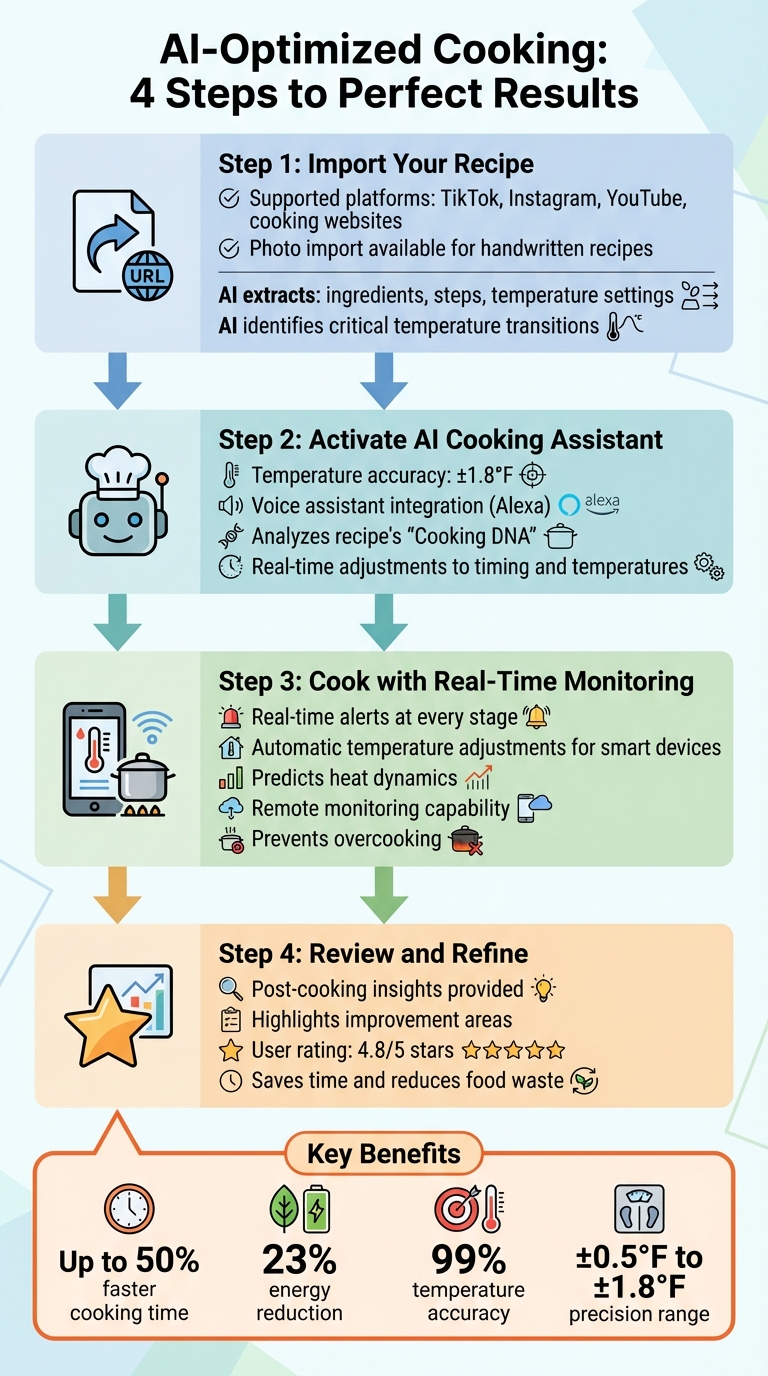
How AI Optimizes Multi-Stage Cooking: 4-Step Process from Recipe Import to Perfect Results
Step 1: Import Your Recipe
Open the Honeydew app and choose the recipe you want to prepare. You can import recipes by pasting a URL from platforms like TikTok, Instagram, YouTube, or any cooking website. The app's AI extracts all the key details, including ingredients, steps, and temperature settings. Got a handwritten recipe or a screenshot? Simply snap a photo, and Honeydew Plus will organize it for you. The AI even identifies critical temperature transitions, so you won't have to guess. Once your recipe is ready, activate the AI Cooking Assistant to guide you through the process.
Step 2: Activate the AI Cooking Assistant
With your recipe imported, turn on the AI Cooking Assistant. This feature offers step-by-step guidance and ensures precise temperature control, maintaining accuracy within ±1.8°F - essential for tasks like tempering chocolate or searing proteins. For added convenience, you can sync it with voice assistants like Alexa for hands-free operation. The assistant also analyzes your recipe's unique "Cooking DNA", making real-time adjustments to timing and temperatures based on your connected appliances.
Step 3: Cook with Real-Time Monitoring
As you cook, the app keeps you updated at every stage with real-time alerts. If you’re using compatible smart devices, such as ovens or sous-vide machines, Honeydew can automatically adjust temperatures between steps. It predicts heat dynamics and fine-tunes power and timing to prevent overcooking. Whether you're in the kitchen or stepping away, you can monitor progress remotely. This ensures a smooth cooking experience from start to finish.
Step 4: Review and Refine
Once your meal is done, take a moment to review your cooking results. The app provides insights into what worked well and highlights areas for improvement, helping you refine your technique over time. Many users praise Honeydew Recipe Manager for saving time and reducing food waste, reflected in its impressive 4.8/5 star rating. It’s a tool that’s changing the way home cooks approach their culinary adventures.
Conclusion
AI is transforming multi-stage cooking by automating intricate temperature changes, ensuring consistent results every time. With its precise control and real-time monitoring capabilities, AI makes advanced techniques - like tempering chocolate, perfectly searing proteins, or smoothly transitioning from steaming to browning - accessible to home cooks.
Take the Honeydew Recipe Manager, for example. This tool brings these AI-driven features into your kitchen, offering hands-free guidance for everything from trendy TikTok recipes to cherished family dishes. It predicts preheating times, adjusts temperatures between steps, and even allows you to monitor progress remotely. The result? You can focus on the fun, creative side of cooking while leaving the technical details to the AI.
But it’s not just about precision. By actively monitoring and adjusting in real time, AI helps cut down on energy waste, speeds up cooking times, and makes the entire process more efficient. According to industry experts, the real magic lies in how AI eliminates the technical roadblocks, empowering cooks to experiment and build confidence in the kitchen.
FAQs
How does AI improve temperature control during cooking?
AI brings a new level of precision to temperature control, using cutting-edge sensors, cameras, and algorithms to monitor and adjust heat and humidity in real time. This helps deliver consistent cooking results while minimizing the chances of overcooking or undercooking your food.
By carefully analyzing each step of the cooking process, AI fine-tunes temperature transitions to create the ideal environment for your dish. The result? More accurate cooking and a lot less stress in the kitchen.
How do sensors and cameras enhance AI-powered cooking systems?
Sensors and cameras play a key role in AI-driven cooking systems, offering the ability to monitor and adjust the cooking process with precision. Sensors keep an eye on critical factors like temperature and humidity, ensuring smooth transitions between different cooking stages. Meanwhile, cameras provide visual data, helping the system recognize ingredients and evaluate how the cooking is progressing.
With this combination, AI can make real-time tweaks - adjusting heat levels or suggesting the best cooking modes - without the need for manual intervention. The result? More accurate cooking, consistent quality, and a process that's not only efficient but also far less stressful.
How does AI help save time and energy in multi-stage cooking?
AI takes the hassle out of multi-stage cooking by managing temperature changes and processes with precision. Equipped with sensors and smart algorithms, it can monitor and adjust temperature, humidity, and timing in real time. This ensures every stage of cooking is handled efficiently, reducing unnecessary heating or cooling. The result? Less energy wasted and quicker cooking times.
It also leverages predictive models to determine the ideal temperature settings for specific recipes. This removes the guesswork, making the entire process smoother and more efficient. By simplifying these transitions, AI not only speeds up cooking but also helps save energy, offering a smarter solution for both home cooks and commercial kitchens.