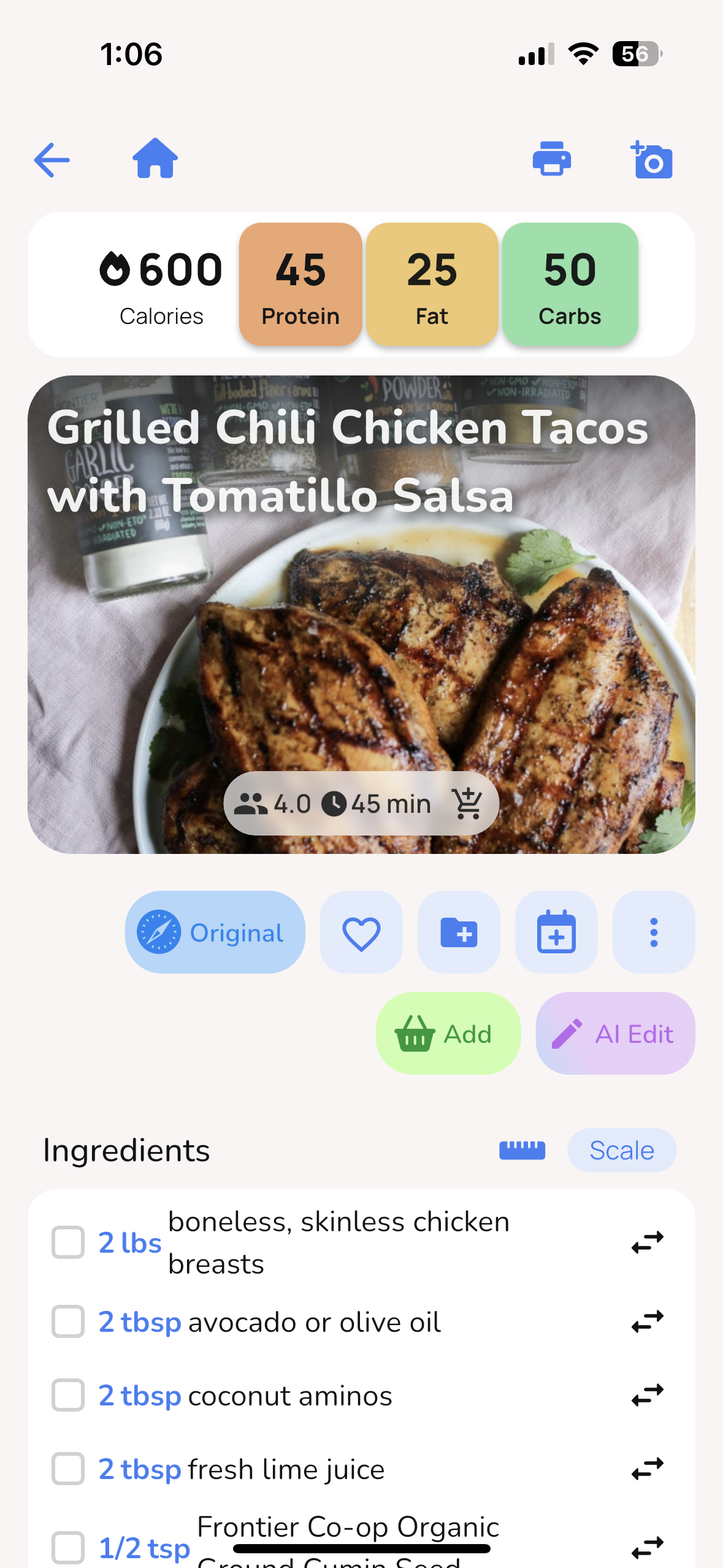
AI-Powered Cooking: What You Need to Know
• Updated
Artificial intelligence is changing how people cook at home. AI tools now help with meal planning, recipe customization, and grocery shopping, offering features like:
- Personalized meal plans: AI considers your dietary needs, schedule, and pantry items to suggest meals.
- Recipe adjustments: Tools modify recipes for dietary restrictions, portion sizes, or available ingredients.
- Smart grocery lists: Automatically organized by store sections and synced with delivery services.
- Reducing food waste: AI suggests recipes using ingredients you already have, cutting waste and saving money.
However, challenges include occasional errors in recipe suggestions, reliance on internet access, and subscription costs for advanced features. AI-powered tools like Honeydew Recipe Manager are making cooking easier, saving time, and helping households reduce food waste by up to 22%.
Bottom line: AI tools simplify cooking, save money, and reduce waste, but users should remain cautious of errors and costs.
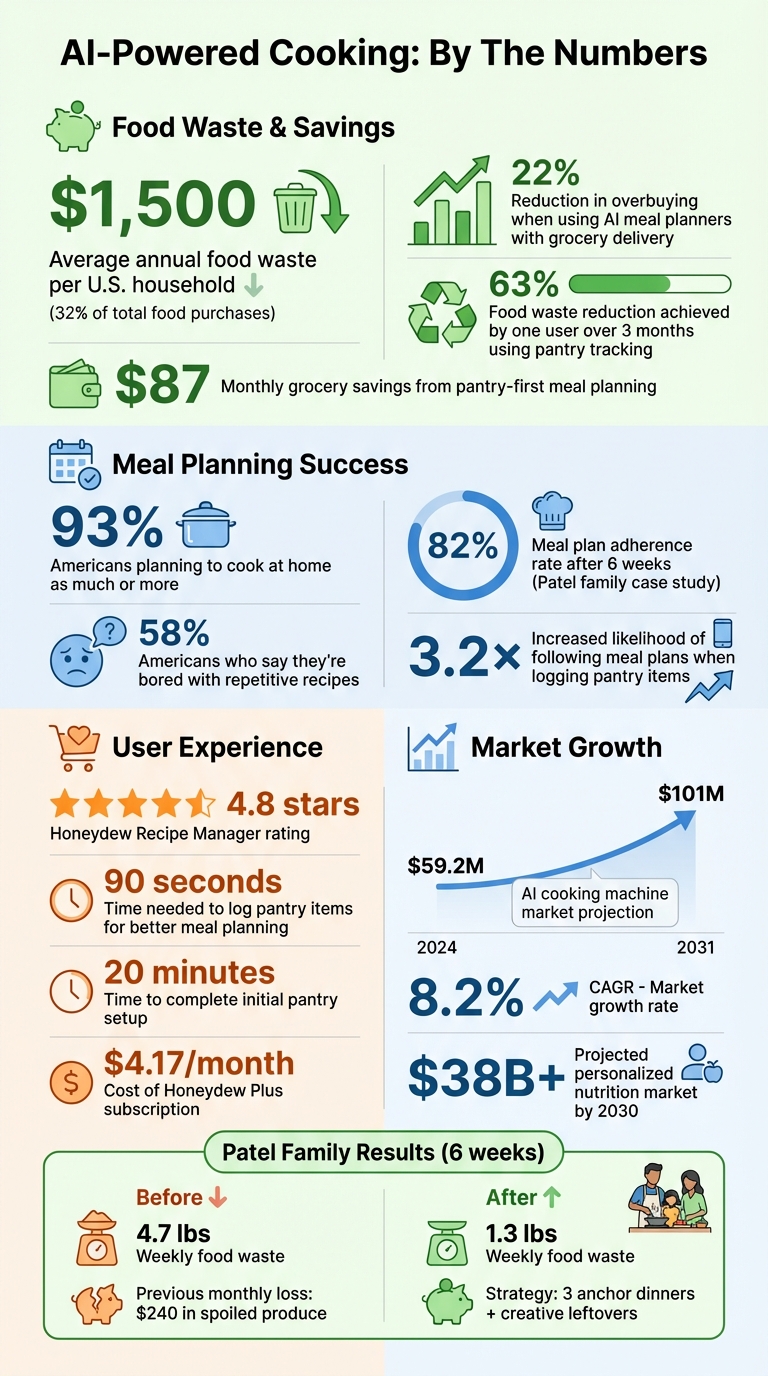
AI Cooking Tools Impact: Food Waste Reduction and Cost Savings Statistics
How to Use AI in the Kitchen
How AI Is Changing Home Cooking
AI is transforming how we approach home cooking by tackling three major challenges: deciding what to eat, tailoring recipes to fit specific needs, and simplifying how we stock our kitchens. These advancements address everyday struggles like repetitive meals and food waste. Let’s dive into how AI is reshaping meal planning, recipe customization, and grocery shopping.
AI in Meal Planning
AI-powered meal planning tools can craft weekly menus tailored to your household. They consider factors like family size, dietary restrictions (e.g., keto or low-FODMAP), cooking skills, and even your schedule. For instance, a tool introduced in late 2025 automatically limits cooking times to 30 minutes on busy nights while suggesting more elaborate dishes for weekends. Some systems even sync with your pantry inventory to suggest recipes based on what you already have, saving you from last-minute grocery trips.
AI also shines in reducing food waste with "cook once, eat twice" strategies. For example, it might recommend roasting a chicken on Sunday, then using leftovers for chicken salad wraps or soup later in the week. If your plans change mid-week, the AI adjusts the remaining meals and updates your shopping list in real time. It can even send reminders to help you stay on track with meal prep.
Once meals are planned, AI takes things further by personalizing recipes to suit your unique needs.
Recipe Personalization with AI
AI can tweak recipes to align with dietary preferences, allergies, or health goals. If you’re on a keto diet and a recipe calls for tortillas, the AI might suggest swapping them for lettuce wraps. It also adjusts portion sizes based on your household and modifies instructions to match your cooking skills and available equipment. Some advanced systems even use health data to offer tailored nutritional advice, making meals both satisfying and aligned with your well-being.
Over time, these tools learn your habits. If you consistently skip certain meals or give high ratings to others, the AI refines its future recommendations to better fit your tastes. Tools like Samsung's AI Vision Inside and FoodiePrep can even analyze photos of your pantry to suggest recipes that use what you already have. This not only reduces waste but also keeps meals fresh and exciting. After all, 58% of Americans who plan to cook less say they’re bored with repetitive recipes.
And when it comes to executing those plans, AI ensures grocery shopping is a breeze.
Automated Grocery Shopping
AI tools simplify shopping by creating organized grocery lists sorted by store sections - produce, dairy, pantry, etc. . For example, Honeydew Recipe Manager instantly generates these lists from your chosen recipes and integrates with services like Instacart, so you can order ingredients without manually entering them. Its pantry tracking feature also suggests recipes based on what’s already in your kitchen, helping you avoid unnecessary purchases.
The Patel family, a dual-income household of four, experienced the benefits firsthand in February 2026. They were losing $240 a month to spoiled produce. By adopting an AI-driven strategy - planning three "anchor" dinners per week and using leftovers creatively - they cut their weekly food waste from 4.7 lbs to 1.3 lbs. By Week 6, they were sticking to their meal plans 82% of the time. Dr. Lena Torres from Tufts University's Friedman School explains:
"AI doesn't reduce waste - it reduces decision fatigue. The real waste reduction happens when the tool respects human rhythm, not algorithmic perfection."
Households that combine AI meal planners with grocery delivery services and pantry tracking have seen a 22% drop in overbuying. That’s a meaningful shift, especially in today’s economic climate.
Main Features of AI Cooking Tools
AI cooking platforms are built around three main features: recipe import and storage, automated meal planning, and smart ingredient management.
Recipe Import and Storage
Gone are the days of manually typing out recipes. Tools like Honeydew Recipe Manager let you pull recipes directly from TikTok, Instagram, YouTube Shorts, and nearly any website - no extra effort required. The app formats recipes automatically, using standard U.S. measurements like cups, tablespoons, and degrees Fahrenheit. Instead of juggling bookmarks or flipping through cookbooks, you get a neatly organized digital library. Plus, the AI can scale recipes in seconds, adjusting ingredient amounts for different serving sizes.
Honeydew Recipe Manager is highly rated, with a 4.8-star score and user feedback highlighting its ability to save money. The free version allows up to 10 AI-powered recipe imports, while the Honeydew Plus plan ($4.17/month) unlocks unlimited storage and social media imports. With this kind of convenience, finding and organizing recipes has never been easier.
AI-Generated Meal Plans
Planning meals for the week? Honeydew Recipe Manager’s AI can create a 7-day meal plan in just minutes. It takes into account household size, cooking skills, available equipment, and even how much time you have to cook. Dietary needs? No problem. The tool supports a variety of preferences, whether you’re following a low-FODMAP, DASH, keto, or vegan diet.
One standout feature is its "cook once, eat twice" approach. For example, roast a chicken on Sunday, and the app will suggest ways to repurpose it into meals throughout the week. If your plans change mid-week, the app adjusts on the fly, updating your shopping list and meal schedule in real time. Flexible swap options also make it easier to stick to your plan.
Smart Ingredient Management
AI doesn’t just help with planning - it also ensures you’re making the most of the ingredients you already have. Honeydew Recipe Manager’s Pantry Mode uses a "pantry-first" approach. Snap a photo of your fridge, and the app will suggest recipes that prioritize the ingredients you’ve got on hand, especially those close to expiring.
The app also tracks your inventory using barcode scanning, receipt photos, and optical character recognition. This feature can lead to real savings. For instance, a dietitian in Portland logged her pantry in 20 minutes and ended up cutting her monthly grocery bill by $87 while reducing food waste by 63% over three months. Users who spend just 90 seconds logging pantry items before generating a meal plan are also 3.2× more likely to follow through on their planned meals.
Benefits and Challenges of AI in Cooking
Benefits of AI in the Kitchen
AI-powered cooking tools bring a lot to the table, especially when it comes to saving time and reducing decision fatigue. For instance, the average U.S. household wastes about $1,500 worth of groceries each year - around 32% of their total food purchases. Many AI tools aim to tackle this issue with a pantry-first approach, helping you use up ingredients before they spoil.
These tools also cater to specific dietary needs, whether it’s managing diabetes, lactose intolerance, or other restrictions. They can track your nutrient intake and even suggest real-time ingredient swaps to align with your goals. Beyond practicality, AI sparks creativity by suggesting unusual ingredient pairings, inspiring you to experiment with flavors you might not have considered otherwise.
On top of that, syncing AI meal planning with grocery delivery services has proven effective. Households using these systems have cut down overbuying by 22%, and flexible meal-swapping features have led to a threefold increase in sticking to meal plans compared to fixed ones. These tools are reshaping how we think about efficiency and inspiration in the kitchen.
Potential Drawbacks
Despite the benefits, AI cooking tools aren’t without their flaws. One major issue is the risk of "hallucinations", where the AI suggests nonexistent ingredients or unsafe recipes. For example, in February 2024, Instacart faced backlash for AI-generated recipes featuring fake ingredients like "monito sauce" and bizarre dishes such as a "hot-dog stir-fry", where the sausage interior looked like a tomato. Even more alarming, a New Zealand supermarket chatbot once recommended recipes that could create toxic chlorine gas or bizarre meals like turpentine-flavored French toast. Margaret Mitchell, a computer scientist at Hugging Face, highlighted the risks:
"It [AI] is also very capable of putting together things that could be poisonous, or harmful, or interact with people's medications and have no way of flagging that or noticing that".
Other challenges include cost and accessibility. Many advanced features require paid subscriptions, and most AI kitchen tools rely on a stable internet connection to function properly. Energy consumption is another concern. For example, a single ChatGPT query uses nearly 10 times the electricity of a standard Google search, and training models like GPT-4 demand enough energy to power San Francisco for three days.
There’s also the risk of losing the human touch in cooking. Over-reliance on AI might strip away the cultural depth and sensory intuition that skilled cooks bring to the table. Melissa Pflugh Prescott from the Center for Food Conservation and Waste Reduction stresses the importance of foundational knowledge:
"You need to have some foundational food and nutrition knowledge to craft appropriate prompts and follow-up questions, as well as to detect false information".
The Future of AI-Powered Cooking
Smart Appliance Integration
The modern kitchen is evolving into a hub of interconnected appliances, all communicating through unified apps. Brands like LG ThinQ, Bosch Home Connect, and Miele@Home have developed platforms where devices work together to simplify tasks and improve efficiency. In fact, the global market for AI-powered cooking machines, valued at $59.2 million in 2024, is expected to grow to $101 million by 2031, with a CAGR of 8.2%.
Future innovations include ovens equipped with multi-point thermal sensors and spectroscopic scanners, capable of detecting moisture and browning in real time to adjust heat levels automatically. For example, the Samsung Bespoke AI 4-Door Flex Refrigerator, priced at $3,599, can already identify dozens of fresh items on its own. Elizabeth Siboldi, Marketing Director at AJ Madison, highlighted this shift:
"AI is redefining what the modern kitchen can do. From smart cooking to predictive maintenance, today's appliances deliver real functional benefits."
These systems also monitor their own performance, identifying potential issues before they lead to breakdowns. Combined with AI meal planners, which adjust recipes for picky eaters and dietary needs dynamically, these technologies make kitchen interactions more intuitive through voice, text, and image-based commands. This interconnected ecosystem paves the way for smarter, more adaptive kitchen management, setting the stage for personalized coaching.
Personalized Dietary Coaching
AI-driven dietary coaching is stepping up from basic calorie tracking to providing recommendations based on real-time biological data, such as blood glucose, cholesterol, and even genetic profiles. By 2030, the personalized nutrition market is projected to surpass $38 billion. Using reinforcement learning algorithms, these systems continuously refine their recommendations based on physiological feedback, with studies showing they can reduce glycemic fluctuations by up to 40%.
In 2025, Omada Health introduced "Omada Spark", an AI-powered nutrition assistant designed for chronic conditions like diabetes. Users simply log meals via photos or barcodes, and the system provides tailored guidance. Similarly, Lumen uses breath analysis to offer real-time macronutrient recommendations based on metabolic data.
Advances in computer vision now enable food classification and nutrient detection with over 99% accuracy in controlled settings. A survey from 2022 revealed that 60% of physicians recommended mobile health apps for diet tracking and meal planning apps, compared to just 27% in 2016. AI-powered dietary chatbots have also been shown to boost adherence to nutrition plans by 32% when compared to traditional counseling methods. As Kushagra Agrawal and colleagues noted in Frontiers in Nutrition:
"AI-driven personalized nutrition is expected to play a crucial role in preventing disease, optimizing performance, and enabling long-term wellness strategies tailored to individual needs."
These personalized insights allow AI systems to predict and plan future meals, which ties directly into advancements in predictive meal suggestions.
Predictive Meal Suggestions
The next wave of AI in cooking will focus on anticipating your needs rather than just responding to commands. By analyzing past cooking habits, ingredient availability, and user feedback, these systems refine their suggestions over time. They’ll even consider external factors like weather or upcoming social events to make more relevant recommendations.
This is made possible through computational gastronomy, which uses extensive datasets of chemical flavor profiles and ingredient compatibility to suggest new pairings. Some systems are already incorporating biological data, such as genetic profiles and microbiome information, to provide highly personalized dietary advice tailored to specific health conditions. Ganesh Bagler, a professor at IIIT-Delhi, envisions this future:
"We are moving towards building computable representations of food - structured, machine-readable models that integrate taste, nutrition, health, sustainability, and culture."
With 75% of households cooking more at home post-pandemic, the demand for these smarter, predictive tools continues to grow. Real-time sensors, like those using infrared spectroscopy and multi-point thermal detection, will learn your preferences down to the smallest detail - whether it’s the perfect toast color or the ideal moisture level for a chicken breast. These tools are also designed to reduce waste by optimizing ingredient use based on changing consumption patterns.
Tools like Honeydew Recipe Manager are already paving the way, offering features like smart ingredient substitutions and Pantry Mode, which suggests recipes based on what’s already in your fridge. As these technologies advance, kitchens will become more personalized, reflecting the unique tastes and habits of their users.
Conclusion
AI is reshaping how we approach home cooking, turning it into a more efficient and personalized experience. From meal planning and grocery list creation to adjusting recipes and swapping ingredients, tasks that used to take hours can now be handled in minutes. With 93% of Americans planning to cook at home as much or more than they did before, the challenge lies in bridging the gap between intention and action.
Apps like Honeydew Recipe Manager make this possible by streamlining the entire cooking process. You can instantly import recipes from platforms like TikTok, Instagram, or YouTube, create AI-driven weekly meal plans tailored to your preferences, and generate organized grocery lists sorted by store sections. Plus, with Instacart integration, you can order everything you need with just one tap. The app’s 4.8-star rating highlights how features like automatic portion adjustments and smart ingredient substitutions simplify cooking and eliminate unnecessary guesswork.
Food waste is another area where AI tools make a real impact. With the average family losing about $1,500 annually due to discarded food, tools like Honeydew help users save hundreds each month. As Mark T. shared:
"The smart grocery lists save me hundreds of dollars a month".
Whether you’re tired of the nightly “what’s for dinner?” dilemma or simply want to enjoy cooking without the hassle, AI-powered tools provide practical solutions. For just $4.17/month, Honeydew Plus offers an affordable way to make cooking smarter and less stressful. AI doesn’t take over your kitchen - it enhances your creativity and helps you cook with ease. It’s time to reclaim your time, cut down on waste, and rediscover the joy of making meals at home.
FAQs
How can I tell if an AI recipe is safe and accurate?
To make sure an AI-generated recipe is both safe and reliable, you’ll want to check if it adheres to proper cooking methods and food safety standards. Watch out for warning signs like overly polished or unrealistic images, mismatched ingredients, or instructions that result in odd textures. Always confirm the recipe comes from a trustworthy source and includes essential details, such as proper cooking temperatures for different foods. Paying close attention to these factors can help you spot recipes you can trust.
What should I track in my pantry so AI meal plans reduce waste?
Keeping an eye on ingredients nearing their expiration date, leftover items, and the overall inventory of your pantry can make a big difference. By doing this, AI meal planning tools can suggest recipes that use what you already have on hand. This not only helps cut down on food waste but also saves you money in the process.
Do AI cooking tools still work if my internet goes out?
Many AI cooking tools can function without an internet connection if they’re built to use pre-downloaded data. However, features that rely on cloud services - like advanced recipe suggestions or detailed meal planning - usually need an active internet connection to work.