AI Recipe Categorization: How It Works
• Updated
AI recipe categorization simplifies finding recipes by using advanced tech like machine learning, natural language processing (NLP), and computer vision. It organizes recipes based on ingredients, cuisines, and dietary needs, saving time and reducing food waste. Here's what you need to know:
- How It Works: AI analyzes ingredients, instructions, and even photos to classify recipes. For example, it can identify vegan recipes by detecting the absence of animal products.
- Why It’s Useful: It speeds up meal planning, suggests recipes based on what’s in your pantry, and helps meet dietary goals like keto or low-carb.
- Tech Behind It: AI uses tools like OCR for handwritten recipes, NLP for text processing, and machine learning models to classify cuisines and dietary types with high accuracy.
- Extra Features: Apps like Honeydew Recipe Manager integrate AI for tasks like grocery lists, nutrition analysis, and real-time recipe adjustments based on user preferences.
AI makes recipe management faster, smarter, and more efficient, whether you’re a home cook or meal prep enthusiast.
How AI Categorizes Recipes: From Data Collection to Smart Meal Planning
How to Create a Food Ingredients Recognizer and Recipe Recommender
How AI Analyzes Recipe Data
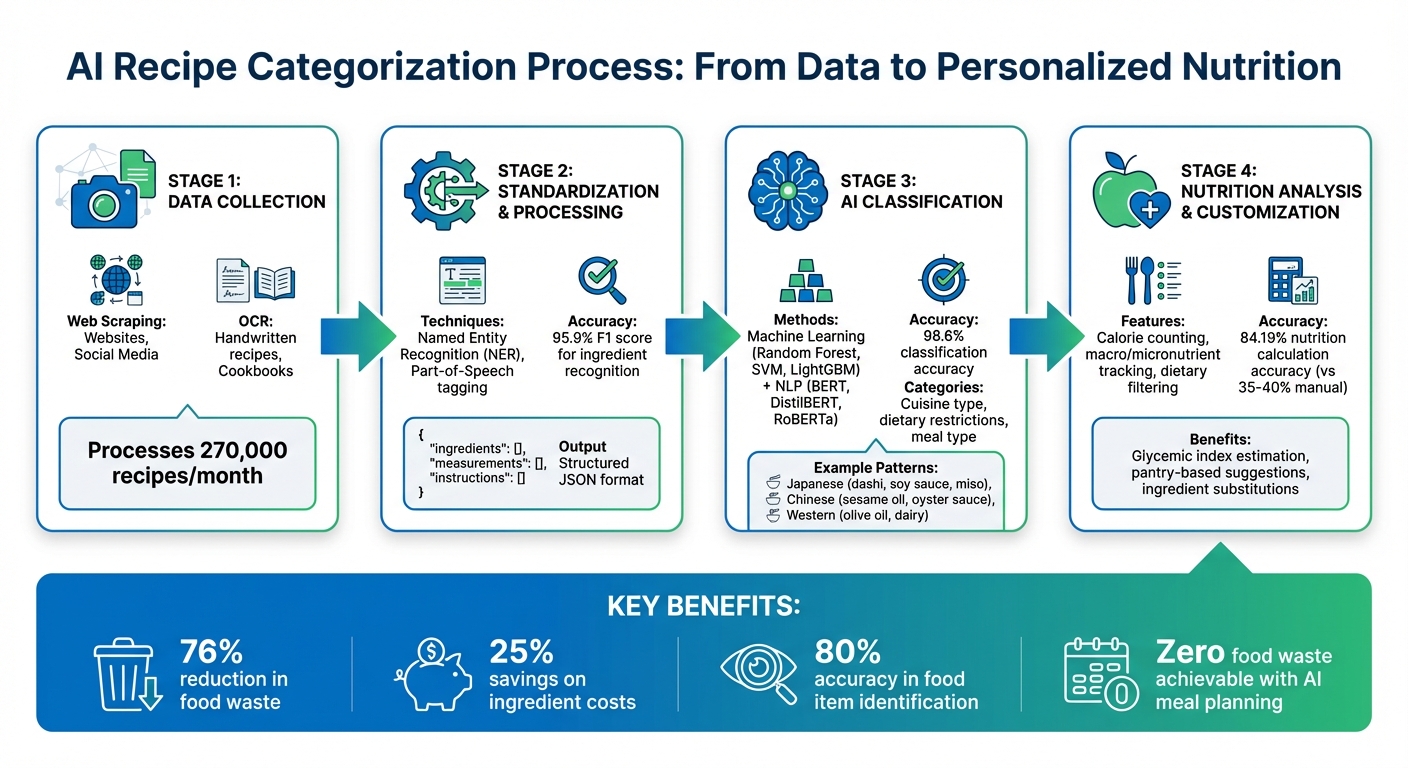
AI takes recipe information from various sources - websites, social media, and even handwritten cards - and converts it into a format that machines can easily process.
Collecting Data from Multiple Sources
AI pulls recipe data from both digital platforms and physical materials, using different techniques depending on the source.
For digital content, AI relies on web scraping to gather text from websites and social media. Platforms like TikTok often hide text within their webpages, but AI can extract this information using similar methods.
When it comes to physical formats, such as handwritten recipe cards or printed cookbooks, AI uses Optical Character Recognition (OCR) to transform images into text. Once the text is extracted, advanced models like GPT-4 or Gemini organize the data into structured formats like JSON. These structures include fields for the recipe’s author, ingredients, measurements, units, and step-by-step instructions. Additionally, datasets like 3A2M+, which contains over 2.2 million labeled recipes, are used to train AI systems to improve their accuracy.
Once the raw information is collected, the next step is standardizing it for consistent categorization.
Standardizing Ingredients and Metadata
AI tackles the challenge of inconsistent ingredient formats - like "extra-virgin olive oil" versus "extra virgin olive oil" - by comparing them to a master list.
To identify key elements such as ingredients and cooking temperatures, AI uses Named Entity Recognition (NER) tools like NLTK and spaCy. It prioritizes longer, multi-word ingredients (e.g., matching "chicken broth" before "chicken") and applies Part-of-Speech (PoS) tagging to differentiate between ingredients and actions. Fine-tuned spaCy-transformer models achieve an impressive 95.9% F1 score for recognizing ingredients.
Through these processes, AI ensures recipes are organized and categorized effectively, making tasks like meal planning more efficient.
AI Techniques for Recipe Categorization
AI uses advanced methods to organize recipes into categories like cuisine type, meal type, or dietary restrictions. But before this can happen, the recipe data must first be collected and standardized.
Machine Learning Algorithms
Machine learning plays a key role in classifying recipes by analyzing details like ingredients, seasonings, and nutrients. For instance, a 2024 study examined 604 features - spanning 12 nutrients and 19 ingredient groups - to differentiate recipes into Japanese, Chinese, and Western dietary styles.
Popular algorithms in this space include Random Forest Classifiers, Support Vector Machines, Logistic Regression, and ensemble models like Extreme Gradient Boosting and LightGBM. These models excel at spotting patterns in ingredient combinations. For example:
- Japanese cuisine often features dashi, soy sauce, and miso.
- Chinese cuisine is marked by chicken broth, sesame oil, and oyster sauce.
- Western dishes frequently include olive oil, dairy products, and consommé.
To refine these classifications, the SHAP (Shapley Additive Explanations) algorithm identifies which ingredients most influence a model’s decisions. For example, soy sauce, miso, and mirin are strong indicators of Japanese recipes, while sesame oil and oyster sauce are key for Chinese dishes.
In addition to these algorithms, AI relies on natural language techniques to process recipe text and extract meaningful insights.
Natural Language Processing (NLP)
NLP transforms unstructured recipe text into structured formats by applying techniques like tokenization, lemmatization, stop-word removal, and TF-IDF (Term Frequency-Inverse Document Frequency). These methods help AI recognize which words stand out - for instance, "saffron" carries more weight than a common term like "salt."
Pre-trained models such as BERT, DistilBERT, and RoBERTa achieve impressive results, with classification accuracy reaching 98.6% for genres like bakery, fast food, and cereals. In January 2025, a research team led by Nazmus Sakib at the Islamic University of Technology used DistilBERT and RoBERTa to classify 2.2 million recipes into nine genres with high accuracy. Interestingly, studies suggest that a recipe’s title often provides more reliable clues for classification than its full instructions.
Nutrition Analysis and Customization
Once recipes are categorized, AI takes things a step further by analyzing their nutritional content and tailoring them to individual health needs. This transforms everyday recipes into powerful tools for better eating.
Using Nutrition Databases
AI taps into resources like the USDA FoodData Central API, which includes Foundation Foods, SR Legacy, and the Global Branded Foods Database. By using YOLOv8, AI can scan ingredient lists and food labels to determine calorie counts, macronutrient profiles, and key micronutrients.
In March 2025, researchers at the NYU Tandon School of Engineering, led by Associate Research Professor Prabodh Panindre and Professor Sunil Kumar, introduced a web-based scanner powered by YOLOv8. This system analyzed a single slice of pizza and found it contained 317 calories, 10g of protein, 40g of carbohydrates, and 13g of fat. The accuracy of these vision-language models is impressive, with a mean Average Precision score of 0.7941, meaning they correctly identify food items about 80% of the time.
"Traditional methods of tracking food intake rely heavily on self-reporting, which is notoriously unreliable. Our system removes human error from the equation." - Prabodh Panindre, Associate Research Professor, NYU Tandon School of Engineering
Armed with this detailed nutritional data, AI can further refine recipes to align with specific dietary requirements.
Customizing Based on User Preferences
AI offers users the ability to filter recipes based on macronutrient and micronutrient targets, making it easier to meet personal health goals. For instance, someone watching their sodium intake can remove recipes that exceed their daily limit, while athletes can focus on meals packed with protein. When portion sizes are adjusted, computer vision and scaling algorithms recalculate the nutritional values, ensuring users stay on track with their goals.
Some systems go even further, estimating the glycemic index of meals and evaluating heart health factors like the potassium-to-sodium ratio. These features align with U.S. dietary guidelines for managing conditions like diabetes and hypertension. AI's semantic search capabilities also shine here. For example, it understands that a "nut-free" recipe must exclude ingredients like pecans, even if the word "nut" isn't explicitly mentioned. This level of precision eliminates guesswork and makes it easier to adhere to dietary restrictions without compromising on taste.
How Honeydew Recipe Manager Uses AI Categorization
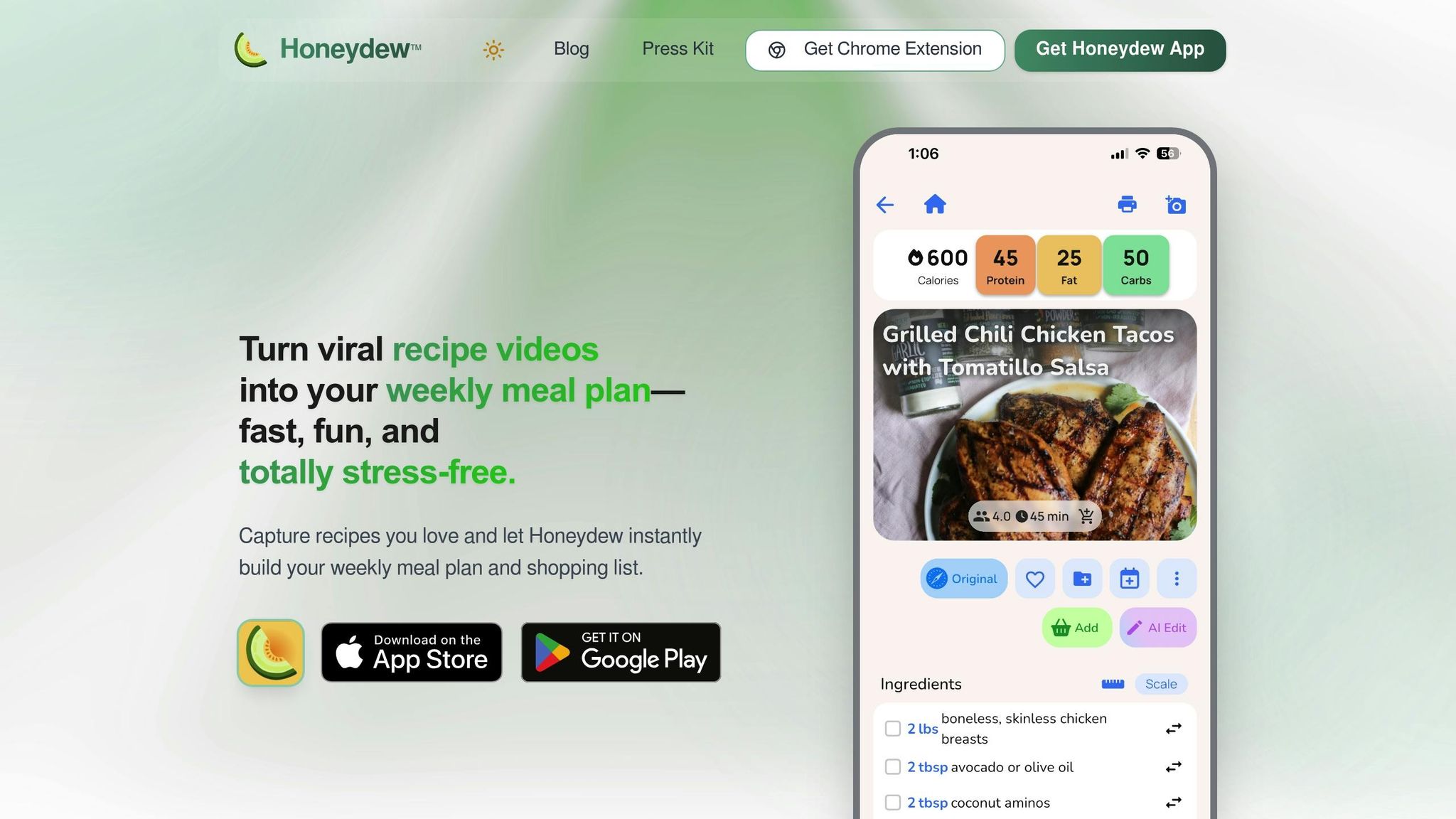
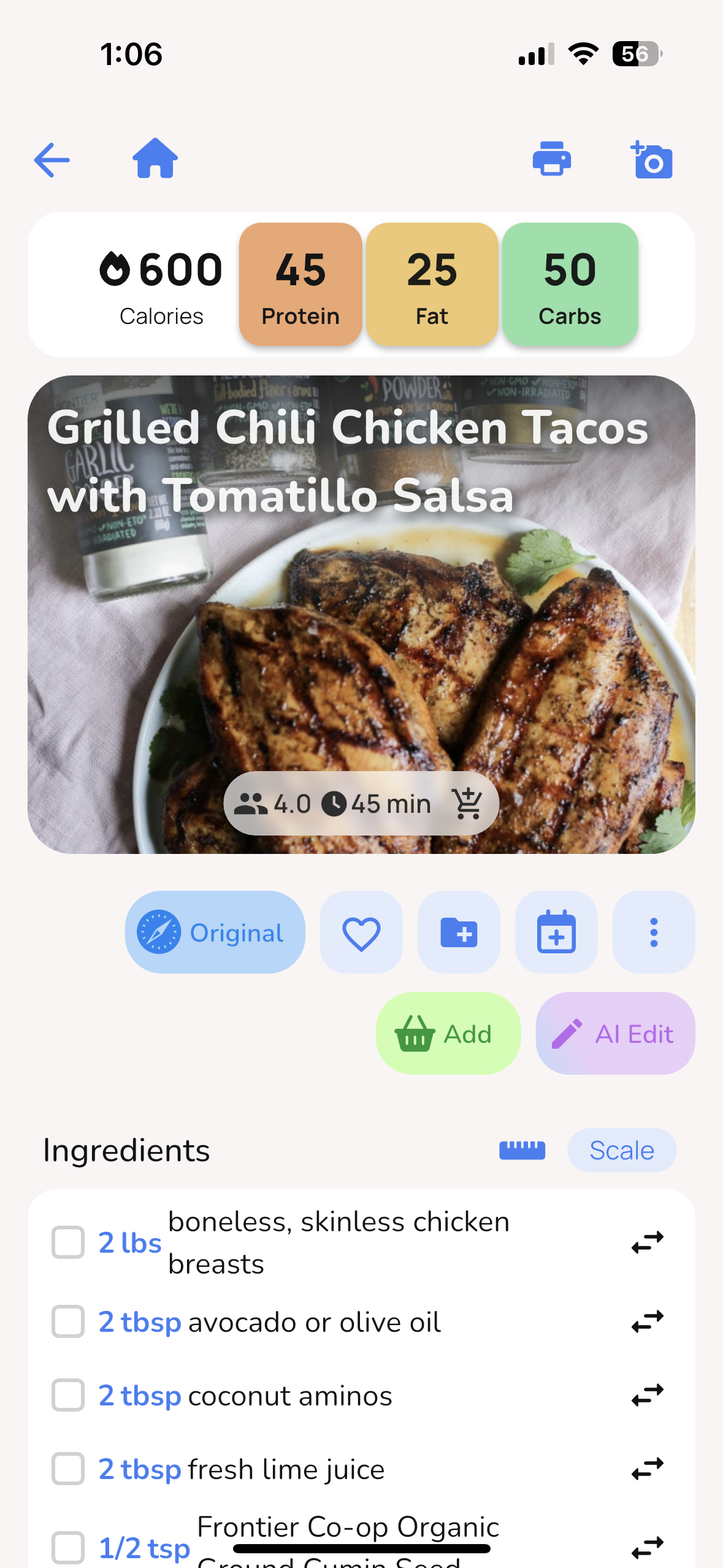
Honeydew Recipe Manager brings advanced AI categorization to life, offering practical tools that make meal planning easier for home cooks. By processing around 270,000 recipes per month, the app handles everything from TikTok and Instagram imports to handwritten family recipes, turning raw data into an organized, user-friendly experience. Whether you’re saving a recipe from a video, a website, or even a photo, the app’s AI takes care of the heavy lifting, ensuring a smooth and accurate categorization process.
From Recipe Import to Automatic Categorization
When you upload a recipe into Honeydew, the AI immediately gets to work. It extracts essential details like ingredients, measurements, cooking steps, and prep times from text, images, or videos. Even handwritten recipes are transformed into structured, searchable recipe cards that include nutrition information.
The app’s AI-powered nutrition and macro calculations boast an 84.19% accuracy rate, a significant improvement over the 35–40% accuracy of manual methods. This level of precision is especially valuable for those tracking calories or managing specific dietary needs.
Additional Features for Home Cooks
Honeydew’s AI doesn’t stop at categorization - it also simplifies meal planning and helps cut down on food waste. By analyzing ingredient and nutrition data, the app creates grocery lists sorted by store aisle, saving time and reducing unnecessary trips. In November 2025, CNET editor Corin Cesaric tested Honeydew’s AI-generated meal plan and achieved zero food waste, avoiding the typical $125 monthly food loss many U.S. households face. The app’s ability to reduce food waste by up to 76% stems from its smart categorization and pantry-based planning.
"The ingredient substitution feature is a game-changer for my dietary restrictions. I can adapt any recipe easily!" - Emily C., Verified User
Another standout feature is Pantry Mode, which takes inventory management to a new level. Snap a photo of your fridge or pantry, and the AI identifies available items, then suggests recipes you can make immediately. If a recipe doesn’t align with your dietary preferences, the Ask Honey assistant can modify the entire ingredient list on the spot - for instance, converting a pasta dish into a keto-friendly version without the hassle of searching for substitutes. For families, Honeydew Plus offers a shared experience, allowing up to six household members to sync recipes and meal plans in real-time for $4.17 per month when billed annually.
Conclusion: AI's Role in Recipe Management
AI has reshaped how home cooks handle recipes, plan meals, and shop for groceries. Whether it's snapping a photo of a recipe or importing one from a TikTok video, this technology takes care of the time-consuming tasks - like pulling out ingredients, calculating nutritional values, and identifying dietary restrictions - so you can focus on the fun part: cooking.
This shift isn't just about making life easier; it’s about making cooking more efficient and budget-friendly. AI-powered tools can cut ingredient costs by up to 25% through smarter planning, while pantry analysis features help you use what you already have, reducing food waste. And with 45% of Gen Z consumers turning to social media for recipe inspiration, AI bridges the gap between watching trending food videos and actually putting meals on the table. The numbers prove its effectiveness too: marketing campaigns that leverage AI-based recipe insights have seen engagement soar by 65%.
For families juggling dietary needs and picky eaters and tight budgets, AI offers real solutions. Features like automatic ingredient swaps, grocery lists sorted by store aisles, and real-time sharing across household members make meal planning easier and more collaborative. Plus, AI keeps things fresh by adapting to seasonal ingredients and predicting what you might want to cook next, turning recipe management into a tailored experience.
"As someone who meal preps weekly, Honeydew's grocery list feature is indispensable. It's saved me countless trips to the store." - Ryan G., User
At its core, AI isn’t about replacing the joy of cooking - it’s about removing the hassle. Whether you’re tracking your macros, diving into new cuisines, or just trying to make the most of what’s in your fridge, AI-powered recipe management helps you cook smarter, waste less, and enjoy the process even more.
FAQs
How does AI handle messy or inconsistent ingredient names?
AI leverages advanced natural language processing (NLP) techniques, such as named entity recognition (NER), to handle inconsistencies in ingredient names. These tools can identify and standardize ingredients, even when dealing with typos, abbreviations, or different formats. By understanding context and normalizing text, AI ensures precise ingredient recognition. This accuracy plays a key role in tasks like organizing recipes, filtering for dietary needs, and creating grocery lists.
How accurate is AI at detecting dietary labels like vegan or keto?
AI does a great job at identifying dietary labels like vegan or keto, with an impressive over 90% expert-weighted recall in recognizing various food types and styles. That said, it can sometimes struggle with more nuanced distinctions, like subtle ingredient variations or specific recipe details.
How does Honeydew Recipe Manager categorize recipes from photos or videos?
Honeydew Recipe Manager makes organizing recipes a breeze by allowing users to assign broad categories like meal type (breakfast, lunch, dinner), main ingredient (chicken, pasta, etc.), or cuisine (Italian, Mexican, and more). For added flexibility, users can create their own custom categories to suit personal preferences. This feature simplifies meal planning and keeps your recipe collection neatly organized.