5 Ways AI Simplifies Grocery Price Tracking
• Updated
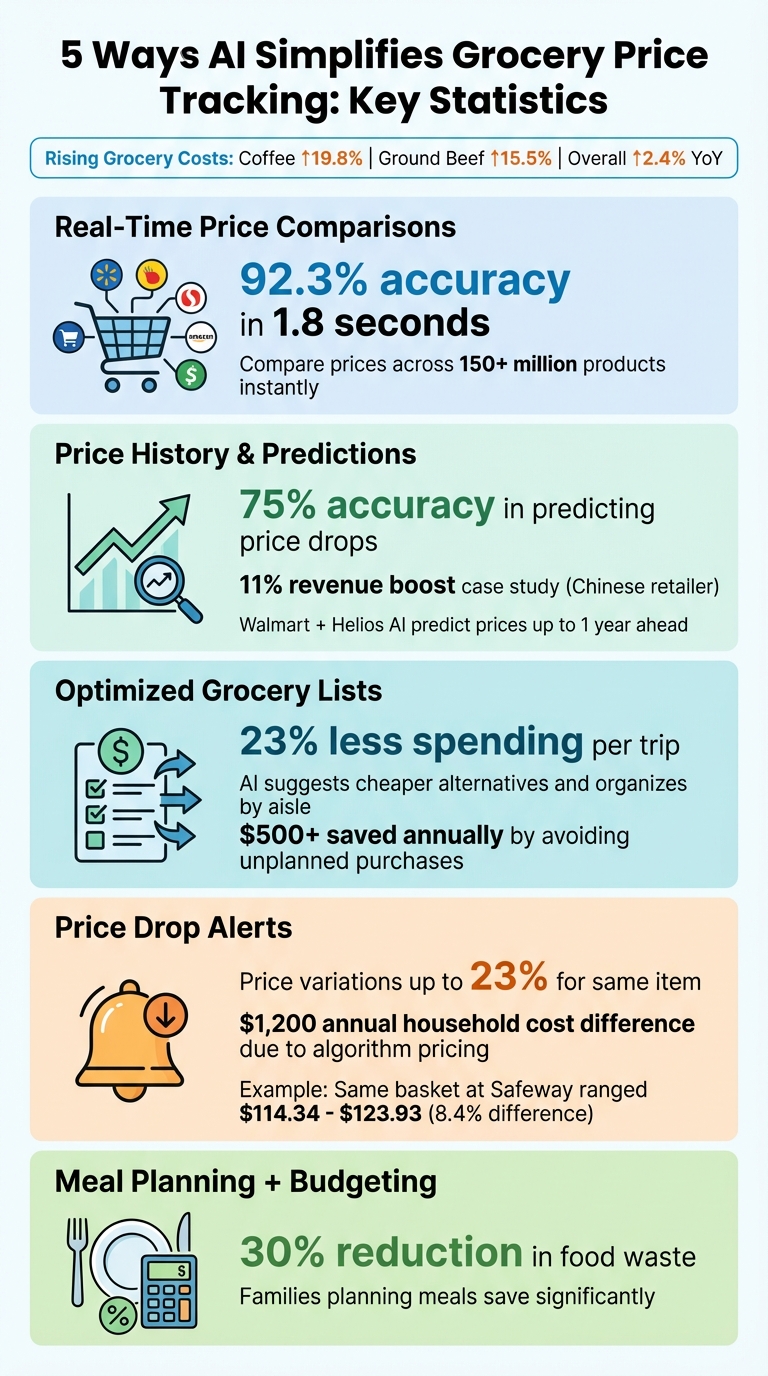
AI tools are changing how we shop for groceries, making it easier to save money and time. With rising grocery costs - coffee prices up 19.8% and ground beef up 15.5% - these tools help families stretch their budgets. Here’s how AI is transforming grocery shopping:
- Real-time price comparisons: Instantly find the best deals across multiple stores without driving around.
- Price history and trends: Predict future prices and time your purchases for maximum savings.
- Optimized grocery lists: AI suggests cheaper alternatives and organizes your shopping for cost efficiency.
- Price drop alerts: Get notified when prices fall, so you never miss a deal.
- Meal planning meets budgeting: AI links recipes, shopping lists, and spending limits to reduce waste and overspending.
AI makes grocery shopping smarter by combining price tracking, budgeting, and meal planning in one place. With tools like Honeydew Recipe Manager and PriceSense AI, you can save hundreds annually while navigating fluctuating prices with ease.
AI Grocery Price Tracking: Savings Statistics and Benefits Comparison
1. Compare Prices Across Multiple Stores in Real Time
Real-time price updates
Gone are the days of driving from store to store, jotting down prices on a notepad. With AI-powered tools, you can now instantly compare prices across multiple retailers. These tools use retailer APIs and automated web scraping to gather up-to-date pricing from major stores like Walmart, Target, Kroger, and Amazon - all in one convenient platform.
Apps like PriceSnap take it a step further by using image recognition to identify products through your phone's camera. The tool delivers highly accurate price comparisons (92.3% accuracy) in just 1.8 seconds (±0.2s). Pairing these updates with grocery delivery services makes shopping easier and more efficient than ever.
Integration with grocery delivery services
Combining price tracking with meal planning offers a smart solution for shoppers focused on saving time and money. For example, Honeydew Recipe Manager (https://honeydewcook.com) lets users import recipes from social media, automatically generates grocery lists, and integrates with Instacart for ordering ingredients - all while comparing prices to ensure you're getting the best deal.
This integration not only simplifies the shopping process but also highlights any pricing inconsistencies, helping you avoid overpaying while keeping everything organized in one place.
2. Analyze Price History and Predict Future Trends
Historical Trend Analysis and Predictions
AI doesn’t just help with real-time price comparisons - it dives into historical data to forecast future trends, giving you a leg up when planning purchases. By analyzing past patterns, it can predict price shifts before they happen.
For example, in February 2025, Walmart teamed up with Helios AI to project produce prices up to a year in advance. This partnership factored in climate risks and weather forecasts to make predictions more precise. Similarly, machine learning models calculate price elasticity - often falling between -8 and -2 - while also considering details like the day of the week to help refine the timing of purchases.
Budget Optimization Features
Price forecasting tools, such as PriceSense AI, boast over 75% accuracy in predicting future price drops. These tools combine simple features like 90-day trend charts with smart alerts, making it easier to spot patterns and act when prices hit your target.
A real-world example comes from a 2023 case study involving a major Chinese online retailer. Researchers Marshall Fisher, Santiago Gallino, and Jun Li implemented an AI pricing model on the top 30 feeding bottle SKUs. By analyzing historical price elasticity and competitor availability, the retailer saw an 11% revenue boost while maintaining its 10% gross margin. This approach not only benefited the retailer but also highlights how consumers can use similar insights to time their purchases for maximum savings.
3. Optimize Your Grocery List to Save Money
AI is making grocery shopping smarter and more budget-friendly by combining real-time price tracking, budget tools, and meal planning features. It’s not just about saving a few dollars - it’s about creating a more efficient and cost-effective way to shop.
Real-Time Price Updates
AI tools now let you compare prices for over 150 million products in real time, pulling data from multiple retailers to calculate the total cost of your shopping basket instantly. Instead of guessing which store has the best deals, these tools help you decide if switching stores or driving a little further is worth the savings.
Retailers using digital shelf labels (ESLs) can update prices throughout the day, and AI tools track these changes to help you buy at the best times. For example, in August 2025, Amanda Smith from CNET shared her experience with Microsoft Copilot's "Cooking Assistant." Starting with a $100–$150 weekly grocery list, the AI helped her create a Mediterranean meal plan and a categorized list that fit within a strict $75 budget. It even suggested swapping expensive proteins for cheaper alternatives and shifting her shopping from Whole Foods to ShopRite to cut costs.
These tools not only provide accurate price updates but also integrate seamlessly into advanced budgeting platforms, ensuring your grocery list is always optimized.
Budget Optimization Features
By analyzing real-time data, AI can recommend affordable substitutions, like switching to store-brand products or choosing cost-effective proteins, to stay within your budget. For instance, if you set a $75 spending cap for the week, the AI calculates the best ingredient quantities and meal plans to meet your goal. It even organizes your list by aisle and syncs it with online shopping carts, so you’re always shopping at the lowest available prices.
Simplified Meal Planning and Grocery List Creation
AI takes the hassle out of meal planning and list-making by turning handwritten notes, recipes, or even photos of your fridge contents into cost-optimized shopping lists. Tools like Honeydew Recipe Manager go a step further, allowing you to import recipes from platforms like TikTok, Instagram, or YouTube. The app then generates a categorized shopping list, sorted by store sections, and suggests cheaper alternatives for pricier items. Its pantry mode even lets you photograph your fridge to get recipe ideas based on what you already have, helping you avoid waste and unnecessary spending.
"The use of AI or just using data gives a competitive advantage to the stores, and it also gives a competitive advantage to the customers if a customer has the time and energy to put into it." - Dr. Shital Thekdi, Professor of Analytics and Operations, University of Richmond
With these tools, meal planning and grocery shopping become not only easier but also more budget-conscious. AI ensures you’re making smarter choices every step of the way.
4. Get Automatic Alerts for Price Drops and Sales
Real-Time Price Updates
AI-powered alerts work around the clock, scanning product pages to catch price changes the moment they happen. Automated systems continuously monitor major retailers like Amazon, Walmart, and Target. This constant tracking is essential, as research shows that prices for the same item can vary by as much as 23%. On top of that, algorithm-driven pricing can lead to yearly cost differences of roughly $1,200 per household.
For instance, in September 2025, Consumer Reports conducted a study with 437 volunteers shopping for identical baskets of 18 to 20 items on Instacart. At a Safeway in Seattle on September 4, 2025, 39 participants saw five different total prices for the same basket, ranging from $114.34 to $123.93 - a gap of $9.59, or 8.4%. Even individual items, like Skippy peanut butter, fluctuated in price from $2.99 to $3.69.
This constant tracking lays the groundwork for predictive features that make shopping even more efficient.
Historical Trend Analysis and Predictions
AI alerts do more than just respond to price drops - they predict them. These systems can forecast price changes with over 75% accuracy, helping you time your purchases to save money.
For example, tools like PriceSense AI offer a free plan that tracks up to five products and provides basic alerts. For $9 a month, their premium plan includes unlimited tracking, advanced AI predictions, and SMS notifications. Meanwhile, Google's AI Mode lets you set specific price targets for items. Once the price hits your desired discount, the AI can automatically purchase the product using Google Pay.
With these tools, you can plan your shopping more effectively, avoid overspending, and make the most of your budget.
Integration with Grocery Delivery Services
Predictive alerts become even more powerful when they integrate directly with grocery delivery apps. This connection allows you to act quickly on price updates, moving from notification to purchase in just seconds. It also helps you avoid personalized pricing, where retailers use your data to set custom prices. For example, Honeydew Recipe Manager combines meal planning with Instacart, enabling you to order ingredients at the best prices without hopping between apps.
"Every step that we take as a consumer is being bundled together in these massive databases and being analyzed so that the next time we confront a purchase decision, everything we've ever done is going to factor into the price we see."
- Len Sherman, Adjunct Professor, Columbia Business School
In physical stores, Electronic Shelf Labels (ESLs) allow retailers to apply real-time discounts, especially for items nearing expiration. AI tools can track these updates to help you snag local deals. To act quickly on short-term sales, opt for push or SMS notifications instead of email.
5. Connect Meal Planning with Budget Management
AI has taken meal planning to the next level by linking it directly to budget management, making grocery shopping smarter and more cost-effective.
Budget-Friendly Meal Planning
AI transforms meal planning into a practical way to save money. By creating grocery lists based on what you already have at home, it helps avoid unnecessary purchases and keeps spending under control. Research shows that shoppers using AI-generated lists spend up to 23% less per trip, and families planning meals in advance reduce food waste by up to 30%.
The savings can be substantial. Even a single unplanned item per shopping trip can add more than $500 annually to your grocery bill. Cleveland Clinic nutrition experts emphasize the value of planning:
"Walking in with a list not only keeps your cart healthier, it also prevents unnecessary items from creeping in".
This approach not only saves money but also streamlines the entire meal planning process.
Simplified Tools for Meal Planning and Grocery Shopping
AI-powered tools like Honeydew Recipe Manager seamlessly integrate meal planning with budgeting. These tools ensure you buy only the quantities you need, avoiding overbuying and ensuring that every purchase fits your financial plan. Features like Pantry Mode even let you snap a photo of your fridge, offering recipe ideas based on what’s already there - helping to cut down on duplicate purchases.
For a deeper dive into spending habits, you can upload past grocery receipts to AI tools like ChatGPT. The AI organizes your expenses into categories such as produce, snacks, and meat, showing you which areas take up most of your budget. While ChatGPT Plus offers advanced analysis for $20 per month, a free version with limited features is also available. This automated system is far more efficient than manually tracking expenses through spreadsheets.
AI also uses tools like Consumer Price Index reports to provide "guide prices", helping you determine if a BOGO (Buy One, Get One) deal is truly a bargain or just clever marketing. With grocery prices climbing 2.4% year-over-year as of early 2026 - and spikes like coffee up 19.8% and ground beef up 15.5% - this kind of price insight can make a noticeable difference in controlling monthly expenses.
Price Comparison Table
AI-driven price tracking can reveal surprising price differences for the same grocery items - even within the same retailer. Here's a quick look at a price comparison table based on a September 2025 Consumer Reports investigation at a Safeway in Seattle:
| Item | Current Price | Historical Low | AI-Recommended Buy |
|---|---|---|---|
| Lucerne Eggs (12 ct) | $6.47 – $6.99 | $6.47 | Buy Now (at $6.47) or Wait (at $6.99) |
| Wheat Thins (9 oz) | $3.99 – $4.89 | $3.99 | Buy Now (at $3.99) or Wait (at $4.89) |
| Skippy Peanut Butter (16 oz) | $2.99 – $3.69 | $2.99 | Buy Now (at $2.99) or Wait (at $3.69) |
| Cheerios Cereal (8.9 oz) | $7.34 – $7.99 | $7.34 | Buy Now (at $7.34) or Wait (at $7.99) |
| Heinz Ketchup (20 oz) | $5.99 | $5.99 | Buy Now (stable pricing) |
This table highlights how AI pinpoints the best times to buy, using real-time price tracking and historical data analysis. For instance, Skippy Peanut Butter shows a 23.4% price swing, with a $0.70 difference between its lowest and highest prices. While it might seem small, these differences add up fast over time.
The investigation uncovered that even on the same day, at the same store, 39 volunteers buying the same 20 items ended up with five different total prices. These ranged from $114.34 to $123.93 - a difference of 8.4% for identical baskets. Over a year, such variations could cost families up to $1,200 in additional grocery expenses.
AI makes this possible by analyzing real-time data from retailer APIs and web scraping with 92.3% accuracy in just 1.8 seconds. Machine learning algorithms also dig into historical pricing to identify the lowest recorded costs for each product.
The "AI-Recommended Buy" column is where these insights shine. It guides shoppers on whether to buy immediately or wait, helping them time their purchases to save the most money. This approach turns everyday shopping into a smarter, more informed experience.
Conclusion
AI-powered price tracking has transformed the way we manage grocery shopping, combining real-time price comparisons, meal planning, and budgeting into one streamlined process. These tools analyze millions of products instantly, predict price trends, and notify shoppers of discounts. Research shows that using organized shopping lists can cut spending by up to 23% per trip, while families who plan meals in advance reduce food waste by as much as 30%.
What sets this technology apart is how it merges meal planning with budgeting seamlessly. For example, apps like Honeydew Recipe Manager simplify grocery management by pulling recipes from platforms like Instagram, TikTok, or YouTube and turning them into structured grocery lists tied to your meal budget. Features like Pantry Mode suggest meals based on what’s already in your kitchen, while smart substitutions recommend cheaper alternatives when ingredient prices spike. By uniting these aspects into one platform, these tools eliminate the hassle of juggling recipes, lists, and budgets across multiple sources.
Why does this matter? Because 60% of families shop more frequently due to last-minute dinner choices, which often leads to overspending. Even a single unplanned purchase per trip can add over $500 to your annual grocery bill. These AI-driven insights not only save money but also help shoppers make smarter, more intentional decisions, enabling them to navigate fluctuating prices and market trends with confidence. With grocery costs continuing to climb, every small saving adds up.
FAQs
How accurate are AI grocery price predictions?
AI tools for predicting grocery prices show a wide range of accuracy levels. Some models boast precision rates exceeding 90%, which is impressive. However, research indicates that certain AI-driven pricing tools might unintentionally raise costs, with increases of around 20-23%. This could mean higher grocery bills for shoppers. The accuracy and impact of these tools often hinge on the specific model used and how it's applied.
How do AI tools pull real-time grocery prices?
AI tools use a mix of retailer APIs, web scraping, and image recognition to gather up-to-the-minute grocery pricing data. Here's how it works:
- Retailer APIs and Web Scraping: These methods pull pricing information directly from store websites or online catalogs, collecting data from multiple retailers in one place.
- Image Recognition: This technology identifies grocery items in photos and matches them to current prices, ensuring accuracy.
By combining these techniques, AI tools deliver precise, real-time pricing. This makes it easier for shoppers to compare prices across stores and snag the best deals without any hassle.
Can AI help me avoid overbuying and food waste?
AI can analyze the contents of your pantry, suggest recipes using the ingredients you already have, and even create smart grocery lists. These tools can help cut down on unnecessary purchases and reduce food waste by as much as 40%.