How AI Tracks Recipe Trends for Healthy Eating
• Updated
AI is transforming how we discover and plan healthy meals. By analyzing social media trends, breaking down recipes into nutritional details, and creating personalized meal plans, it simplifies the process of eating well. Here's how it works:
- Social Media Analysis: AI identifies trending recipes on platforms like Instagram and TikTok, tracking engagement metrics (e.g., saves, shares) and spotting ingredient patterns.
- Nutritional Insights: Recipes are deconstructed to calculate macronutrients, allergens, and portion sizes, ensuring they meet dietary guidelines.
- Personalized Meal Planning: AI tailors recipes to individual health goals, dietary restrictions, and available pantry items.
- Smart Grocery Lists: Automatically generated lists minimize waste and save money by optimizing purchases.
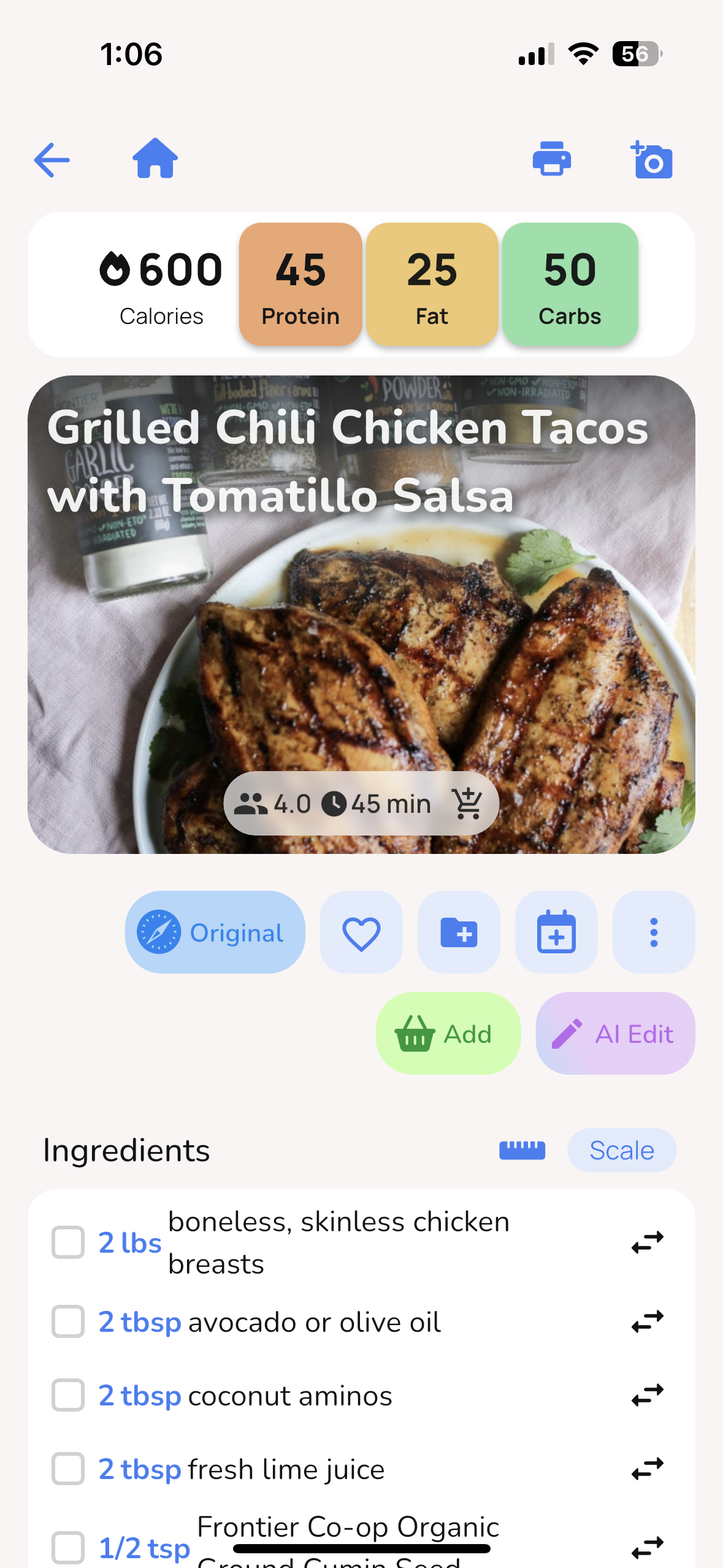
Tools like Honeydew Recipe Manager even integrate grocery delivery and suggest ingredient swaps for dietary needs. While AI streamlines meal planning, users should double-check measurements and adjust recipes to their taste.
How AI Tracks Recipe Trends and Creates Personalized Meal Plans
Here's how AI can build the perfect personalized meal plan
How AI Tracks Recipe Trends on Social Media
Social media has become a hotspot for discovering trending healthy recipes, and AI plays a crucial role in keeping up with these shifts. By leveraging tools like natural language processing, image recognition, and engagement analytics, AI scans platforms like Instagram, TikTok, and YouTube to identify which healthy recipes are gaining traction. This constant surveillance provides insights into both user engagement and ingredient trends.
Analyzing Social Media Engagement
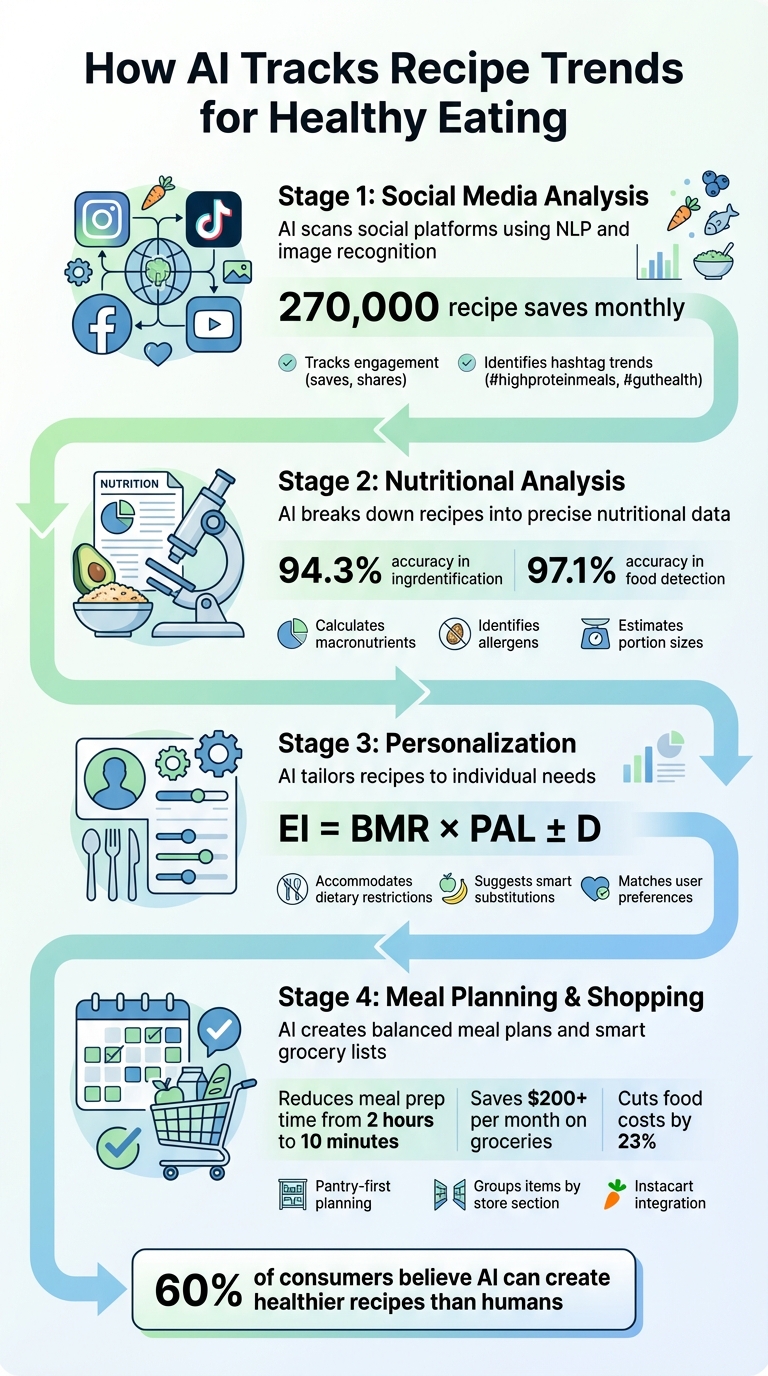
AI doesn’t just track what’s posted - it measures how people interact with it. Engagement metrics like saves and shares are key indicators of a recipe’s popularity. For instance, apps such as Honeydew Recipe Manager handle an impressive 270,000 recipe saves monthly from social media platforms. This massive dataset gives AI the ability to spot which recipes people are actually trying out.
Hashtags are another powerful tool AI uses. A sudden surge in tags like #highproteinmeals or #guthealth, especially when linked to specific ingredients, can signal the rise of a new trend. This kind of real-time analysis ensures users can discover trending healthy recipes while they’re still gaining momentum.
Identifying Key Ingredients and Patterns
AI doesn’t stop at engagement - it also digs deep into the content itself. Through computer vision, it identifies recurring ingredients, cooking methods, and even how dishes are presented. On video-heavy platforms like TikTok and Instagram, AI can transcribe and interpret on-screen text, turning quick recipe demos into detailed, user-friendly recipe cards.
Interestingly, nearly 60% of consumers believe AI can create recipes and food products that are healthier or more nutritious than those crafted by humans. For example, AI might notice that "bowl food" featuring specific combinations of ingredients is becoming trendy. Similarly, it could detect that visually striking ingredients like ube, a vibrant purple tuber popular in vegan dishes, are gaining popularity. By recognizing these visual and ingredient patterns, AI helps predict which health-focused ingredients are poised to go viral, enabling tools like the Honeydew Recipe Manager to offer personalized meal-planning options tailored to emerging trends.
Using AI for Nutritional Analysis of Recipes
AI doesn't just follow trends in recipes; it dives deeper to analyze their nutritional value and confirm if they align with balanced dietary practices. After identifying popular recipes on social media, AI breaks them down to calculate precise nutrient values and compare these findings with established dietary guidelines. This eliminates the need for manual tracking and provides a clearer understanding of a recipe's health benefits.
Breaking Down Macronutrients and Allergens
AI has the ability to dissect recipes into their most basic components. Take a complex dish like chicken cacciatore - it’s deconstructed into individual ingredients like chicken, tomatoes, onions, and olive oil. These elements are then matched to standardized databases like the USDA FoodData Central using unique identification codes.
Advanced tools such as Food Compass 2.0 go a step further, assessing nutrient ratios (like fat and carbohydrate quality), levels of food processing, and the presence of artificial additives. For example, the NutriScan system boasts 94.3% accuracy in identifying common ingredients and 97.1% accuracy in detecting food items under proper lighting conditions. A notable achievement came in March 2025 when researchers at NYU Tandon School of Engineering used an AI food scanner to analyze a slice of pizza. The scanner accurately calculated 317 calories, 10 grams of protein, 40 grams of carbohydrates, and 13 grams of fat, using a dataset of 95,000 food samples across 214 categories.
"Traditional methods of tracking food intake rely heavily on self-reporting, which is notoriously unreliable. Our system removes human error from the equation."
– Prabodh Panindre, Associate Research Professor, NYU Tandon School of Engineering
AI also estimates portion sizes by analyzing the area of food on a plate and correlating it with food density. This allows it to calculate calories and macronutrients with impressive precision. AI-powered food scanners can correctly identify food items about 80% of the time, even when items overlap or are partially hidden. This capability is crucial for recipes sourced from social media, where ingredient lists are often incomplete or vague.
Evaluating Recipes Against Health Goals
Once the ingredients are broken down, AI evaluates recipes against specific health objectives. Systems like the nutriRECIPE-Index use mathematical models to score recipes based on nutrient relevance and population health needs. For instance, a 2021 study by the Institute for Agricultural and Nutritional Sciences at Martin-Luther-University analyzed 106 recipes from a university canteen in Chemnitz, Germany. The study successfully differentiated between standard recipes (average score: 62.8%) and "MensaVital" health-focused recipes (average score: 82.2%).
AI also personalizes dietary recommendations by factoring in user metrics like BMI, age, and medical conditions. Variational Autoencoders (VAE) help create tailored dietary frameworks. However, as Raul Palacios, Director of the Didactic Program in Dietetics at Texas Tech University, points out:
"These tools are really good at giving you what you ask for, as long as you know what you're asking for."
To get the most out of AI meal-planning tools, users should provide clear instructions, such as asking the AI to "act as an expert dietitian specializing in cardiac care". Palacios also advises double-checking AI-generated recipes for errors, like incorrect measurements (e.g., teaspoons versus tablespoons of salt). Treat the first draft of an AI-generated meal plan as a starting point, making adjustments to better suit specific needs - whether that’s swapping ingredients or focusing on quick, microwave-only meals. With accurate nutritional profiles, AI can refine recipes to meet individual health goals effectively.
Personalizing Healthy Recipes with AI
AI has taken meal planning to the next level by personalizing recipes based on individual dietary needs. By analyzing user health data and dietary preferences, these systems can automatically tailor recipes to fit specific requirements. Using Variational Autoencoders (VAE), AI creates a digital profile of your nutritional needs and pairs it with trending recipes that align with your health goals.
To calculate a personalized daily energy intake, AI uses the formula EI = BMR × PAL ± D, where BMR is your basal metabolic rate, PAL reflects your physical activity level, and D adjusts for weight goals based on BMI. This ensures that every recipe supports your objectives, whether that's weight loss, managing a chronic condition like diabetes, or promoting heart health.
Customizing Recipes for Dietary Restrictions
AI also excels at accommodating dietary restrictions. Through Natural Language Processing (NLP), it scans ingredients from social media posts, food blogs, and videos, cross-referencing them with nutritional databases to identify allergens or non-compliant items. If a recipe includes problematic ingredients - like dairy for someone lactose-intolerant or gluten for someone with celiac disease - the system suggests smart substitutions that maintain both flavor and nutritional value.
For instance, Honeydew Recipe Manager simplifies this process. When you import a recipe from platforms like Instagram or TikTok, the AI flags conflicting ingredients and offers alternatives. It might replace heavy cream with Greek yogurt to lower saturated fat or swap wheat flour for almond flour to make a dish gluten-free. By analyzing flavor networks across thousands of ingredient combinations, the system ensures these substitutions don’t sacrifice taste.
That said, experts recommend a cautious approach. A 2023 study published in Nutrition revealed that while AI-generated allergy-safe diets are nutritionally balanced, they can sometimes lack variety or be slightly off in energy values. For accuracy, it’s wise to double-check ingredient quantities, especially for items like salt or baking leaveners.
Matching Recipes to User Preferences
AI goes beyond dietary restrictions by tailoring recipes to your preferences and lifestyle. Features like Vision AI allow you to photograph the contents of your pantry, enabling the system to identify available ingredients and suggest recipes that meet your filters, such as "dairy-free" or "nut-free." This functionality, sometimes called Pantry Mode, helps you make the most of what you already have on hand.
Conversational AI adds another layer of customization. You can request modifications like "give this stir-fry a Mexican twist" or "make this dish low-sodium", and the system adjusts the ingredients and instructions accordingly. For best results, provide detailed context, such as: "Create a 2,000-calorie, low-sodium meal plan for a family of four, tailored for cardiac health".
Modern apps also cater to households with diverse dietary needs. With household sharing, up to six members can coordinate their preferences within a single meal plan. For example, one person might follow a vegan diet while another needs gluten-free options. AI balances these requirements, recommending recipes that satisfy everyone. This makes it easier for families to embrace healthier eating habits without preparing multiple meals for each individual.
Transforming Trends Into Balanced Meal Plans
AI has taken meal planning to a whole new level by turning food trends into fully tailored meal plans. Instead of just analyzing popular recipes, it organizes them into balanced plans that align with your health goals. Forget the hassle of manually piecing together meals - AI handles the heavy lifting. It ensures your macronutrients are balanced across breakfast, lunch, and dinner while keeping your calorie goals on track without any tedious math.
"FitChef handles the math for you."
- FitChef
One standout feature is pantry-first planning. By scanning your current inventory - whether through receipt uploads or photos of your fridge - AI prioritizes recipes that use what you already have. This clever approach can cut weekly meal prep time down from two hours to just 10 minutes and reduce food costs by 23%. Considering that the average American wastes about $125 each month on uneaten food, this method offers both convenience and a solution to food waste.
Creating Smart Grocery Lists
After finalizing your meal plan, AI generates precise grocery lists that eliminate guesswork. These lists calculate the exact quantities needed for all recipes - like summing up the total chicken required for multiple meals - so you buy only what’s necessary. Items are also grouped by store sections (produce, dairy, pantry), making shopping faster and helping you avoid unnecessary splurges. Pantry staples like salt or olive oil are excluded, so you don’t end up with duplicates.
Some apps, like Honeydew Recipe Manager, go a step further with Instacart integration. This allows you to order groceries directly from your meal plan. The app’s AI can identify missing ingredients and even suggest substitutions - like swapping out-of-season produce for more affordable options - while keeping the recipe’s nutritional balance intact. You can also refine your lists with prompts like "high fiber" or "under 30-minute prep". Just keep in mind that AI has a 15% error rate in measurements, so it’s wise to double-check quantities before you shop.
Integrating Seasonal and Budget-Friendly Trends
AI doesn’t just optimize for health; it also tailors recipes to include seasonal and budget-friendly ingredients. By recommending items like frozen vegetables or locally available substitutes, it helps you save money while still delivering nutritious meals. For example, it might suggest pumpkin recipes in the fall or berry-based dishes in the summer, aligning with local harvests.
The financial benefits are impressive: users of AI-powered meal planners report saving over $200 per month on groceries and takeout. Features like an "Improvise" mode can further maximize savings by suggesting recipes for ingredients nearing their expiration date, helping to reduce waste. You can also tag recipes by season - think "Summer Grilling" or "Fall Comfort Food" - to easily access them when ingredients are at their cheapest. For families, household sharing options let up to six members contribute to a single meal plan, accommodating everyone’s dietary needs while avoiding duplicate purchases.
Conclusion
AI brings together the ever-changing world of social media trends and transforms them into practical meal plans tailored just for you. By analyzing engagement patterns, breaking down macronutrient details, and organizing balanced weekly menus in mere minutes, these tools help cut down on food waste, manage grocery budgets, and align your meals with your health goals.
What makes AI even more impressive is its ability to fine-tune meal plans through personalization. It adjusts recipes to fit your dietary restrictions, offers ingredient swaps for items you don’t have, and prioritizes what’s already in your pantry. Experts agree that providing clear and specific prompts - like "high protein, under 30 minutes" or "gluten-free comfort food" - leads to the best results. Plus, refining your input over time can make AI even more effective.
For those seeking a streamlined approach to healthy eating, the Honeydew Recipe Manager is a standout option. This app combines trend insights with detailed nutritional information, allowing you to import recipes directly from platforms like TikTok, Instagram, and Pinterest. Its AI-powered meal planner creates weekly menus in seconds, builds grocery lists sorted by store sections, and even integrates with Instacart for hassle-free shopping. Need inspiration? Snap a photo of your fridge, and the app suggests recipes based on what you have.
That said, it’s wise to double-check AI-generated measurements - errors like mixing up tablespoons and teaspoons can happen. Think of AI recommendations as a helpful starting point rather than definitive instructions, and tweak them to suit your tastes and needs.
FAQs
How does AI analyze recipes from social media to provide accurate nutritional information?
AI leverages cutting-edge tools like natural language processing and image recognition to break down recipes shared on social media. It picks out ingredients, serving sizes, and cooking techniques, then uses this information to calculate nutritional values. When some details are missing or unclear, AI steps in with predictions to fill the gaps, offering dependable and tailored insights for anyone aiming to keep their diet balanced.
Can AI create meal plans that meet multiple dietary needs?
AI is capable of managing various dietary needs within a single meal plan by customizing recipes to fit specific restrictions. It can recommend alternative ingredients, eliminate allergens, and sort recipes based on preferences such as gluten-free, vegan, or low-carb options. This approach ensures every meal is tailored to be both nutritious and aligned with individual dietary requirements.
How can AI-generated grocery lists simplify meal planning?
AI-powered grocery lists simplify meal planning by generating accurate shopping lists tailored to your chosen recipes. This not only saves you time but also helps cut down on food waste by ensuring you buy only what you need. Plus, AI can recommend meals based on your dietary preferences and the ingredients you already have, making it easier to stick to healthier eating habits while adding a personal touch to your meal prep.