AI vs. Manual Cooking Temperature Control
• Updated
When it comes to cooking, temperature control is everything. It’s the key to food safety, flavor, and consistency. But should you rely on AI-driven systems or stick with manual methods? Here’s a quick breakdown:
- AI cooking systems: Use sensors, cameras, and software for precise and automated temperature control. They deliver consistent results, save time, and reduce energy use but come with higher upfront costs.
- Manual methods: Depend on thermometers and visual cues. They’re more affordable and hands-on but less precise and require more skill.
Quick takeaway: AI systems excel at precision and convenience, while manual methods give you more control and flexibility. Your choice depends on your cooking style, budget, and how much effort you want to invest.
Comparison Table
| Factor | AI-Driven Control | Manual Control |
|---|---|---|
| Accuracy | ±1°C precision | ±5°C variance |
| Consistency | High; automated settings | Variable; user-dependent |
| Ease of Use | Low learning curve | Requires experience |
| Energy Use | 20–30% lower | Higher due to heat loss |
| Cost | $700–$1,200+ upfront | Low to moderate |
| Control | Automated, preset programs | Full manual adjustments |
Keep reading for a detailed comparison, including the pros and cons of each approach, and how to combine both for the best results.
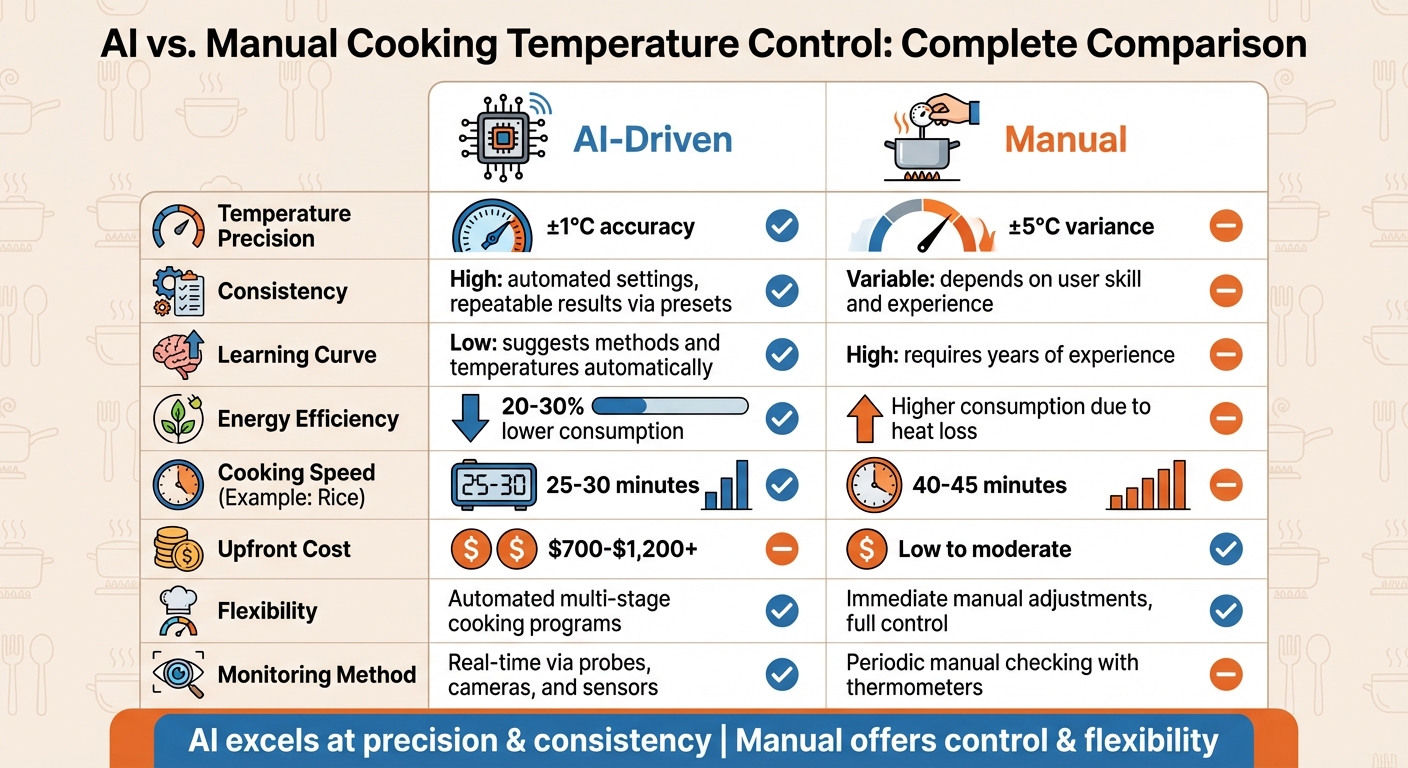
AI vs Manual Cooking Temperature Control: Complete Comparison Chart
How AI-Driven Temperature Control Works
Main Features of AI Cooking Systems
AI cooking systems excel by using closed-loop feedback to maintain precise temperature control. High-accuracy sensors (with a margin of ±1°C) continuously provide data to adjust heating in real time, ensuring temperature stability and avoiding sudden fluctuations .
Another standout feature is multi-stage automation. These systems can seamlessly transition between cooking phases. For example, they might start with a low temperature to ensure even cooking and then increase heat to achieve perfect browning .
Vision-based monitoring takes precision even further. Internal HD cameras, capable of withstanding temperatures as high as 500°F, work alongside neural networks to identify food types and track browning levels in real time. On top of that, smart food probes monitor internal food temperatures and alert you when your dish reaches the desired doneness .
These features come together to create cutting-edge appliance technologies designed to make cooking more accurate and reliable.
AI Technology in Cooking Appliances
Modern cooking appliances integrate these advanced AI capabilities into user-friendly designs, combining smart software with innovative hardware for consistent and effortless results.
Take the June Oven, for instance. It processes sensor data in real time to control heating elements and convection fans. It also offers over 200 automatic cooking programs developed by professional chefs. According to June Oven:
"The knowledge from our professionally-trained chefs has been translated into software to create our automatic multi-step Cook-Programs guaranteeing you consistent and delicious results every time".
Another standout appliance is the Anova Precision Oven 2.0, which was named "Editors' Pick #1" at the 2025 Inspired Home Show. It combines convection cooking with precise steam injection - a feature once reserved for professional kitchens. Food & Wine described it as "one of the smartest ovens on the market", while The Verge highlighted its ability to "recognize your food and tell you how to cook it".
For those seeking more budget-friendly options, devices like the Sur La Table Multifunctional AI Air Fryer are bringing advanced technology to countertop appliances. This air fryer uses vision technology to scan recipes from printed cookbooks, digital links, or frozen food packaging. It then translates that information into optimized cooking settings, including temperature, steam levels, and cook times .
Advantages of AI-Driven Cooking
One of the biggest perks of AI cooking systems is consistency. These systems maintain stable temperatures within ±1°C. Additionally, software-driven cooking has shown a 633% improvement in thermal heating uniformity compared to traditional microwave ovens.
AI systems also save time. Features like "Sous Vide Express" modes use probes to monitor internal food temperatures, cutting traditional sous vide cooking times by up to 50%. By accurately detecting when food reaches its optimal temperature, these systems prevent overcooking and reduce energy waste.
Convenience is another major benefit. Wi-Fi-enabled appliances let you monitor live video feeds of your cooking through mobile apps, so you don’t have to open the oven and disrupt the cooking environment. These apps also deliver automatic software updates, introducing new cooking modes and improved algorithms over time. As Anova Culinary explains:
"Precision isn't just about being fancy, it's about delivering mind-blowing, consistent results that keep people coming back for more".
Manual Temperature Control Methods
Common Manual Temperature Control Techniques
Even with the rise of AI-driven precision cooking systems, many chefs and home cooks still prefer the hands-on approach of manual temperature control. One of the most trusted methods in manual cooking is using thermometers. These tools come in various forms: digital thermometers like thermocouples, which provide readings in 2–5 seconds, and thermistors, which take about 10 seconds. On the other hand, dial bimetal thermometers require more time - 15–20 seconds for instant reads and up to 1–2 minutes for oven-safe models.
Another common practice involves visual and sensory cues. This means judging doneness based on meat color, juice clarity, texture, or firmness. However, these methods can be misleading. For example, meat can appear browned before it has reached a safe internal temperature capable of killing harmful bacteria. Studies, such as one conducted by the USDA, revealed that 21% of participants relied solely on visual cues like color and grill marks when cooking hamburger patties - an approach that can lead to unsafe food.
Cooks also rely on manual heat adjustments, such as turning stove knobs, tweaking oven settings, or physically moving food closer to or farther from heat sources. However, actions like opening the oven door can cause a temperature drop, often requiring 5 to 15 minutes for the oven to recover its original heat. Another technique is time-temperature balancing, where cooking times are adjusted to match changes in temperature. For instance, baking at a lower temperature for a longer duration can result in more evenly cooked food.
While these traditional methods come with their challenges, they remain a cornerstone of cooking for many.
Benefits of Manual Cooking Methods
Manual cooking provides a level of hands-on control that automated systems simply can't replicate. You decide when to adjust the heat, check for doneness, or respond to the sights, smells, and sounds of the cooking process. Over time, this builds a strong sense of cooking intuition.
Another advantage is adaptability. With manual methods, you can quickly adjust to unexpected situations. For example, if something starts browning too quickly, you can lower the heat or shift the food's position. These methods also work with any basic kitchen setup - no need for specialized gadgets or software updates.
Limitations of Manual Temperature Control
Despite its benefits, manual temperature control has some clear downsides.
The most notable issue is inconsistency. Even though many people own thermometers, visual cues like color and grill marks remain a popular but unreliable method for judging doneness. As the USDA Food Safety and Inspection Service cautions:
"Color and grill marks are not indicators that food is safe to eat and could put you at risk for foodborne illness if dangerous bacteria are still present in your food".
Human error is another major concern. For example, placing a thermometer probe against bone, fat, or gristle can result in inaccurate readings. Thin foods, like burger patties, require the probe to be inserted sideways through the edge to reach the center - a technique many home cooks are unaware of.
Additionally, manual thermometers need regular calibration to ensure accuracy. This involves testing them in ice water (which should read 32°F) or boiling water (212°F at sea level). Yet, most home cooks skip this step entirely. Finally, the frequent opening of ovens to check food disrupts the cooking process, causing heat loss and extending cooking times.
While manual methods have their place, these limitations highlight the challenges of relying solely on traditional techniques.
wan AIChef Ultra cooking system: chef mode, temperature control, $3,999 US launch
AI vs. Manual Temperature Control: Direct Comparison
Here’s a side-by-side look at how AI-driven and manual temperature control methods stack up across several key aspects of cooking.
Accuracy and Consistency
AI systems bring a level of precision that manual methods simply can’t replicate. Using tools like thermal cameras and integrated probes, these systems monitor food temperatures in real time, maintaining accuracy to within ±1°C. By contrast, manual methods often fluctuate by ±5°C or more. This difference is stark in practical scenarios - like when an AI-driven oven produced six slices of toast that were nearly identical in color and texture. Achieving this level of uniformity manually is nearly impossible.
This accuracy stems from continuous closed-loop measurement. AI systems constantly track food temperature and automatically stop heating once the target is reached. For example, a deep learning-based intelligent microwave prototype achieved 93% accuracy in identifying food types and recommending the correct target temperature. Meanwhile, manual cooking relies on estimating cooking times based on food properties. As Tareq Khan from Eastern Michigan University explains:
"The thinking process of calculating the exact required time is complex and may be guessed inaccurately".
Anova Culinary sums it up perfectly:
"Precision isn't just about being fancy, it's about delivering mind-blowing, consistent results that keep people coming back for more".
But accuracy isn’t the only difference - ease of use is another major factor.
Ease of Use and Learning Curve
AI systems take the guesswork out of cooking. Devices like the Agari AI Cooker use 3D scanning to determine optimal cooking settings automatically. This means no more guessing cooking times, checking doneness by touch, or reheating - everything is handled for you.
On the other hand, manual temperature control requires significant expertise. You need to understand how different foods respond to heat and learn to interpret visual and tactile cues - a skill set that can take years to master. Modern AI systems, however, offer "Assistant Modes" that simplify even advanced techniques while still letting experienced cooks fine-tune settings through apps. With AI, even beginners can achieve professional-quality results, while manual methods demand constant attention and experience.
When it comes to energy use and cost, the differences become even clearer.
Energy Efficiency and Cost
AI-driven systems are designed to be energy-efficient, using 20% to 30% less energy than traditional appliances. Advanced algorithms optimize performance by analyzing factors like temperature, humidity, and usage patterns. For instance, induction-based AI cookers can complete tasks in 25–30 minutes, compared to the 40–45 minutes typically needed with manual methods.
However, AI appliances come with a higher upfront cost. The Anova Precision Oven 2.0, for example, is priced at $1,199 - double the cost of its predecessor. Similarly, the Agari AI Cooker ranges from $699 (early bird pricing) to $1,099 at retail. In comparison, manual cooking tools are generally more affordable and don’t require subscriptions for advanced features. While AI systems may offer long-term savings - thanks to features like predictive maintenance alerts and reduced food waste from overcooking - the initial investment can be a barrier for many.
Finally, let’s look at user experience and flexibility.
User Experience and Flexibility
AI systems shine when it comes to automation and repeatability. Once you find settings that work, you can save them and replicate the same results every time, regardless of your skill level. These systems can also handle complex transitions, like switching from pressure cooking to high-heat searing, with minimal input.
Manual methods, however, offer unmatched hands-on control. You can adjust heat levels instantly based on what you see or feel, allowing for more experimentation. Plus, manual cooking avoids potential missteps from AI misidentifications. Interestingly, many high-end AI appliances now include "pro" modes, letting experienced cooks override automated settings for more creative freedom.
Comparison Table
| Factor | AI-Driven Control | Manual Control |
|---|---|---|
| Temperature Precision | ±1°C accuracy | ±5°C variance |
| Consistency | High; repeatable results via presets | Variable; depends on user skill |
| Learning Curve | Low; suggests methods and temps | High; requires experience |
| Energy Efficiency | 20–30% lower consumption | Higher consumption due to heat loss |
| Cooking Speed | Faster (e.g., 25–30 min for rice) | Slower (e.g., 40–45 min for rice) |
| Upfront Cost | High ($700–$1,200+) | Low to moderate |
| Flexibility | Automated multi-stage cooking | Immediate adjustments |
| Monitoring | Real-time via probes/cameras | Periodic manual checking |
Which Method is Right for You?
Finding the right cooking method depends on your style, budget, and how much control you’d like to have in the kitchen. Think about your spending limits, how often you cook, and how hands-on you want to be when preparing meals.
What to Consider When Choosing
Budget matters. AI-powered tools like the Combustion Predictive Thermometer come with a price tag of $199.99, while the Brava Oven costs $1,495.00. On the other hand, manual dial thermometers are far more affordable and easy to find in stores. If you’re a casual cook or just starting out, spending big on AI tools might not be worth it. But for frequent cooks who value time efficiency, the long-term payoff could justify the upfront cost.
How often and how much you cook also plays a role. AI tools shine when it comes to consistency and energy efficiency, making them ideal for repetitive tasks or cooking in larger quantities. For instance, if you’re prepping meals for the week or cooking the same dishes regularly, AI can save you time and effort. Manual methods, however, are better suited for handling unique variations, like irregularly sized cuts of meat that might not fit preset AI programs.
Decide how involved you want to be. Manual cooking gives you creative freedom, while AI tools handle the monitoring for you. If you’ve ever overcooked a meal out of fear of undercooking, you’re not alone - around 50% of people admit to this. AI thermometers can take the guesswork out by calculating USDA safety standards, which allow for lower cooking temperatures over longer times, ensuring food is both safe and delicious. As freelance tech writer Amanda Blum puts it:
"It turns out the tedious part of the process, which involves keeping an eye on a dish as it cooks, is skippable; that the oven that cuts cooking time by half or more, even better: You can enjoy the prep and the results, and not worry about the in between."
Food safety is non-negotiable. Most harmful bacteria are destroyed when food reaches internal temperatures between 140°F and 165°F. Whether you go the AI route or stick with manual tools, using a thermometer is crucial. Smart thermometers can give you a reading in as little as 2 to 5 seconds, while manual thermistors take about 10 seconds.
Combining AI with Manual Techniques
You don’t have to choose one method and stick to it - many cooks combine AI and manual approaches for the best results. AI can handle the precision tasks, like monitoring temperature and timing, while you take charge of the creative elements like seasoning and searing. For instance, a smart thermometer can provide predictive data while you manually control the heat on a grill or in a pan.
Use AI for tasks that require precision and automation, but rely on manual methods for the finishing touches that machines can’t quite replicate yet. Still, double-checking with a food thermometer is the only surefire way to confirm that your food has reached a safe internal temperature. As the Academy of Nutrition and Dietetics emphasizes:
"A food thermometer is the only way to ensure food is cooked to the proper internal temperature and harmful bacteria are eliminated."
Make sure to calibrate your tools regularly. When checking temperatures, always insert the probe into the thickest part of the food, steering clear of bone, fat, or gristle for the most accurate reading.
For those who want to streamline meal planning, the Honeydew Recipe Manager is a handy tool. Its AI-powered meal planner can create weekly menus in seconds, generate grocery lists organized by store sections, and even suggest ingredient swaps when needed. Whether you’re using high-tech appliances or sticking to manual methods, keeping recipes, nutrition tracking, and meal planning all in one place can make cooking an easier and more enjoyable experience.
Conclusion
Final Thoughts
Deciding between AI-driven and manual temperature control isn't about picking a universal solution - it’s about finding what works best for your cooking style and priorities. AI systems shine with their precision and consistency, thanks to features like closed-loop sensors and automated multi-stage cooking. These technologies can achieve up to 93% accuracy in food classification and temperature recommendations. However, they often come with a higher upfront cost and a bit of a learning curve. On the other hand, manual methods are budget-friendly, straightforward, and allow for quick, creative adjustments, though they rely heavily on human judgment, which can sometimes lead to inconsistencies.
For most home cooks, the sweet spot lies in blending both approaches. AI is perfect for tasks that demand precision, like proofing dough or cooking proteins to exact temperatures. Meanwhile, manual control lets you make quick tweaks and add those personal, finishing touches. Experts often recommend this balanced approach, as it caters to the diverse needs of different cooking scenarios. This perspective naturally ties into the tools that can support modern home cooking.
How Honeydew Recipe Manager Can Help
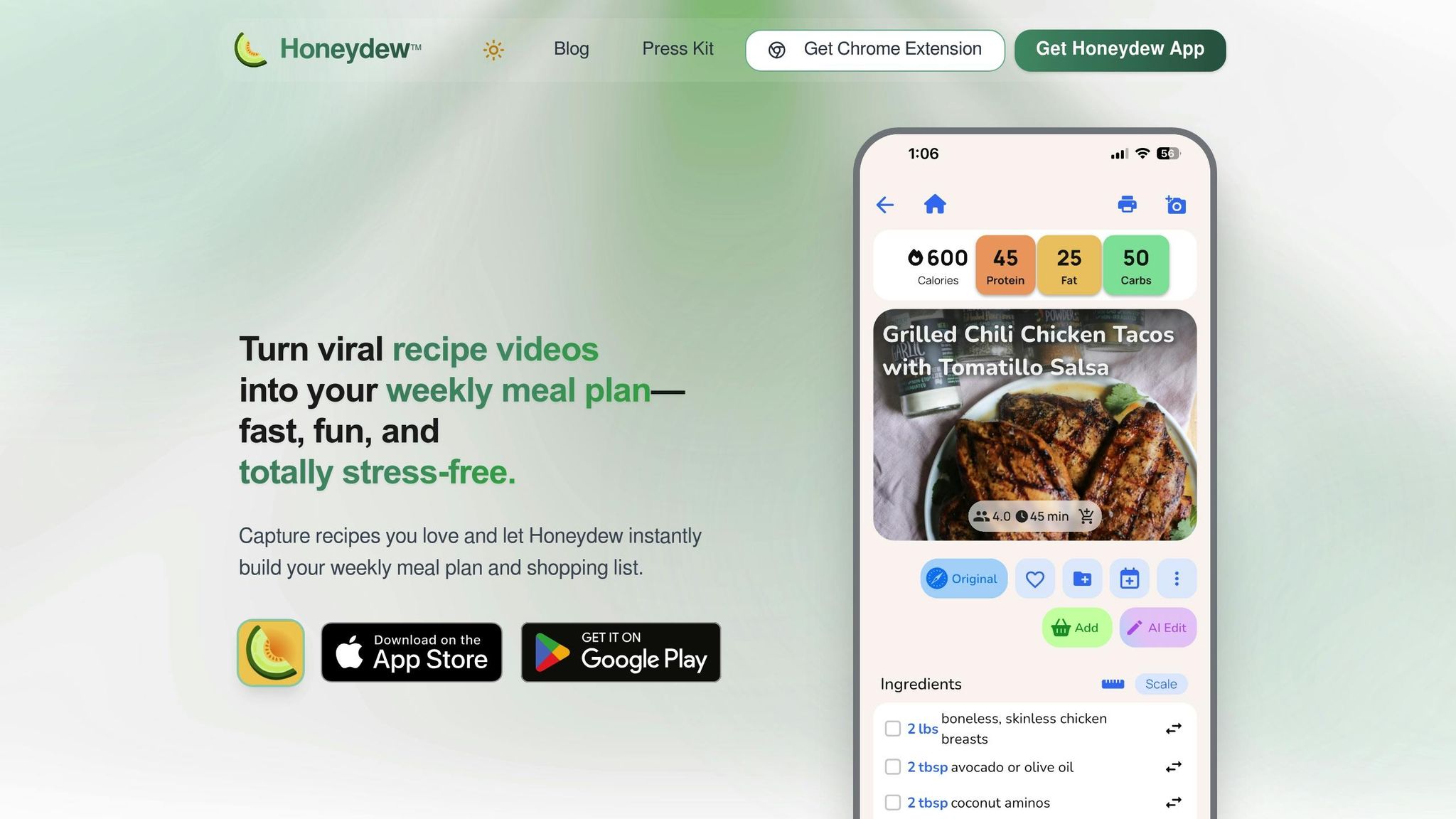
In today’s tech-savvy kitchen, having the right tools can make all the difference. Whether you lean on AI for precision or prefer manual adjustments, staying organized is key. That’s where Honeydew Recipe Manager steps in. This app’s AI-powered planner can create weekly menus in seconds, generate grocery lists sorted by store sections, and even track nutrition automatically. Plus, its ingredient substitution feature helps you adapt recipes when something’s missing.
You can also import recipes directly from TikTok, Instagram, YouTube, or any website, and access them offline while cooking. With features like household sharing and unlimited recipe storage, everyone in your home can contribute to meal planning and keep track of favorite dishes - no matter which cooking method they prefer.
FAQs
What are the benefits of using AI for cooking temperature control compared to manual methods?
AI-powered cooking systems bring a new level of precision and ease to the kitchen. These systems can automatically adjust heat in real-time, ensuring your food is cooked at the ideal temperature without the need for constant attention. This not only minimizes mistakes but also guarantees consistent, high-quality results every time.
Many of these systems go beyond cooking. They often include features like meal planning, pantry inventory tracking, and even generating grocery lists, making the entire cooking process smoother and less stressful. By saving time and improving accuracy, these AI-driven tools make it easier to prepare meals that are both delicious and enjoyable.
How does AI improve temperature control in cooking?
AI brings a new level of precision to cooking temperature control by leveraging advanced sensors and machine learning. These technologies work together to monitor and adjust settings in real time, analyzing factors like the internal temperature of food and visual cues such as color and texture. The result? Consistently perfect cooking outcomes.
Take AI-powered devices, for instance - they can automatically tweak cooking parameters to ensure even heat distribution. This minimizes the chances of overcooking or undercooking, helping you achieve that ideal level of doneness and reliable quality with every dish.
Are traditional cooking methods still effective compared to AI temperature control?
Traditional cooking methods certainly have their charm and can yield excellent results, but they often depend heavily on the cook's skill and intuition. Techniques like judging doneness by sight or relying on timing can work beautifully for seasoned cooks. However, these methods can sometimes lack the precision needed for consistently accurate results.
For dishes where hitting the right temperature is crucial - think poultry or baked goods - tools like food thermometers are invaluable. They not only ensure that your food is cooked safely but also take the guesswork out of achieving perfect doneness. While manual methods can still shine, pairing them with modern tools can elevate your cooking by adding an extra layer of safety and reliability.