Best Free AI Food Scanners for Nutrition Tracking
• Updated
AI food scanners simplify nutrition tracking by analyzing photos of meals to estimate calories and nutrients in seconds. Here's a quick overview of the top free apps:
- MyFitnessPal: Known for its massive database (20+ million foods), but AI scanning requires a premium subscription.
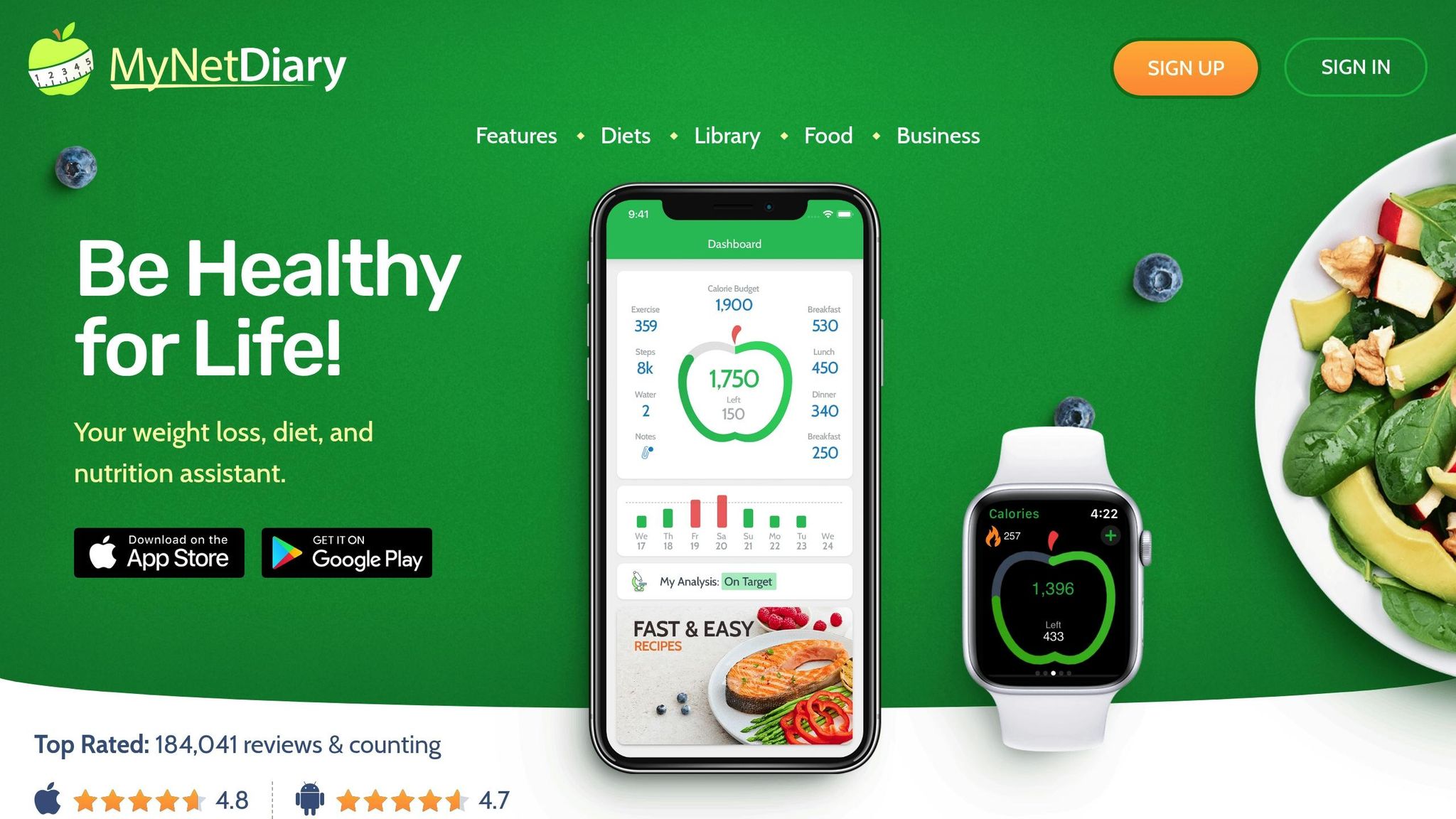
- MyNetDiary: Offers free AI scanning with a verified database of over 1 million foods, plus barcode scanning.
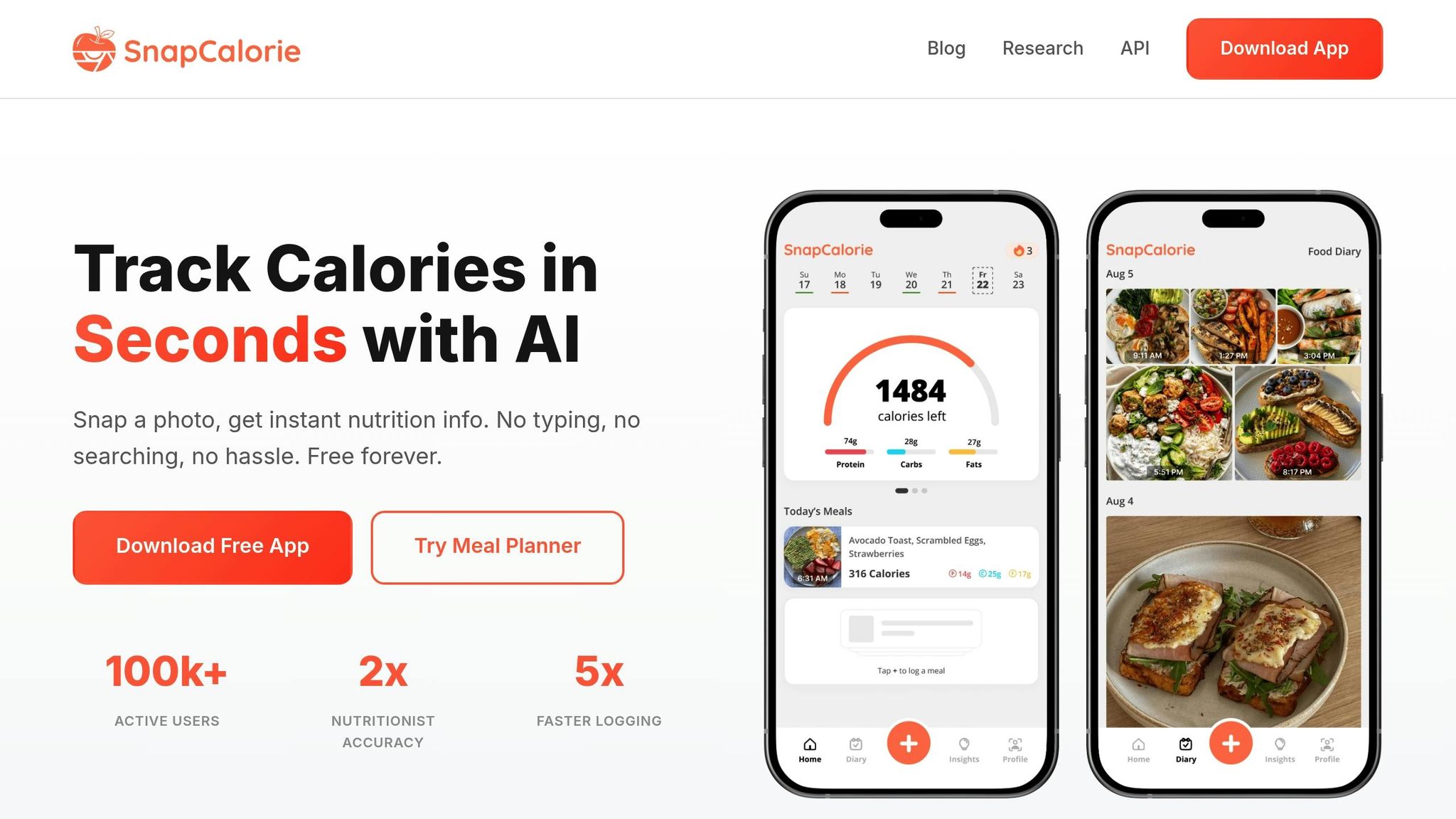
- SnapCalorie: Free AI scanning with advanced depth-sensing for portion accuracy, developed by former Google AI researchers.
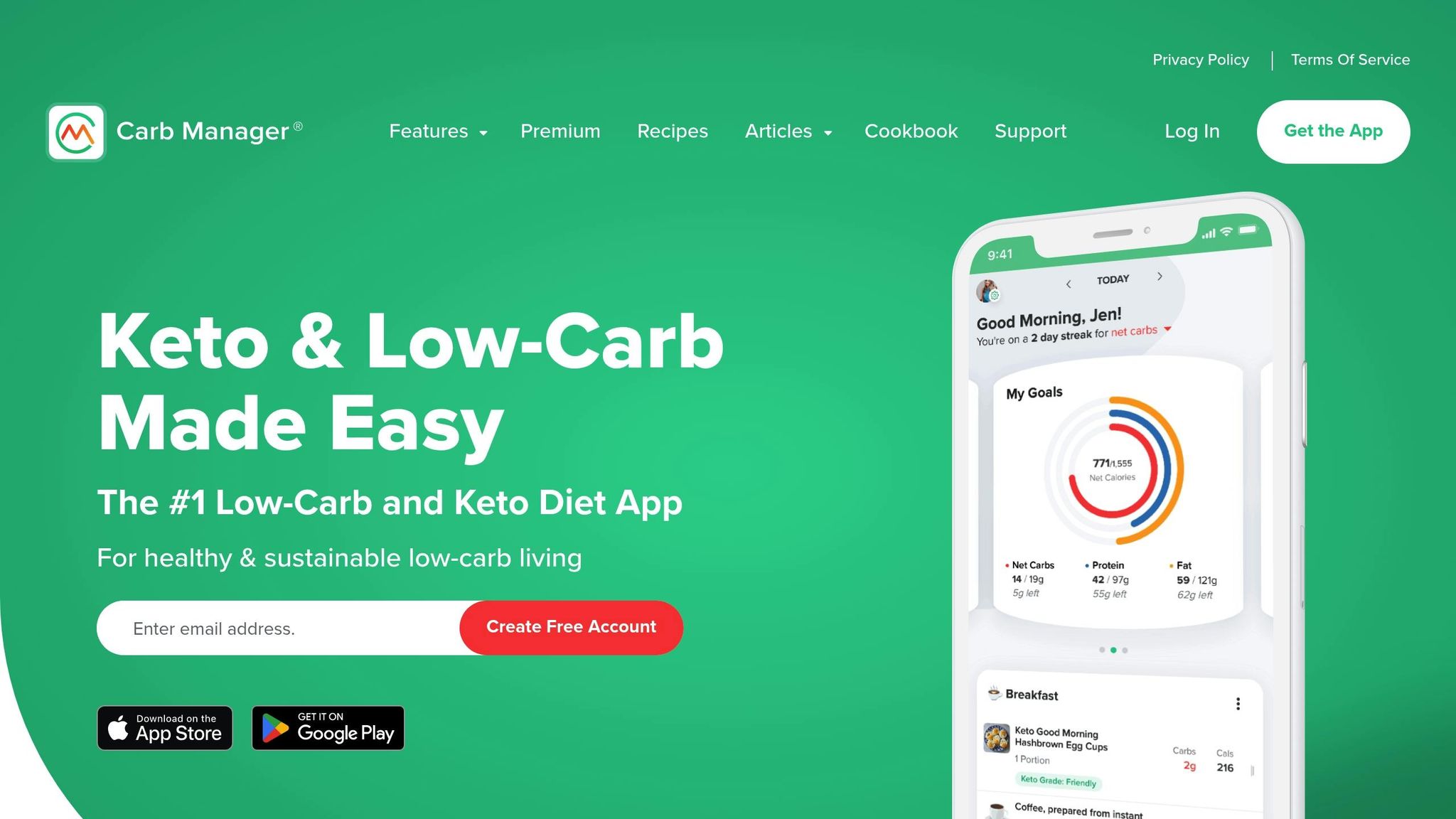
- Carb Manager: Ideal for low-carb diets, with free macro tracking and barcode scanning, but AI photo logging is premium-only.
- FatSecret: Free barcode scanning and nutrient tracking, but AI scanning is limited to premium users.
Quick Comparison
| App | Free AI Scanning | Barcode Scanner | Food Database Size | Free Macro Tracking | Premium Features Needed for AI Scanning |
|---|---|---|---|---|---|
| MyFitnessPal | No | Yes | 20+ million foods | Yes | Yes |
| MyNetDiary | Yes | Yes | 1+ million foods | Yes | No |
| SnapCalorie | Yes | Yes | Extensive | Yes | No |
| Carb Manager | No | Yes | Large | Yes (carb-focused) | Yes |
| FatSecret | No | Yes | 1.9+ million foods | Yes | Yes |
If you want free AI scanning, SnapCalorie and MyNetDiary are top choices. For database size, MyFitnessPal leads but with limited free features. Choose based on your goals - calorie tracking, low-carb focus, or detailed nutrient analysis.
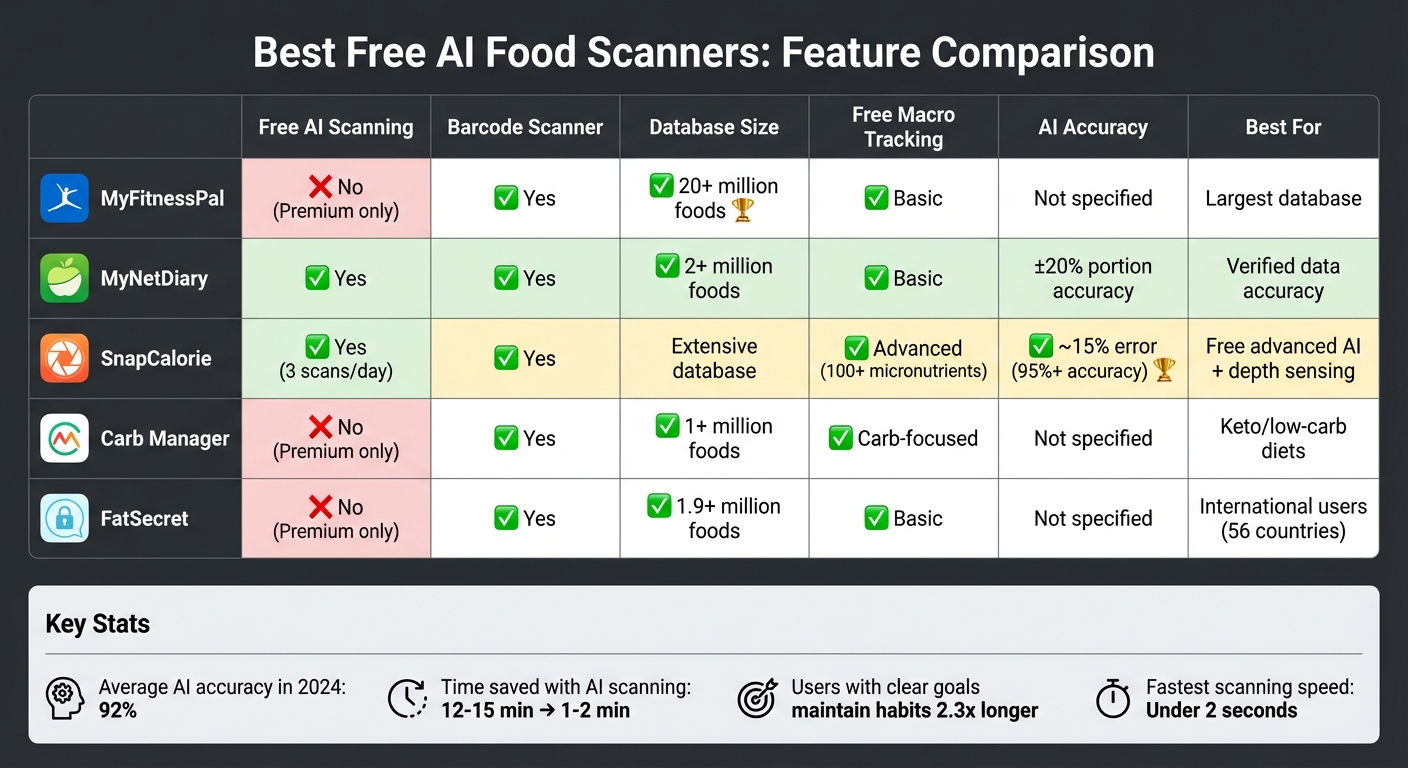
Free AI Food Scanner Apps Comparison Chart: Features and Limitations
1. MyFitnessPal
AI Food Scanning Capability
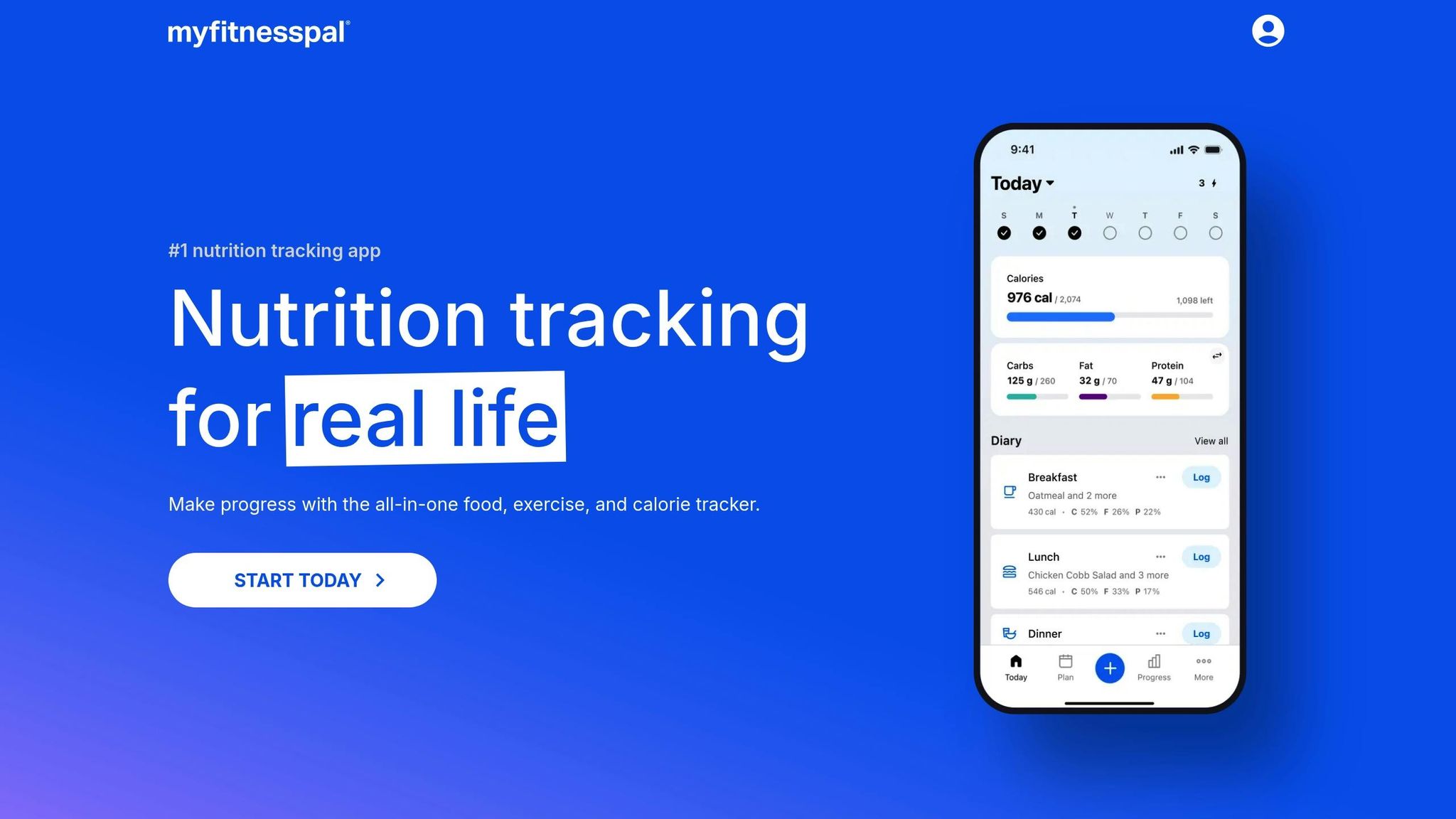
MyFitnessPal's Meal Scan feature uses advanced machine learning and computer vision to identify food items in real time. With this tool, you can point your smartphone at your plate to recognize multiple foods at once or upload a photo later if you're using iOS in the U.S.. The AI behind this feature has been trained on millions of images, enabling it to identify thousands of food items. After scanning, the app generates a list of suggestions, which you need to confirm before logging your meal.
Michael La Guardia, Senior VP of Product at MyFitnessPal, explains: "We're trying to make logging as effortless as possible, similar to how AI meal planning with pantry integration streamlines kitchen management. We want to help more people be mindful of their nutrition and successfully change their habits".
For the best results, ensure all ingredients are clearly visible. For blended dishes like soups or smoothies - or recipes with hidden components such as oils or sauces - the Voice Log feature is a better alternative. Let’s now dive into how MyFitnessPal leverages barcode scanning and its large community database for logging.
Barcode Scanning and Database Size
MyFitnessPal's barcode scanning feature makes logging packaged foods incredibly easy, offering precise matches almost instantly. The app supports a vast community, with users logging more than 6,000 meals every minute. However, as of October 1, 2022, barcode scanning became a Premium-only feature. To get the most accurate results, make sure the entire barcode fits within the camera’s scanning frame.
Macro and Micronutrient Tracking
The free version of MyFitnessPal provides a breakdown of daily totals for carbohydrates, fats, and proteins in both grams and percentages. A dedicated Macros tab displays a pie chart showing how your calorie intake is divided among these three nutrients in Day View. Additionally, the Nutrients tab tracks vitamins and minerals, comparing your intake to daily goals. Premium subscribers, priced at $19.99/month or $79.99/year, unlock additional features like custom macro tracking (by gram or percentage), meal-by-meal macro breakdowns, and a Net Carbs Mode, which automatically subtracts fiber to calculate net carbs. While these features are helpful, the free tier does come with several limitations.
Free Tier Limitations
Certain features, like Meal Scan and Barcode Scan, are exclusive to Premium users. Free-tier users can still log basic food and water intake, track weight, and maintain exercise journals, but they’ll encounter ads. Since much of the food database is crowdsourced, users may need to double-check serving sizes and nutrient information against actual packaging. The free version also lacks custom macro goals and automatically adds burned exercise calories back to your daily calorie budget.
2. MyNetDiary
AI Food Scanning Capability
MyNetDiary's AI Meal Scan uses advanced technology to identify multiple food items in a dish - down to toppings and sauces - while estimating portions and calculating nutrition based on a verified food database. Unlike apps that rely on crowdsourced data, MyNetDiary ensures accuracy by exclusively using a verified database.
Sergey Oreshko, CEO of MyNetDiary, explains: "AI Meal Scan allows users to log meals in seconds with unmatched accuracy, by combining the latest AI advancements with our verified food database".
The app can calculate up to 107 nutrients with portion accuracy within ±20%. To get the best results, use good lighting, a neutral background, and include a utensil or your hand for scale. For flat foods like pancakes, take the photo from directly above, while for deeper dishes like stew, a 45-degree angle works better. Beyond photo recognition, MyNetDiary also includes a powerful barcode scanner, further enhancing its food database.
Barcode Scanning and Database Size
In addition to its AI scanning, MyNetDiary offers a free barcode scanner that taps into an expansive, verified database. This database contains over 2,000,000 food items, including nearly 899,000 UPC barcodes for packaged foods. It spans items from the United States, Canada, the United Kingdom, and Australia, as well as data from 2,423 restaurants and 3,478 vendors.
The app also features a PhotoFoods service, where users can upload photos of food packaging and nutrition labels. The MyNetDiary team manually verifies and adds this information, often within 24 hours, and extracts up to 45 specific nutrients from a single label. For packaged foods, the barcode scanner typically provides more precise nutrition details than AI photo scanning, as it pulls data directly from the product label.
Macro and Micronutrient Tracking
The free version of MyNetDiary includes basic calorie counting and tracks essential macronutrients - carbohydrates, fats, and protein. It also offers features like water logging and an exercise tracker. Premium users, however, gain access to tracking 108 macro and micronutrients, including vitamins, minerals, omegas, and amino acids. Premium membership also includes advanced macro planning, allowing users to set specific targets by grams or percentages.
"Rather than relying on guesswork, the AI food scanner offers objective data about calories, macronutrients, vitamins, and minerals in your meals".
Free Tier Limitations
Free-tier users benefit from the barcode scanner and basic macronutrient tracking without ads. However, they have limited AI Meal Scans, cannot sync fitness trackers, and miss out on features like recipe importing and advanced AI tools. Premium membership, which costs $5 per month, unlocks these additional benefits. While the barcode scanner is generally reliable, some users have noted occasional difficulties with less common items. In such cases, the PhotoFoods upload service serves as a valuable alternative.
3. SnapCalorie
AI Food Scanning Capability
SnapCalorie takes a unique approach to calorie tracking by incorporating depth sensors to measure food volume - addressing one of the biggest challenges in accurate calorie estimation. This feature works alongside the instant tracking capabilities found in other leading apps. Developed by former Google AI researchers, the app's AI was trained on 5,000 dishes with precisely measured ingredients. The technology behind SnapCalorie was peer-reviewed and presented at the Conference on Computer Vision and Pattern Recognition (CVPR), an event known for its rigorous standards, rejecting 75% of submissions.
The AI system can identify every item on your plate and immediately provide a breakdown of calories, protein, carbohydrates, and fats. For ingredients that aren’t immediately visible, like oils or sugars, the algorithm makes educated guesses based on visual cues - such as recognizing oily textures on vegetables - and averages for that type of dish.
"Our photo calorie counter is approximately twice as accurate as visually estimating portion sizes", states Perception Labs, Inc.
SnapCalorie boasts an average caloric error of about 15%. For comparison, professional dietitians average a 40% error, app users 53%, and even nutrition labels can have up to 20% error. For a 500-calorie meal, this means an error margin of ±80 calories on an iPhone Pro with LiDAR or ±130 calories on a standard iPhone. The app also includes features like barcode scanning and the ability to extract data from photographed nutrition labels.
Macro and Micronutrient Tracking
Beyond calorie estimates, SnapCalorie provides detailed nutrient tracking. It monitors all macronutrients and over 100 micronutrients, including vitamins and minerals, using verified data from the USDA database. The AI delivers specific nutritional insights for each food item on your plate. Users can also add voice notes to specify hidden ingredients, like oils, or describe cooking methods for more precise analysis. Logging meals with the AI scanner is five times faster than manual entry, making it especially handy when eating out, where weighing portions isn’t practical.
Free Tier Limitations
The free version of SnapCalorie allows up to three AI-powered photo logs per day. For those who eat more than three meals or snacks daily, this limit might feel restrictive. However, basic food logging and barcode scanning are available without a subscription. The app’s standout feature - LiDAR depth sensing for precise volume measurements - is exclusive to iPhone Pro models. While the app is available for Android, integration with wearable fitness trackers through Apple Health was still in progress as of early 2026. Users can also manually adjust AI predictions, such as correcting cooking oil estimates, if needed.
4. Carb Manager
AI Food Scanning Capability
Carb Manager's "Snap" feature is a standout tool for Premium users, utilizing AI-powered image recognition to identify foods and predict their nutrient content from a simple photo. According to Carb Manager, "In Carb Manager Premium, you can log your food by simply taking a picture of it", showcasing its forward-thinking approach. Additionally, users can log meals hands-free by saying, "Hey Carb Manager". For those using the Carb Manager Keto Diet Cookbook, the app includes a dedicated QR code scanner, enabling users to log entire recipes instantly. This feature complements its barcode scanning function, providing a comprehensive way to track meals accurately.
Barcode Scanning and Database Size
Carb Manager's barcode scanning feature is another powerful tool. By scanning UPC or EAN barcodes, users can access nutrition data from a massive database of over 1,000,000 foods. This includes commonly consumed items verified by the USDA and University of Minnesota, as well as branded products from the US, Canada, UK, and Australia. What makes Carb Manager especially useful for ketogenic dieters is its inclusion of "Keto grades" for many foods, helping users quickly determine if an item aligns with their dietary goals. The app also allows users to log entire recipes via a QR code scanner and create custom food entries when needed.
Macro and Micronutrient Tracking
Even on the free tier, Carb Manager provides robust tracking options. Users can monitor essential macronutrients - like carbs (net, total, and diabetes-specific counts), protein, fat, and calories - along with a variety of micronutrients, including vitamins and minerals. The app has earned praise for its ease of use and effectiveness in low-carb tracking. One user shared, "Carb Manager made it effortless to maintain ideal macros". Free users can also filter food searches based on their preferred macro ratios, making it easier to stick to specific dietary plans.
Free Tier Limitations
While the free version includes barcode scanning, voice logging, and macro tracking, some features are reserved for Premium subscribers. The AI photo logging feature ("Snap") is exclusive to Premium users. Free users can access three "Premium recipes of the day" on the Daily Log page, but Premium subscribers unlock the full recipe collection, advanced meal planning tools, custom meal grouping, and auto-generated shopping lists.
5. FatSecret
AI Food Scanning Capability
FatSecret's Smart Food Scan uses advanced AI to recognize meals through images. Just snap a picture, and the app identifies the items using its verified nutrition database. It can even handle multiple foods in a single image, distinguishing between generic items and branded products. Plus, it uses natural language processing for interpreting text or voice inputs. Available in 56 countries and supporting 24 languages, recent updates have reduced response times by 80%, making it five times faster. Each scan provides detailed insights, including calorie counts, macronutrients, micronutrients, allergens, and dietary preferences.
Barcode Scanning and Database Size
FatSecret also excels with its barcode scanning feature. Its global database includes over 1.9 million verified food items - covering generic, branded, supermarket, and restaurant foods - with a barcode scanner that boasts over 90% global UPC/EAN coverage.
Sarah Jenkins, a verified user, shared, "fatsecret is the only one that doesn't hide essential features like the barcode scanner behind a paywall".
This database, divided into 56 localized datasets, ensures accurate scanning and includes over 17,000 international recipes with full nutritional details. Together, these features make food logging quick and reliable, rivaling other top free apps.
Macro and Micronutrient Tracking
FatSecret goes beyond basic calorie counting by offering detailed nutrient tracking. The free version tracks calories along with the three primary macronutrients - carbs, protein, and fat - displayed in pie charts for an easy daily breakdown. Users can also monitor micronutrients like fiber, sugar, sodium, cholesterol, potassium, calcium, iron, and vitamins A and C. The app provides data for entire days, individual meals, and specific foods.
Additionally, FatSecret syncs seamlessly with platforms like Apple Health, Google Fit, and Fitbit, automatically integrating exercise and weight data. With over 31 million users worldwide and a 4.8/5-star rating on the Apple App Store, it’s praised for keeping key features free and accessible.
Free Tier Limitations
While the free version covers essential barcode scanning and image recognition, features like Smart Food Scan and the Smart Assistant (for voice logging) are Premium-only. Free users also miss out on water tracking, custom meal headings, and dietitian-created plans for specific diets like Keto or Mediterranean. Even so, the free tier offers strong core tracking tools, making it a solid option for everyday nutrition management.
I Tested AI Meal Scans, and The Results Are SHOCKING!
Comparison Table
Here's a quick breakdown of the key features of free AI food scanner apps, making it easier to see how they stack up against each other.
| App | AI Scanning Capability | Barcode Scanner | Database Size | Macro Tracking | Free Tier Limitations |
|---|---|---|---|---|---|
| MyFitnessPal | Premium only | Yes | 20+ million foods (largest) | Yes | AI photo scanning and some features require a subscription |
| MyNetDiary | Free | Yes | Over 1 million foods | Yes | Advanced meal planning and customization need a subscription |
| SnapCalorie | Advanced (developed with Google AI tech) | Yes | Extensive food database | Yes, including 100+ micronutrients | Entirely free |
| Carb Manager | Free | Yes | Large food database | Yes (carb-focused) | Some advanced tracking features require a subscription |
Here’s the gist:
- MyFitnessPal boasts the largest food database, but its AI scanning is locked behind a paywall.
- SnapCalorie stands out for its advanced AI capabilities and being completely free.
- MyNetDiary and Carb Manager offer robust free options, with upgrades available for more tailored features.
If you're looking to save time, AI scanning and AI meal planning tools can cut logging from 12–15 minutes down to just 1–2 minutes. Depending on whether you value database size, advanced scanning, or a no-cost experience, there's an app to fit your needs.
Conclusion
When choosing an AI food scanner, focus on what matters most to you. If detailed micronutrient tracking is your priority and you're looking for a no-cost option, SnapCalorie offers over 95% accuracy without any fees. For those following low-carb or keto diets, Carb Manager excels with its specialized net carb tracking. Meanwhile, MyFitnessPal remains a favorite due to its extensive food database, though many advanced AI scanning features require a premium upgrade.
Speed is another key factor. Some scanners can analyze meals in under 2 seconds, making them ideal for users seeking fast, hassle-free tracking. If you're monitoring micronutrients for medical purposes or want a deeper nutrient breakdown beyond basic macros, look for apps that provide a more detailed analysis.
AI food recognition technology has come a long way, with accuracy now averaging 92% as of 2024. However, even the most advanced apps can miscalculate, particularly with complex dishes. Mixed meals, for example, can sometimes lead to calorie overestimations of up to 49%. To ensure accuracy, it's a good idea to double-check AI results and manually input data for homemade recipes with multiple ingredients.
A practical approach is to download two or three apps and test them with meals you eat regularly. Stick with the app that performs best for at least 30 days to build a consistent tracking habit. For optimal results, take photos of your meals with proper lighting and angles to help the AI identify your food more accurately.
Interestingly, users with clear tracking goals guided by AI tend to maintain their nutrition habits 2.3 times longer than those without. Whether you're counting calories, managing a health condition, or simply aiming to eat more mindfully, there's a free AI food scanner out there that fits your needs. Try out a few options with your daily meals and find the one that works best for your lifestyle.
FAQs
How accurate are AI food scanners with mixed meals?
AI food scanners tend to struggle with mixed or homemade meals, often showing errors in the range of 10% to 40%. The complexity of the dish, the quality of the photo, and the presence of hidden ingredients all play a role in these inaccuracies. However, results tend to improve when the food is simpler and the images are clearer.
What photo tips improve AI scan results?
To get better AI scan results, make sure your plate is centered in the frame and well-lit. Use clear photos with minimal shadows, and keep the area around the food free from clutter. Good lighting is key - it allows the AI to analyze important visual details like the food's shape, color, and texture. Following these tips can make the scanning process quicker and more accurate.
Should I scan a barcode or take a photo?
Both approaches are effective for tracking food and nutrition but cater to different scenarios. Barcode scanning works quickly and is perfect for packaged items, delivering instant nutritional information. On the other hand, photo-based scanning is more flexible, capable of identifying homemade dishes, fresh ingredients, and meals from restaurants. If you're logging packaged goods, barcodes are your go-to. For everything else, photos provide a broader and more adaptable option.