Best Materials for Food Storage Containers
• Updated
Food storage containers come in four main materials: glass, plastic, stainless steel, and silicone. Each has unique strengths and limitations, impacting safety, durability, portability, and environmental impact. Here's a quick breakdown to help you get started with meal planning:
- Glass: Non-toxic, long-lasting, and recyclable, but heavy and fragile. Ideal for reheating and home storage.
- Plastic: Lightweight, affordable, and portable, but prone to chemical leaching and short lifespan. Best for on-the-go use.
- Stainless Steel: Durable, non-toxic, and recyclable, but not microwave-safe and opaque. Great for long-term use and travel.
- Silicone: Flexible, heat-resistant, and space-saving, but can absorb odors and may leak under pressure. Perfect for freezer-to-oven use.
Quick Tip: Use a mix - glass for reheating, stainless steel for durability, and silicone for flexibility. Avoid cracked or scratched plastic to ensure safety.
6 Sustainable Food Storage Containers - Which Plastic-free Materials You Should Prioritize
1. Glass
Glass containers have become a favorite choice for meal prep, largely because they don’t interact chemically with food. This means you can store even acidic items like tomato sauce, citrus fruits, or vinegar-based dressings without worrying about chemicals like BPA or phthalates leaching into your meals.
Safety and Non-Toxicity
Glass is non-porous, which means it doesn’t absorb odors, flavors, or stains. As SafeKitchn highlights:
"Glass is completely non-reactive, meaning it will never leach chemicals into your food regardless of temperature, acidity, or how long food is stored."
It’s also microwave and oven safe. Tempered soda-lime glass can handle temperatures up to 450°F, while borosilicate glass can go as high as 950°F.
But glass isn’t just about safety - it’s built to last.
Durability
With proper care, glass containers can last anywhere from 5 to 10 years. They don’t warp in the microwave or break down under high heat. While glass is inherently fragile, drop tests show that most models hold up well, with breakage being the exception rather than the rule. To avoid cracks or shattering, let refrigerated glass containers reach room temperature before heating to prevent thermal shock.
Glass’s long lifespan also ties into its environmental benefits.
Environmental Impact
Glass stands out as a sustainable option in the kitchen. It’s 100% recyclable and can be recycled repeatedly without losing quality. Compare this to plastic: only about 9% of the 6,300 metric tons of plastic waste produced in 2015 was recycled. Epicurious sums it up perfectly:
"With care, glass containers will last almost indefinitely, and if you do discard of them, they're 100 percent recyclable."
Portability
The main downside? Glass is heavy, which makes it less ideal for carrying lunches or traveling. If you’re using tools like Honeydew Recipe Manager to plan your meals, think about whether you’ll need to transport your containers often or if they’ll mostly stay at home.
2. Plastic
Plastic containers are a budget-friendly option, costing around $2–$5 each or $15–$25 for a 10-pack. Premium options, like the Rubbermaid Brilliance 10-piece set (priced at about $26.99), stand out for their tight seals and leak-proof design.
Portability
Plastic shines when it comes to portability. Its lightweight and shatter-resistant qualities make it perfect for carrying kids' lunches, work meals, or picnic snacks. For those using tools like the Honeydew Recipe Manager to organize meals, plastic containers provide a convenient way to transport food. However, this convenience often comes at the expense of long-term durability.
Durability
Plastic containers may not break when dropped, but they typically last only 2–3 years. High-quality versions can endure up to 100 washes before succumbing to stains, odors, or warping. Jane Muncke, Managing Director of the Food Packaging Forum, notes:
UV radiation can break the molecular bonds in the polymer and make it brittle.
It’s time to replace your containers if they become cloudy, scratched, or if the lids stop sealing properly.
Safety and Non-Toxicity
Most plastic containers today are BPA-free. To ensure safety, check for recycling codes #2 (HDPE), #4 (LDPE), or #5 (PP) on the bottom, as these are considered safer for food use. Avoid containers with codes #3 (PVC), #6 (PS/Styrofoam), or #7 (Other), as they’re more likely to leach harmful chemicals. Heat also plays a role in chemical migration, so avoid pouring boiling-hot food into plastic containers. Jane Muncke highlights this concern:
The chemistry of plastic is very oil-like and very much aligned with fatty food... with the right temperature, the molecules could migrate into foods.
To reduce risks, hand wash plastic containers with warm, soapy water instead of using a dishwasher.
Environmental Impact
Plastic has a substantial environmental downside. Of the 6,300 metric tons of plastic waste generated in 2015, only 9% was recycled. Between 97% and 99% of polypropylene ends up in landfills because recycling it is both expensive and challenging. Polystyrene, often used for takeout containers, makes up about 35% of U.S. landfill waste and isn’t recyclable. Local recycling programs often accept only plastics labeled #1, #2, and #5, so always check what’s accepted in your area.
3. Stainless Steel
When it comes to food storage, stainless steel stands out with its own set of advantages that differentiate it from glass and plastic. While stainless steel containers come with a higher upfront cost compared to plastic, they’re built to last for decades, making them a solid long-term investment. Food-grade stainless steel, particularly Grade 304 (commonly labeled as 18/8 or 18/10), contains 18% chromium and 8–10% nickel, offering excellent resistance to rust.
Durability
Stainless steel is tough - no shattering, warping, or breaking under pressure. It can handle extreme temperatures effortlessly, allowing you to transfer it from the freezer to the oven (without the lid) without worry. Plus, its non-porous surface resists micro-cracks, ensuring long-term reliability. Food writer and editor Kelly Vaughan highlights its practicality:
"They're also highly durable, eco-friendly, and dishwasher safe, which makes clean-up a breeze. They may show scuff marks or scratches eventually, but this is only cosmetic and won't affect the performance of the container."
However, storing highly acidic foods like citrus juices or tomato sauce for extended periods can cause slight surface damage, known as pitting. Despite this, its durability and safety make it a dependable choice.
Safety and Non-Toxicity
One of stainless steel’s biggest strengths is its chemical stability. It doesn’t leach harmful substances like BPA or phthalates into your food, even when exposed to heat. SafeKitchn reinforces this point:
"Stainless steel is completely non-reactive, meaning it will never leach chemicals into your food regardless of temperature, acidity, or how long food is stored."
Its smooth, non-porous surface also resists bacterial growth, as most microorganisms can’t survive on it for long. That said, stainless steel isn’t microwave-safe - it reflects microwaves, creating a fire hazard.
Portability
Stainless steel strikes a balance between the weight of glass and the fragility of plastic, making it a great option for meals on the go. Lighter than glass and virtually unbreakable, it’s perfect for school lunches, work meals, and outdoor adventures. Using these durable containers can help with smarter ingredient prep during your weekly routine. The only downside is its opacity - you’ll need to either label the container or open it to see what’s inside.
Environmental Impact
Stainless steel is a champion of sustainability. It’s 100% recyclable and can be reused indefinitely. Incredibly, about 75% of stainless steel products made over a century ago are still in use today. By choosing stainless steel, you cut down on single-use plastics and reduce waste in landfills and oceans. While the initial cost may be higher, its unmatched longevity ensures you won’t need to replace it every few years, unlike plastic containers.
4. Silicone
Silicone stands out for its flexibility and ability to handle high temperatures without breaking down over time. Food-grade silicone can endure a wide temperature range, from -80°F to 450°F, making it suitable for everything from freezer storage to oven use. Prices for silicone containers typically range from $10 to $15, with premium sets costing around $48. Its unique characteristics make it a practical choice for efficient meal prep and kitchen organization.
Durability
One of silicone's greatest strengths is its flexibility. Unlike glass, which can crack under sudden temperature changes, silicone is resistant to thermal shock. It also outlasts plastic, which tends to degrade after repeated heating. High-quality silicone containers can last 4–5 years, offering better longevity than plastic. While silicone is less prone to staining, it can sometimes absorb strong odors from spices like curry or garlic. A quick fix? A baking soda paste does the trick for removing lingering smells.
Safety and Non-Toxicity
Food-grade silicone is non-toxic and free of harmful chemicals like BPA, phthalates, lead, and PVC. Even when exposed to high heat in ovens or microwaves, it won’t leach chemicals into your food. To ensure you're buying pure silicone, try the "pinch test": twist a flat section of the material - if it turns white, it likely contains plastic fillers. For added peace of mind, look for LFGB-certified or FDA-approved products, as these meet strict safety standards.
Portability
Silicone is lightweight, and many containers are designed to collapse flat, saving up to 80% of storage space. This makes them a great option for packed lunches, camping, or kitchens with limited storage. The collapsible feature also means you can carry multiple containers without the bulk of more rigid materials like glass or stainless steel.
Environmental Impact
Silicone is a more eco-friendly choice compared to plastic. It doesn't break down into microplastics, which are a growing environmental concern. When incinerated, food-grade silicone decomposes into silicon, water, and carbon dioxide without releasing harmful fumes. Ushma Pandya Mehta, cofounder of Think Zero, highlights the importance of long-term use:
"The key is to replace the single-use plastic bag and to use the silicone ones for a long time."
While silicone recycling requires specialized facilities that aren't as common as those for plastic or glass, its durability means you'll need to replace it far less often. Given that Americans threw away about 4.2 million tons of plastic shopping and food storage bags in 2018 - an average of 26 pounds per person - switching to reusable silicone containers can help reduce waste significantly.
Advantages and Disadvantages
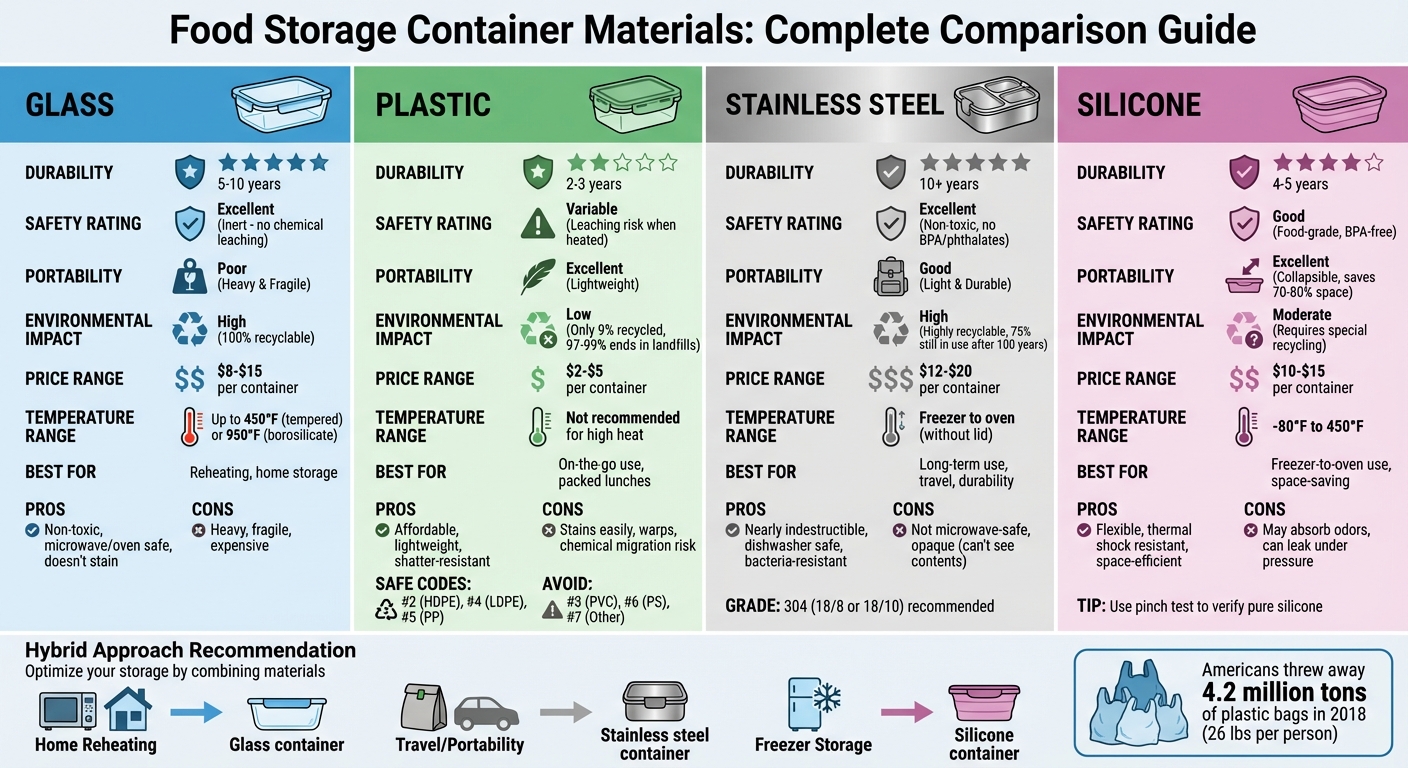
Food Storage Container Materials Comparison: Glass vs Plastic vs Stainless Steel vs Silicone
When choosing storage materials for your kitchen, understanding the trade-offs can help you build an efficient system that suits your meal prep and storage needs. Here's a breakdown of the key strengths and weaknesses of each material discussed earlier.
Glass stands out for its safety - it’s completely inert, meaning it won’t leach chemicals into your food - and it has a lifespan of 5–10 years. Plus, it’s fully recyclable. However, glass is heavy, fragile, and costs around $8–$15 per container. Bernie Deitrick from Consumer Reports shared that the Caraway glass model shattered during a drop test from 36 inches onto a linoleum-covered concrete floor. While its safety and sustainability are strong points, its fragility and cost can be drawbacks.
Plastic is the go-to option for affordability and portability, with prices ranging from $2–$5 per container. It’s lightweight and impact-resistant, making it a practical choice for packed lunches. On the downside, it degrades quickly (lasting only 2–3 years), stains easily, and poses risks of chemical migration when heated. Leanne Stapf, COO of The Cleaning Authority, cautions:
Chemicals can 'leak' out of the plastic when heating up.
These factors make plastic a convenient but short-term solution, especially for on-the-go use.
Stainless steel is incredibly durable, lasting over 10 years, and it’s non-toxic, eliminating any chemical concerns. It’s lighter than glass and nearly indestructible, with a price range of $12–$20 per container. Its main limitations? You can’t see the contents without opening it, and it’s not microwave-safe. For those prioritizing longevity and safety, stainless steel is a solid choice.
Silicone offers unique advantages like collapsible designs that save up to 70–80% of storage space. It’s versatile, handling extreme temperatures - from the freezer to the oven (up to 450°F) - and typically costs $10–$15 per container. Silicone lasts 4–5 years, but Bernie Deitrick noted that all tested silicone models leaked under pressure. While space-saving and heat resistance are standout features, leakage issues might be a concern for some.
Here’s a quick comparison of these materials:
| Material | Durability | Safety | Portability | Environmental Impact | Price Range |
|---|---|---|---|---|---|
| Glass | 5–10 years | Excellent (Inert) | Poor (Heavy/Fragile) | High (100% recyclable) | $8–$15 |
| Plastic | 2–3 years | Variable (Leaching risk) | Excellent (Lightweight) | Low (Landfill waste) | $2–$5 |
| Stainless Steel | 10+ years | Excellent (Non-toxic) | Good (Light/Durable) | High (Highly recyclable) | $12–$20 |
| Silicone | 4–5 years | Good (Food-grade) | Excellent (Collapsible) | Moderate (Special recycling) | $10–$15 |
Many households are adopting a hybrid approach: using glass containers for home storage and reheating, while relying on plastic or stainless steel for portability and travel. This strategy allows you to capitalize on each material’s strengths while sidestepping their limitations, making it easier to tailor your choices to your specific kitchen needs.
Conclusion
When choosing food storage containers, think about what matters most to you. Glass and stainless steel are great for safety and durability, BPA-free plastic is a budget-friendly option, and silicone works well if you need something flexible and space-saving. From an environmental standpoint, glass and stainless steel tend to have a lower overall impact compared to plastic.
To get the best of all worlds, consider a mix-and-match approach: glass for reheating, stainless steel for portability, and silicone for freezer storage. As the Zenda Guide Editorial Board notes:
Glass is the gold standard for safety. Silicone is also excellent for freezer and fridge. Stainless steel is durable but not microwave-safe.
Smart food storage starts with good meal planning. Knowing what you’ll cook for the week helps you pick the right container sizes and materials, cutting down on food waste and keeping your kitchen tidy. Tools like the Honeydew Recipe Manager (https://honeydewcook.com) can make this even easier by letting you save recipes from social media, create grocery lists sorted by store sections, and plan meals in just a few clicks.
To keep your containers in top shape, label them with dates, follow the "first in, first out" rule, and replace any plastic that’s cracked or cloudy. For glass and stainless steel containers, take care of the lids - hand-wash them or place them on the top rack of the dishwasher to keep seals intact, as lids often wear out faster than the containers themselves.
FAQs
What is the safest material for storing acidic foods?
Glass is an excellent choice for storing acidic foods because it doesn't react with them. Unlike some other materials, glass won’t release any chemicals or change the taste of your food, no matter how acidic it is.
How can I reduce chemical exposure when using plastic containers?
To reduce exposure to harmful chemicals, skip heating food in plastic containers. Heat can cause substances like BPA and phthalates to seep into your food. Instead, opt for safer options such as glass, stainless steel, or silicone for storing and heating food.
What’s the best container choice for leak-proof lunches?
When choosing containers for leak-proof lunches, focus on those with locking lids or screw-top lids. Containers featuring silicone gaskets and tight seals are especially effective at preventing spills and leaks. These details help keep your meals secure and your bags mess-free while on the go.