Bluetooth vs. WiFi Cooking Devices
• Updated
Choosing between Bluetooth and WiFi cooking devices depends on your cooking habits and needs. Bluetooth is ideal for short-range tasks like grilling or quick cooking, offering easy setup and longer battery life. WiFi, on the other hand, provides remote monitoring and greater control for longer, more complex cooking sessions like smoking or roasting.
Key Points:
- Bluetooth Devices: Short range (up to 165-250 feet), lower cost, easy setup, no internet needed, but limited by physical barriers like walls or smoker doors.
- WiFi Devices: Unlimited range via internet, advanced features like remote control and data logging, but requires stable WiFi, higher cost, and more power.
Quick Comparison:
| Factor | Bluetooth Devices | WiFi Devices |
|---|---|---|
| Range | Up to 165-250 feet, reduced by obstacles | Unlimited via internet |
| Setup | Simple pairing with phone | Requires WiFi setup and app permissions |
| Cost | Lower | Higher |
| Power Consumption | Low (longer battery life) | Higher (frequent charging or wall outlet) |
| Best For | Grilling, searing, camping | Smoking, slow roasting, remote monitoring |
If you need flexibility, hybrid devices like the ThermoPro TempSpike Pro combine both technologies. Whether you're grilling nearby or monitoring a brisket from across town, there's a device to match your style.
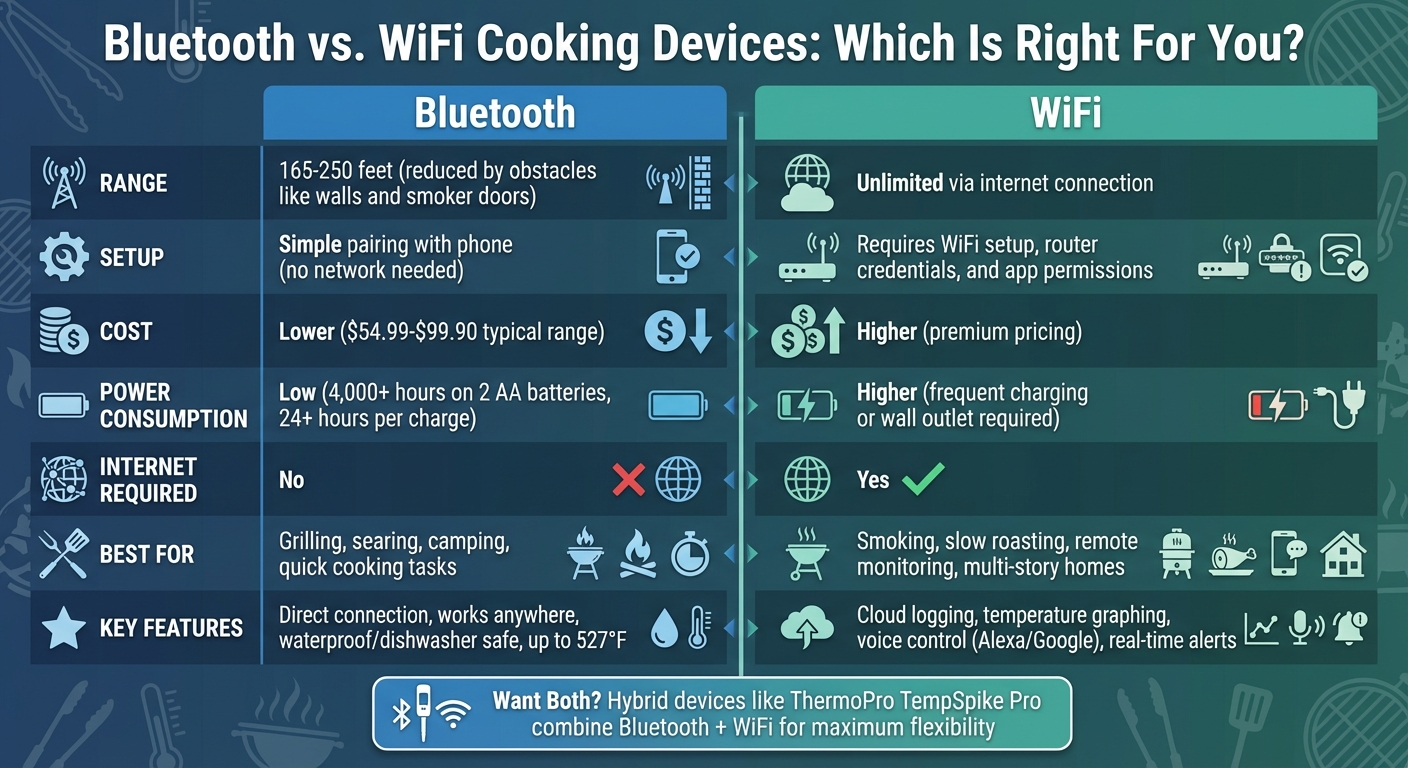
Bluetooth vs WiFi Cooking Devices Comparison Chart
I tested EVERY wireless thermometer and found the BEST and WORST ones!
What Are Bluetooth Cooking Devices?
Bluetooth cooking devices - like wireless meat thermometers, smart kitchen scales, and connected probes - use short-range radio waves to communicate with your smartphone or tablet. They operate on the 2.4 GHz frequency band and don’t require a router or internet connection. Instead, you simply power them on, open the app, and pair them through a quick security-key exchange.
Most of these gadgets rely on Bluetooth Low Energy (LE) technology, which helps conserve battery life. For instance, the ThermoWorks ThermaQ Blue can run for about 4,000 hours on just two AA batteries. Similarly, newer probes, such as those from MEATER, can last over 24 hours on a single charge. Now, let’s break down how these devices connect to your smartphone.
How Bluetooth Works in Cooking Devices
When you activate a Bluetooth cooking device, it establishes a direct connection with your phone or tablet. Operating in the 2.4 GHz band, these devices use adaptive frequency hopping to reduce interference from nearby electronics. Under ideal conditions, Bluetooth meat thermometers typically have a range of 100 to 200 feet, with some advanced models boasting up to 250 feet. However, in real-world use, that range can shrink significantly. As ChefsTemp points out:
"Bluetooth connection struggles with obstacles like oven and smoker doors. This means that the signal is drastically shortened, and many cooks had to be within ten feet of the thermometer to retain a consistent signal."
Metal barriers, like heavy smoker doors or walls, can dramatically reduce the range. For the best performance, it’s a good idea to keep your phone close to the cooking area.
Benefits of Bluetooth Cooking Devices
Bluetooth cooking gadgets come with several perks that make them appealing to home cooks. They’re generally more budget-friendly than WiFi-enabled models, and the setup is a breeze - no need to deal with network passwords or router configurations. This simplicity makes them ideal for small to medium kitchens or outdoor cooking spaces.
Bluetooth technology also shines in places where WiFi isn’t reliable. Whether you’re camping, tailgating, or competing in a barbecue contest, these devices keep you connected. Martin Earl, Culinary Editor at ThermoWorks, explains:
"Bluetooth thermometers allow you to record data and be somewhat connected in places where Wi-Fi cannot reach: competitions, camping, or in that corner of your yard that your router can't quite get to."
Additionally, many Bluetooth probes are designed to withstand tough conditions. They’re often waterproof, dishwasher safe, and capable of handling temperatures as high as 527°F. However, these conveniences come with a few limitations.
Drawbacks of Bluetooth Cooking Devices
Despite their advertised ranges of 165 to 250 feet, real-world performance often falls short, especially when physical barriers are involved. In many cases, you may only get a stable connection within 30 to 100 feet. This means you’ll need to stay relatively close to your cooking area to monitor progress effectively.
Connectivity issues can also arise. Pairing the device with your phone can sometimes be tricky, and maintaining a stable connection over long cooking sessions isn’t always guaranteed. Plus, interference from other Bluetooth devices and the constant connection can drain your phone’s battery faster than usual.
What Are WiFi Cooking Devices?
WiFi cooking devices - like smart pressure cookers, connected ovens, and meat thermometers - connect to your home network, allowing them to communicate through the cloud. Unlike Bluetooth gadgets that pair directly with your phone, these devices rely on your router and an Internet connection. This setup enables remote control and real-time updates, like notifications when your food is ready.
Some popular examples include the Instant Pot Smart WiFi, the KitchenAid 27-inch Smart Single Wall Oven, and ThermoWorks Signals, which features four temperature channels. With these devices, you can monitor your cooking, tweak settings, and get alerts - all through your smartphone, whether you're in the kitchen or not. Let’s dive into how these devices establish their connections.
How WiFi Works in Cooking Devices
To get started with a WiFi cooking device, you'll need to connect it to your home network by entering your router credentials. Once it's linked, the device communicates with the cloud, which syncs with your smartphone or tablet. This lets you monitor and control your cooking from virtually anywhere.
WiFi connectivity also opens the door to voice control features using assistants like Amazon Alexa or Google Assistant. On top of that, software updates keep your appliance equipped with the latest features. As Britannica explains:
WiFi allows devices to connect to the Internet... [it] is open to more devices and more users.
Some high-end devices, such as the ThermaQ WiFi thermometer, even take it a step further by logging and graphing temperature data over time for detailed analysis. MEATER highlights this feature:
One of the key features of our multi-probe MEATER models is the built-in WiFi and Cloud capability, which gives them the longest range out of our products.
To ensure smooth operation, make sure your kitchen has a strong 2.4 GHz WiFi signal, as many smart cooking devices require this frequency over the faster 5 GHz band. You'll also need to grant the app permissions for Local Network and WiFi access. These steps lay the groundwork for unlocking the advanced capabilities of WiFi cooking devices.
Benefits of WiFi Cooking Devices
WiFi cooking devices come with several perks, especially when compared to their Bluetooth counterparts. One standout advantage is their virtually unlimited range. As long as you have an Internet connection, you can control and monitor your appliances from anywhere. This makes them perfect for tasks like slow roasting or smoking meat, where you might want to step away while keeping tabs on your meal.
Beyond range, WiFi devices offer advanced control options. You can remotely preheat your oven, adjust cooking temperatures, manage pressure levels, or even start and stop cooking cycles - all from your phone. Real-time notifications keep you updated, so you’ll know exactly when your food is ready, even if you’re multitasking. Some smart ovens also include features like "Scan-to-Cook" and "Rapid Preheat".
WiFi devices integrate seamlessly with smart home systems, enabling hands-free control and automatic updates. Steve Gow from Smoke Trails BBQ describes the convenience:
The CHEF iQ is just a great wireless probe thermometer…It has built-in WiFi, so I always have a connection. It has great Bluetooth range when there's no internet available.
Drawbacks of WiFi Cooking Devices
While WiFi cooking devices offer convenience, they also come with some downsides. For starters, they tend to be more expensive than Bluetooth models. They also depend on a stable home network - if your Internet connection goes down, you lose remote access.
The setup process can be a bit of a hassle, requiring you to enter network credentials, create an account, and configure app permissions. Additionally, these devices consume more power than Bluetooth gadgets because they maintain a constant high-speed connection.
Some users also feel that the added features don’t drastically change the cooking experience. Molly Price, a former editor at CNET, noted:
Wi-Fi might bring peace of mind to anyone hesitant to leave their multicooker unmonitored, but overall the smarts don't revolutionize the way you'll use your Instant Pot.
She gave the device a 7.3/10 rating, pointing out that the inability to change cooking modes once started was a notable drawback.
Bluetooth vs. WiFi: Side-by-Side Comparison
Main Differences Between Bluetooth and WiFi
When deciding between Bluetooth and WiFi devices for your kitchen, it’s important to understand how they function. While both handle wireless communication, they serve different purposes. WiFi connects devices to a network or the Internet, allowing for remote access and advanced features. Bluetooth, on the other hand, is designed for direct communication between two devices without needing a network.
Here’s a quick breakdown of the key differences:
| Factor | Bluetooth Cooking Devices | WiFi Cooking Devices |
|---|---|---|
| Range | Short (typically 10–30 meters); walls can limit signal | Local (up to 46 meters) or virtually unlimited via cloud |
| Setup Difficulty | Easy; simple device pairing with your phone | Moderate; requires entering network credentials |
| Reliability | Strong for close-range use; no internet needed | Relies on router and internet stability |
| Power Consumption | Very low; batteries can last months or even years | Higher; often needs a wall outlet or frequent charging |
| Cost | Lower initial cost | Higher due to additional features |
| Typical Uses | Ideal for grilling, searing, or quick tasks | Best for smoking, slow roasting, or multitasking |
This table highlights the strengths and limitations of each technology, helping you narrow down which one aligns with your needs.
Which Technology Fits Your Kitchen?
Your choice between Bluetooth and WiFi ultimately depends on your cooking habits and kitchen setup. If you have a small kitchen or enjoy grilling outdoors, Bluetooth devices are a great fit. They’re easy to pair, have excellent battery life, and are perfect for quick cooking sessions when you’re nearby.
WiFi devices, however, shine in scenarios requiring extended monitoring, like a 12-hour smoked brisket. With features like remote access, temperature graphing, and cloud-based history, they’re ideal for more complex cooking tasks.
For those who want the best of both worlds, hybrid models are worth considering. Devices like the ThermoPro TempSpike Pro (TP980) combine Bluetooth for local monitoring with WiFi for long-range access. Just keep in mind that these dual-function devices are typically more expensive than single-technology options.
When to Use Bluetooth vs. WiFi Cooking Devices
When Bluetooth Devices Work Best
Bluetooth cooking devices shine in outdoor settings like grilling, camping, or barbecue competitions. They connect directly to your smartphone, offering a monitoring range of up to 165 feet without needing internet access. This makes them perfect for situations where WiFi might not be available.
Another big advantage? Affordability. Bluetooth thermometers are generally easier on the wallet. For example, the ThermoPro TempSpike TP960 costs about $54.99, while mid-range options like the Armeator A1 are priced around $99.90. Some models, like the ThermaQ Blue, even feature exceptional battery life - roughly 4,000 hours on just two AA batteries.
"Bluetooth thermometers allow you to record data and be somewhat connected in places where Wi-Fi cannot reach: competitions, camping, or in that corner of your yard that your router can't quite get to." - Martin Earl, Culinary Editor, ThermoWorks
Bluetooth devices are also great for quick cooking tasks. Their straightforward setup lets you pair with your phone in seconds, making them ideal for searing steaks, grilling chicken, or cooking burgers - no need to fuss with network credentials.
However, for tasks that require consistent, long-range monitoring, WiFi devices take the lead.
When WiFi Devices Work Best
WiFi thermometers are built for extended cooking sessions, offering continuous monitoring from virtually anywhere with an internet connection. Whether you're slow-smoking a brisket overnight or roasting a holiday turkey, WiFi lets you check temperatures remotely - perfect for multi-story homes where Bluetooth signals might struggle.
WiFi devices also come with advanced features like cloud-based data logging and temperature graphing. These tools allow serious home cooks to analyze past sessions, export detailed reports, and receive real-time alerts when food reaches its target temperature.
"Wi-Fi means unlimited range, so you can monitor your cook from anywhere with an internet connection, whether you're in the backyard or at the grocery store." - MEATER
Ultimately, the choice between Bluetooth and WiFi cooking devices depends on your cooking habits, the layout of your home, and whether you prioritize simplicity and cost or advanced remote monitoring capabilities.
Conclusion
When deciding between Bluetooth and WiFi for your wireless meat thermometer, it all comes down to your cooking style and needs. Bluetooth shines in proximity tasks, offering low power consumption and easy setup for quick, close-range cooking. On the other hand, WiFi steps up for long-range cooking, like smoking meat, with features like cloud logging and remote alerts - though it does require more power.
"The main factors to consider when purchasing a wireless meat thermometer are range, durability, and connectivity." - ChefsTemp
For those who want the best of both worlds, hybrid models combine the convenience of local Bluetooth backup with the extended reach of WiFi, giving you flexibility for any cooking scenario. Whether you're grilling a steak nearby or keeping tabs on a brisket from across the house, there's a wireless option to match your needs and elevate your kitchen game.
FAQs
What’s the difference between Bluetooth and Wi-Fi cooking devices?
Bluetooth and Wi-Fi cooking gadgets differ in how they connect and the distance they cover. Bluetooth devices link directly to your phone or tablet within a short range (usually 15–100 feet). They’re straightforward to set up and great for keeping an eye on things nearby. The downside? You’ll need to stay relatively close to the device.
Wi-Fi devices, however, connect via your home’s router, letting you monitor and control them from virtually anywhere with internet access. This makes them ideal for remote notifications, managing multiple devices, and using cloud-based apps. That said, Wi-Fi devices usually cost more and require a bit more effort to set up, like entering your network details.
If you’re just looking for simple, single-probe monitoring while you’re in the kitchen, Bluetooth is a solid option. But if you’re after advanced features or want to check on your cooking while you’re out and about, Wi-Fi is the way to go.
When is it better to use a Bluetooth cooking device instead of a WiFi one?
Bluetooth cooking gadgets are perfect if you're using just one or two appliances and staying nearby - usually within about 100 feet. They’re budget-friendly, simple to set up, and connect straight to your smartphone without requiring internet access.
On the flip side, WiFi cooking devices work best for larger setups or when you want to keep an eye on your appliances from anywhere - whether you're in another room or away from home. These rely on your home’s internet connection, making them great for handling more detailed cooking tasks or managing multiple devices at once.
Do any cooking devices use both Bluetooth and WiFi?
Some modern cooking gadgets, such as wireless grill thermometers, come equipped with both Bluetooth and WiFi capabilities. This dual connectivity lets you monitor your cooking up close using Bluetooth, while WiFi takes over for a longer range - perfect for keeping tabs on your food even if you leave the house. This combination of convenience and control is ideal for home cooks who want to stay on top of their grilling without being tied to the kitchen.