How to Check Ingredient Quality with AI Tools
• Updated
AI tools are changing how we evaluate food quality and safety, making it easier to identify hidden contaminants, allergens, and nutritional details. With apps like Honeydew Recipe Manager, you can scan food labels, analyze ingredients, and even plan meals using AI-powered insights. These tools help you make safer food choices, reduce waste, and save time with an AI-powered grocery shopping checklist.
Key Takeaways:
- Food Safety Stats: 600M people get sick annually from contaminated food; food fraud costs $40B globally.
- AI Accuracy: Tools achieve over 95% accuracy in detecting contaminants, allergens, and nutritional info.
- Features to Look For: Apps with dietary filters, label scanning, and meal planning integrations.
- Example: Honeydew Recipe Manager offers ingredient analysis, meal planning, and grocery list creation for $4.17/month.
AI simplifies food safety by turning your smartphone into a powerful analysis tool, ensuring every meal is safer and tailored to your needs.
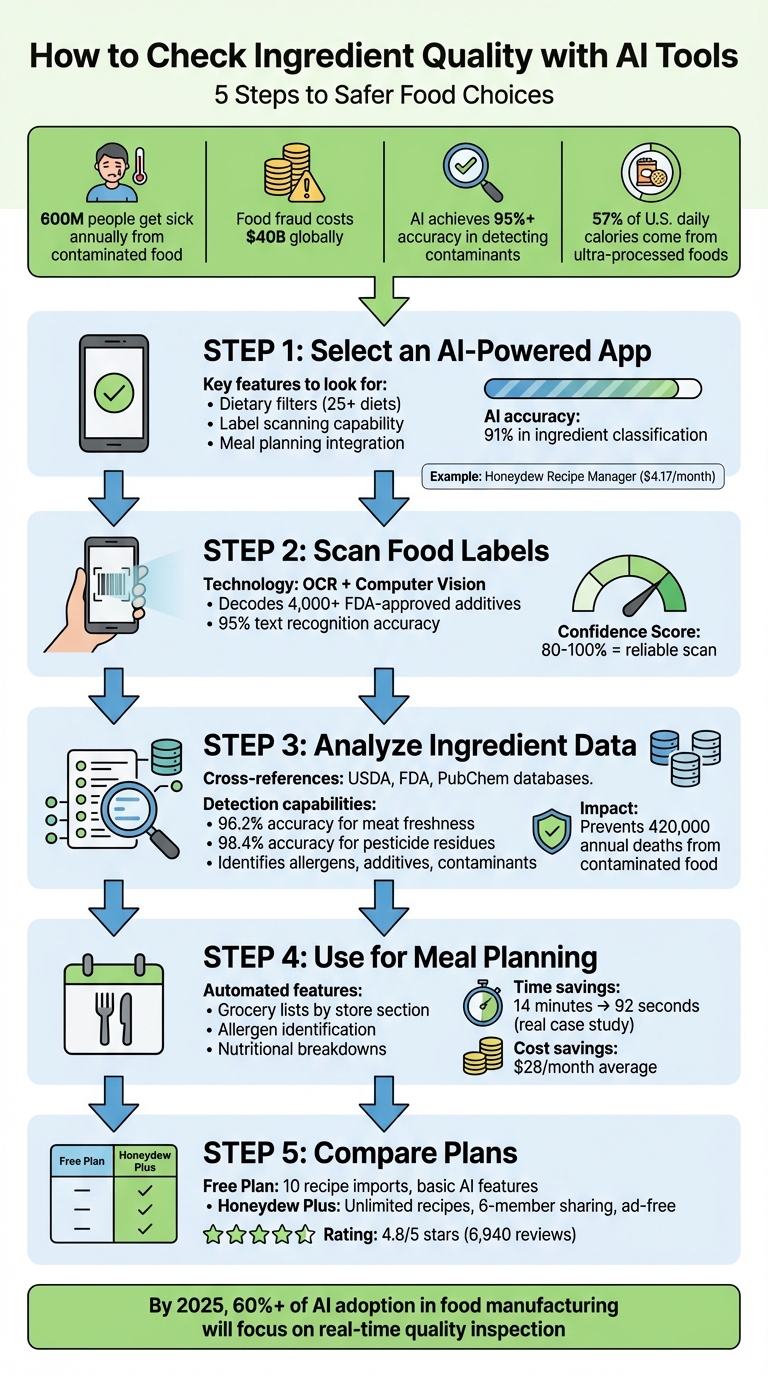
5-Step AI Ingredient Quality Check Process with Key Statistics
Step 1: Select an AI-Powered App for Ingredient Analysis
Why AI-Powered Apps Matter
An AI-powered app turns your smartphone into a mini food lab, capable of analyzing ingredient lists in just seconds. These tools are game-changers - they uncover hidden allergens, flag harmful additives, and make sense of complex labels that most of us would struggle to interpret. Considering that 57% of daily calories in the U.S. diet come from ultra-processed foods, having quick and reliable ingredient analysis at your fingertips can make a big difference for your health.
These apps rely on supervised machine learning models, achieving an impressive 91% accuracy in ingredient classification. Unlike manually reading labels, AI apps cross-check ingredients with trusted databases like the USDA and FDA. This not only explains each ingredient's purpose but also highlights potential health risks. This level of precision and speed makes these apps indispensable for making smarter food choices.
Key Features to Look For
When choosing an app, focus on features that align with your dietary needs and lifestyle. Look for apps that offer personalized dietary filters for over 25 diets, including Low FODMAP, Keto, and Vegan. Transparent scoring systems are another must-have, as they explain why certain products are flagged.
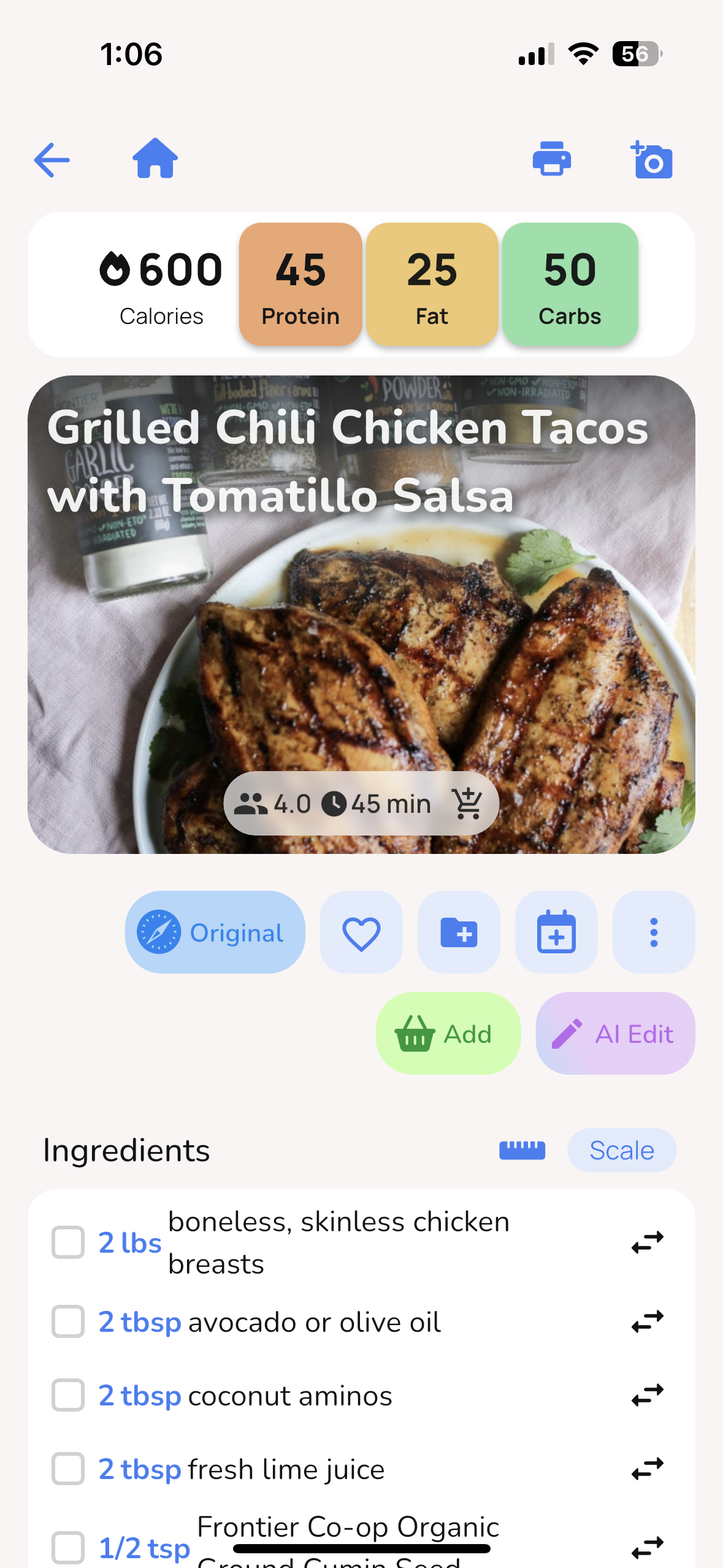
One standout option is Honeydew Recipe Manager, which combines ingredient analysis with meal planning. The app doesn’t just analyze ingredients - it also creates grocery lists organized by store sections and suggests ingredient swaps when you're missing something. For added convenience, it integrates with Instacart, letting you order verified products directly. Its Pantry Mode even uses fridge photos to recommend recipes based on what you already have. The free version supports AI-powered imports for up to 10 recipes, while Honeydew Plus ($4.17/month) unlocks unlimited recipe storage and advanced meal planning features.
Step 2: Scan Food Labels with AI
How AI Improves Label Scanning
With AI-powered scanning, your smartphone's camera transforms into a highly accurate tool for analyzing food labels. By leveraging Optical Character Recognition (OCR) and computer vision, this technology converts the text on labels into digital data for immediate analysis. Advanced systems, often using Convolutional Neural Networks, compare the scanned information against extensive databases like the USDA and Open Food Facts. This process helps identify allergens, additives, and key nutritional details.
AI simplifies complicated ingredient lists by decoding over 4,000 FDA-approved additives and translating chemical jargon into plain English. For instance, if a label mentions "pyridoxine hydrochloride", the AI identifies it as Vitamin B6. It also flags potentially concerning ingredients like BHT, sodium benzoate, artificial dyes, and hidden sugars. Impressively, computer vision achieves an accuracy rate of 95% when recognizing text and ingredients.
To ensure reliability, many apps include a Confidence Score feature. Scores between 80–100% indicate a dependable scan, while anything below 50% suggests retaking the photo for better accuracy. This feedback loop ensures you’re basing decisions on precise and trustworthy data.
Ready to get the best scans? Check out the tips below for sharper results.
Tips for Better Scanning Results
To make the most of AI scanning, follow these practical tips for capturing clear and accurate images:
- Focus on the ingredient list, not just the front of the packaging, which often includes marketing buzzwords.
- Use natural light whenever possible to reduce shadows and improve text clarity. Keep your phone steady and close enough to ensure sharp text, and adjust angles to avoid glare from plastic wrapping.
- For cylindrical containers with wrap-around labels, take multiple overlapping photos to capture the entire ingredient list without distortion.
- Include the product name and brand in your shot. This helps the AI cross-check its database for more precise results.
- If you’re scanning several items at once, apps like Honeydew’s Pantry Mode allow you to photograph an entire shelf, making it easier to analyze everything in one go.
With these tips, you’ll get cleaner scans and more accurate insights every time.
The AI Nutritionist in Your Pocket, Scan Food, Get Answers
Step 3: Analyze Ingredient Data with AI
Once the labels are scanned, AI takes over to dive deep into the ingredient data, ensuring both safety and quality.
### Analyze Nutrition Data and Verify Sources
After the scanning step, AI processes the label data by tapping into various datasets - like chemical compositions, spectral data, and sensor readings - to create a thorough ingredient profile. It cross-references this information with global databases such as the USDA and PubChem, as well as peer-reviewed studies, to identify any potential health concerns.
Some advanced AI tools go a step further, using knowledge graphs to uncover connections between foods, chemicals, and diseases. A great example is FoodAtlas, a platform developed by the AI Institute for Next Generation Food Systems at UC Davis. It uses tools like GPT-4 and BioBERT to extract food-chemical relationships from scientific papers. These insights are organized into triplets, showing how specific ingredients could influence health outcomes.
AI also verifies sourcing claims by analyzing data on product origins, certifications for organic status, and metrics related to ethical practices. Some platforms even evaluate factors like environmental impact and labor conditions, helping consumers align their purchases with personal values.
Get Quality Predictions from AI
AI isn’t just about nutrition - it also predicts how long a product will last and whether it might be contaminated. By analyzing factors like temperature, humidity, and past spoilage trends, AI can estimate shelf life and identify risks. For example, smartphone-based platforms using deep learning can determine meat freshness with an impressive 96.2% accuracy. Similarly, AI-powered gas sensors can detect spoilage-related compounds before any visible signs appear.
When it comes to contamination, AI employs advanced techniques like Surface-Enhanced Raman Spectroscopy (SERS) and hyperspectral imaging to detect harmful substances such as pesticide residues, veterinary drugs, or heavy metals. SERS methods, for instance, have achieved a 98.4% accuracy rate in spotting pesticide residues on vegetables. On top of that, AI can identify adulterants such as melamine in milk or Sudan IV dye in oils - substances that pose serious health risks. With contaminated food affecting roughly 600 million people annually and causing 420,000 deaths, these technologies have the potential to save lives.
"Artificial intelligence is comprehensively transforming the food safety governance system by integrating modern technologies and building intelligent control systems that provide rapid solutions for the entire food supply chain from farm to fork."
- MDPI Foods Journal
Step 4: Use Ingredient Analysis for Meal Planning
Take the detailed ingredient analysis you’ve already done and turn it into a practical tool for your weekly meal planning and shopping. By connecting ingredient insights to action, you can make smarter, more efficient decisions about what to cook and buy. This approach ensures that the AI-backed data you’ve gathered translates seamlessly into meals on your table.
Create Grocery Lists and Meal Plans Automatically
AI-powered meal planning tools can simplify even the most complex recipes by breaking them down into their core components. This means they can identify hidden allergens and provide accurate nutritional breakdowns. For example, advanced models like Llama-3 (70B) are capable of analyzing recipes like "Chicken Marsala" ingredient by ingredient, ensuring nothing is overlooked.
When using AI to generate meal plans, being specific in your requests makes a big difference. Instead of asking for "healthy dinners", try more detailed prompts like "meals with at least 25g of protein" or "dinners ready in under 30 minutes." If the results feel repetitive, you can refine them by requesting adjustments such as "include more vegetable variety" or "make the meals kid-friendly". Tools like Honeydew Recipe Manager take this a step further by not only generating meal plans but also creating organized grocery lists sorted by store section.
"AI is inspiration. The apps are for the math. And when you combine both... you'll have the tools to plan meals that are not just creative and satisfying, but also realistic." - Liz Weiss, Registered Dietitian
Here’s a real-world example: In February 2024, the Chen family from Portland, Oregon, who manage type 1 diabetes, celiac disease, and hypertension, adopted an AI-based system for their meal planning. Using tools that combined PaddleOCR and a dietary intent parser, they cut their meal planning and grocery list creation time from 14 minutes to just 92 seconds. The system flagged high-glycemic items and suggested alternatives like cauliflower rice, helping them avoid dietary errors for six weeks straight. It even saved them $28 a month by comparing unit prices offline.
Order Verified Ingredients Through Instacart
Once your meal plan is ready, the next step is making shopping easier. With tools like Honeydew Recipe Manager, you can convert your grocery list directly into an Instacart order. The app organizes items by store aisle, so you can quickly check product quality before purchasing. Features like Pantry Mode help you avoid buying duplicates by cross-referencing your current inventory, while the Ask Honey AI assistant can tweak recipes to fit dietary needs or restrictions.
This combination of AI-driven meal planning and shopping tools makes the entire process faster, easier, and more tailored to your specific needs.
Step 5: Compare Free vs. Honeydew Plus Plans
Once you've explored the AI-powered ingredient insights, it's time to decide which Honeydew Recipe Manager plan aligns best with your needs. Both the Free and Honeydew Plus plans come with essential features like smart substitutions, nutrition tracking, and Instacart integration. However, the Plus plan goes a step further, offering advanced tools for more detailed ingredient analysis and collaborative meal planning.
Feature Comparison: Free vs. Honeydew Plus
The Free plan is a great starting point, offering up to 10 recipe imports, basic AI meal planning, and handy tools like a calorie calculator and grocery list generator. But if you're juggling complex dietary needs or want to analyze ingredient quality across multiple recipes, the Plus plan delivers added functionality.
For just $4.17 per month (billed annually at $39.99), Honeydew Plus removes limits on recipe storage, letting you import and analyze as many recipes as you want - even from social media or screenshots. It also supports household sharing for up to 6 members, making it easier to plan meals collaboratively while catering to different dietary restrictions. Plus, you’ll enjoy an ad-free experience and priority support.
The app has earned high praise, with a 4.8/5 star rating on the App Store from around 6,940 reviews. Here's a quick comparison of the two plans:
| Feature | Free Plan | Honeydew Plus |
|---|---|---|
| Recipe Storage | Limited (up to 10 imports) | Unlimited |
| AI Recipe Import | URL only | URL, Photo, Social Media, Screenshots |
| Ads | Ad-supported | Ad-free |
| Household Sharing | Not included | Up to 6 members |
| Smart Substitutions | Included | Included |
| Nutrition Tracking | Included | Included |
| Instacart Integration | Included | Included |
| Support | Standard | Priority |
One standout feature of the Plus plan is its ability to import recipes directly from social media platforms. This means you can take a trending recipe video and instantly transform it into a structured ingredient list, ready for nutritional analysis. Both plans also include the Cookbook Translator, which seamlessly converts recipes between Imperial and Metric measurements - perfect for analyzing dishes from all over the world.
Conclusion
AI-powered tools are taking the guesswork out of meal planning by automating tedious tasks like reading labels and cross-referencing ingredients with trusted databases such as the USDA. They also help reduce human error, making it easier to plan meals with confidence.
This shift in how we approach food quality is changing everything - from how food is produced to what ends up on your plate. By 2025, more than 60% of AI adoption in food manufacturing is expected to focus on real-time quality inspection and contamination detection. And now, this kind of technology is available right on your smartphone. Apps like Honeydew Recipe Manager bring advanced ingredient analysis into your kitchen, giving home cooks access to tools that were once only available to professionals.
The benefits go beyond safety. Substitution algorithms suggest ingredient swaps that maintain both nutritional value and flavor. Features like Pantry Mode help you use up what you already have, cutting down on food waste and saving you money. Plus, with Instacart integration, you can order the exact ingredients you need directly from your meal plans.
You can start exploring these features with the Free plan or upgrade to Honeydew Plus for $4.17 per month, which unlocks unlimited recipe storage and household sharing. It’s a small investment for a tool that simplifies grocery shopping and keeps your family’s dietary needs front and center.
FAQs
How accurate are AI label scans in real life?
AI label scans are typically reliable due to advancements in AI and OCR (Optical Character Recognition) technologies. However, their accuracy can depend on several factors, such as the quality of the label, how clear the font is, and the thoroughness of the database being used. While some systems offer more detailed analysis and achieve higher precision, the results can still vary based on the tools and conditions involved.
What should I do if an AI scan has a low confidence score?
If an AI scan gives a low confidence score, check that your photos are clear, well-lit, and focused on important details like the ingredient list or product label. Avoid blurry images, incomplete captures, or labels in non-English languages, as these can lead to errors. For labels that are hard to read or missing, you might need to enter the information manually. If the issue continues, reaching out to support for help could be a good next step.
Can Honeydew help me avoid allergens across my whole meal plan?
Honeydew leverages AI technology to help you steer clear of allergens in your meal plans. It works by analyzing ingredients, scanning labels, and offering tailored substitutions that fit your dietary restrictions. This way, you can enjoy meals confidently, knowing they align with your specific needs.