5 Common Gluten-Free Diet Challenges Solved by AI
• Updated
Living gluten-free can be overwhelming, but AI tools are making it simpler. From identifying hidden gluten to meal planning, these technologies are transforming how people manage gluten-free diets. Here’s how AI tackles five major challenges:
- Spotting Hidden Gluten: AI apps use image recognition and text analysis to scan labels for gluten, with 99% accuracy in identifying safe products.
- Ingredient Substitutions: AI suggests precise swaps (e.g., almond flour for wheat) and adjusts recipes for texture, flavor, and nutrition.
- Preventing Cross-Contamination: Tools guide safer cooking practices, though human oversight is still necessary for maximum safety.
- Maintaining Nutrition: AI ensures gluten-free meals meet dietary needs by analyzing nutrients and suggesting balanced substitutes.
- Simplifying Meal Planning: Apps like Honeydew Recipe Manager automate recipe imports, grocery lists, and inventory checks, saving time and reducing food waste.
These tools don’t replace vigilance but make gluten-free living far less stressful. Whether you're newly adjusting or experienced, AI can help you eat safely and efficiently.
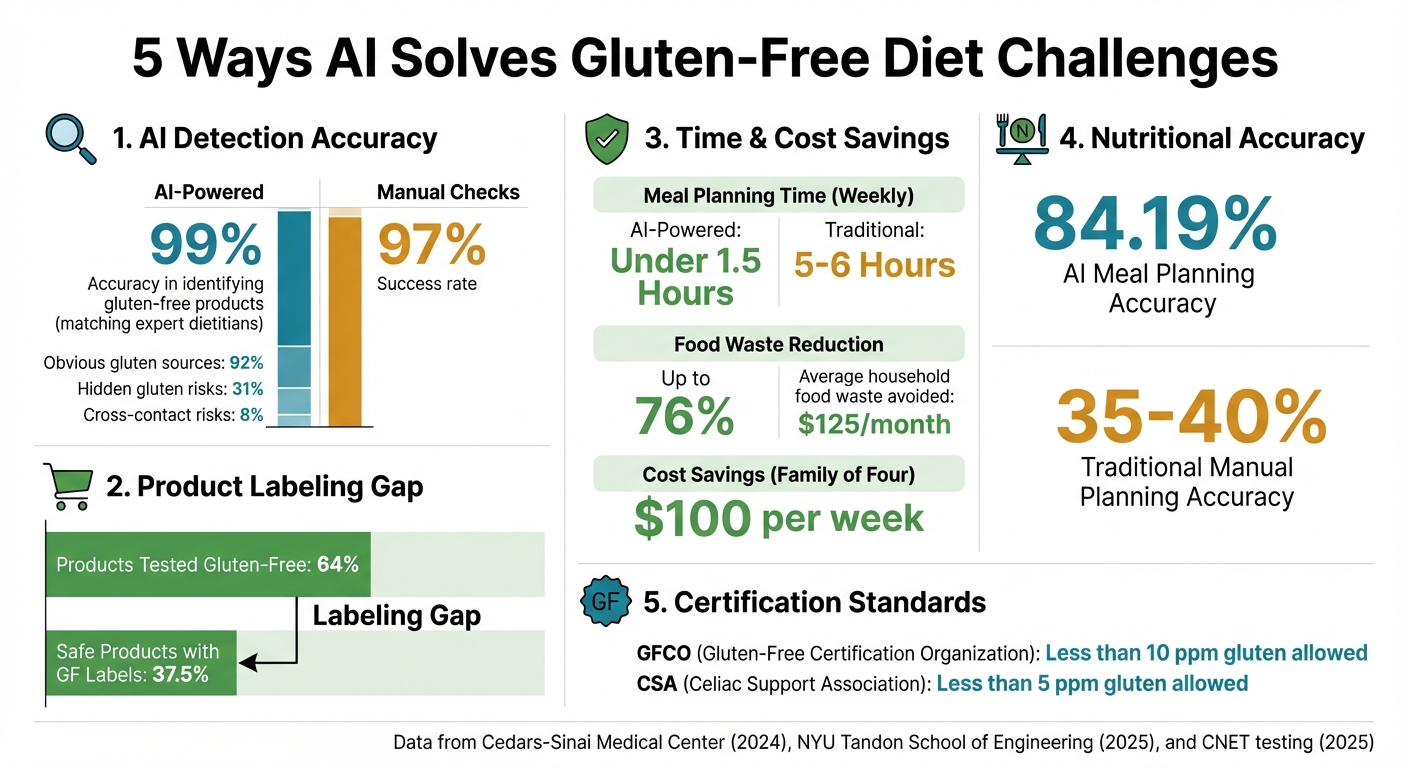
AI Accuracy Rates for Gluten Detection and Meal Planning Benefits
AI Meal Planners & Recipe Generators for Vegan, Keto & Gluten Free Diets!
Challenge 1: Finding Hidden Gluten in Packaged Foods
Navigating ingredient labels can feel like solving a mystery when you're avoiding gluten. The challenge isn't just spotting wheat flour - it’s uncovering the many disguises gluten wears. Ingredients like malt flavoring (from barley), modified food starch, dextrin, hydrolyzed wheat protein, and even "natural flavors" can all harbor gluten. To complicate things further, many products that are safe for gluten-free diets don’t even carry a gluten-free label.
In September 2024, a team led by Dr. Jamil S. Samaan at Cedars-Sinai Medical Center tested an AI-powered smartphone app in a Los Angeles supermarket. This app combined image recognition and natural language processing to evaluate 1,884 ingredients across 100 products. The results? An impressive 99% accuracy in identifying gluten-free items, matching the performance of expert dietitians. Interestingly, the study revealed that while 64% of the products were gluten-free, only 37.5% of those safe items displayed a gluten-free label.
AI tools work by capturing label text using OCR (optical character recognition) and analyzing it with natural language processing to detect gluten-related terms like wheat, barley, rye, and malt. Advanced systems can even understand context - knowing, for instance, that traditional soy sauce contains wheat, while tamari is generally safe.
But let’s be clear: AI isn’t flawless. While it identifies obvious gluten sources 92% of the time, it struggles with less obvious risks, achieving only 31% accuracy for ambiguous ingredients like "natural flavors". Dr. Lena Torres, RD, CDE, and Director of Clinical Nutrition at the University of Chicago Celiac Center, emphasizes:
"AI tools are excellent starting points for identifying obvious gluten sources - but they cannot replace the layered, skeptical inquiry required for true safety".
What’s the best strategy? Use AI as your first line of defense to quickly weed out products with clear gluten risks. For items that seem safe but lack clear labeling, rely on third-party certifications like GFCO or NSF to ensure safety. This layered approach combines speed with reliability, setting the stage for even more sophisticated AI-driven solutions in gluten-free meal planning, from ingredient substitutions to managing cross-contamination.
Challenge 2: Finding the Right Ingredient Substitutions
Switching out gluten-containing ingredients isn’t as straightforward as swapping wheat flour for rice flour. Gluten plays a crucial role in baking - it provides elasticity, structure, and helps retain moisture. Without the right replacements, you might end up with crumbly cookies, overly dense bread, or sauces that just don’t thicken properly. This is where AI steps in, offering precision in finding substitutes that replicate gluten’s unique properties.
AI systems use advanced techniques, like Graph Neural Networks, to analyze ingredient swaps. They match chemical and sensory profiles while factoring in flavor, texture, nutrition, and even the cooking method. For example, Honeydew Recipe Manager’s "Ask Honey" AI assistant makes gluten-free recipe adjustments a breeze. A simple command like "make this gluten-free" updates the ingredient list and fine-tunes critical elements such as liquid ratios, baking times, and leavening techniques. When converting a yeasted bread recipe, the AI might suggest adding xanthan gum or psyllium husk for elasticity and recommending a blend of almond and oat flours to maintain moisture and lift.
Unlike traditional trial-and-error, AI uses sophisticated modeling to predict how substitutes will behave in different cooking scenarios - whether you’re baking, frying, or thickening a sauce. It even tailors recommendations to the cooking method. For instance, the best flour substitute for thickening gravy isn’t the same as one used to give structure to bread. AI tools go a step further by offering compensatory tweaks, like adding hydrocolloids to restore the viscoelasticity needed in baked goods. This ensures gluten-free recipes maintain both their flavor and nutritional value.
"The ingredient substitution feature is a game-changer for my dietary restrictions. I can adapt any recipe easily!" - Sarah M., Honeydew User
With precise substitutions and tailored adjustments, AI not only improves recipe results but also takes the stress out of planning and preparing gluten-free meals.
Challenge 3: Avoiding Cross-Contamination
On top of dealing with hidden gluten and substitution hurdles, avoiding cross-contamination is absolutely critical for those with celiac disease or severe gluten sensitivity. Even trace amounts of gluten (measured in parts per million, or ppm) can trigger serious reactions. Cross-contamination happens when gluten-free foods come into contact with gluten-containing ingredients - often through shared cutting boards, utensils, cookware, or mixing bowls. This makes shared kitchens a particularly tricky environment to navigate.
The Honeydew Recipe Manager offers a helpful solution by filtering recipes based on your dietary profile. Its AI assistant, "Ask Honey", can even rewrite recipes to update ingredient lists and preparation steps for safer cooking practices.
That said, AI tools have their limits, especially when it comes to spotting cross-contact risks. While these tools can correctly identify obvious gluten sources 92% of the time, they fall short in other areas - detecting hidden gluten risks only 31% of the time and achieving a mere 8% accuracy in identifying cross-contact risks in cooking instructions. In comparison, manual checks are far more reliable, with a 97% success rate.
"AI tools are excellent starting points for identifying obvious gluten sources - but they cannot replace the layered, skeptical inquiry required for true safety."
- Dr. Lena Torres, RD, CDE, Director of Clinical Nutrition at the University of Chicago Celiac Center
To ensure safety, treat AI-generated recipes as drafts that need thorough human review. Double-check preparation steps to confirm the use of dedicated utensils, cooking surfaces, and mixing tools. When using substitutes, look for third-party certifications like GFCO (which allows less than 10 ppm of gluten) or CSA (which requires less than 5 ppm) to ensure they meet strict gluten-free standards. Combining AI's efficiency with human oversight is the key to creating a safer gluten-free cooking process.
While AI can provide a solid starting point for minimizing cross-contamination, your own careful attention is irreplaceable. Up next, we’ll explore how to maintain nutritional balance when removing gluten from your diet.
Challenge 4: Maintaining Nutritional Balance Without Gluten
Cutting out gluten means saying goodbye to foods that are often packed with B vitamins, iron, and fiber. Without careful planning, this can leave some nutritional gaps. Many people on gluten-free diets fall short on key nutrients like Vitamin D, calcium, iron, and potassium. Balancing macronutrients - like protein and healthy fats - can also be tricky. That’s where AI tools step in, providing precise insights to help fill these gaps.
Nutritional balance goes beyond just picking gluten-free ingredients. AI tools are now capable of analyzing nutrition labels and using databases like USDA FoodData Central. Coupled with natural language processing (NLP), they can instantly calculate calories, protein, fat, carbohydrates, and fiber. For instance, in March 2025, researchers at NYU Tandon School of Engineering developed a web-based AI scanner using YOLOv8 and ONNX Runtime. This tool achieved 80% accuracy in tests, such as analyzing a slice of pizza and determining it contained 317 calories, 10g of protein, 40g of carbohydrates, and 13g of fat.
"Traditional methods of tracking food intake rely heavily on self-reporting, which is notoriously unreliable. Our system removes human error from the equation."
- Prabodh Panindre, Associate Research Professor, NYU Tandon School of Engineering
AI tools like Honeydew Recipe Manager’s assistant, "Ask Honey", take things a step further by rewriting recipes to make them gluten-free while preserving their nutritional value. For example, swapping wheat flour for almond or coconut flour adds healthy fats and fiber, while lentil or chickpea pasta boosts protein and iron. Honeydew’s Pantry Mode even scans your existing gluten-free ingredients to suggest recipes that promote variety and reduce food waste. This adaptability highlights how AI can simplify gluten-free cooking challenges.
Another standout feature of AI is real-time nutritional adjustments. These tools recalculate nutritional data instantly based on portion sizes. Some platforms can even sync with wearable devices, tailoring meal suggestions to match your activity levels and energy needs. Studies show that AI-generated meal plans lead to better nutrient intake and improved adherence to dietary goals compared to manual efforts. By combining smart substitutions with automated nutritional analysis, AI makes it easier to maintain a balanced gluten-free diet.
Challenge 5: Streamlining Meal Planning and Grocery Shopping
Building on the basics of ingredient checks and nutritional balance, the next big step is simplifying meal planning - a time-consuming task that AI is well-equipped to tackle.
For those following a gluten-free diet, meal planning can easily eat up 5–6 hours a week. Between searching for recipes, reading labels, and managing shopping lists, it’s a logistical headache. Add tracking your home inventory into the mix, and it’s no wonder many find it overwhelming to stick to their dietary goals.
This is where tools like Honeydew Recipe Manager shine. By automating much of the process, this app can reduce meal planning time to under 1.5 hours. Its "Ask Honey" AI assistant allows users to import recipes from platforms like TikTok, Instagram, YouTube, and websites, then instantly converts them into gluten-free versions. With a simple drag-and-drop interface, you can organize these recipes into a weekly calendar that tracks essential nutritional details - calories, protein, carbs, fat, and fiber - in real time. Once the plan is set, the app generates a smart grocery list, consolidating duplicate ingredients and enabling shared access for up to six family members. This ensures everyone in the household is on the same page, reducing waste and coordinating efforts seamlessly.
The app also integrates with Instacart, making it possible to order all your gluten-free ingredients with just one click. In November 2025, CNET editor Corin Cesaric tested this feature and managed to achieve zero food waste for an entire week, avoiding the average $125 monthly loss many U.S. households face. Similarly, digital parenting expert Abby Brody shared her experience:
"Letting AI help me make the most of what I already have saves our family of four roughly $100 a week".
Another standout feature is the app's Pantry Mode, which uses AI to scan photos of your fridge and suggest gluten-free recipes based on what you already have. It prioritizes ingredients nearing their expiration date, helping users cut food waste by up to 76%.
When it comes to nutritional accuracy, AI-driven meal planning surpasses traditional methods, achieving 84.19% accuracy compared to the 35–40% range of manual planning. This ensures gluten-free diets remain balanced while saving both time and money. The app’s free version supports AI-powered imports for up to 10 recipes, while the premium Honeydew Plus plan starts at just $4.17 per month, offering unlimited recipe storage, social media imports, and real-time household sharing.
Conclusion
Living gluten-free no longer has to feel like a daunting task filled with endless label reading, nutritional calculations, and meal-planning stress. Thanks to advancements in AI technology, what once took hours can now be done in seconds. These tools simplify everything from identifying hidden ingredients to crafting balanced meal plans.
Take the Honeydew Recipe Manager, for example. Its "Ask Honey" AI assistant makes recipe adjustments effortless by automatically filtering out allergens based on your dietary needs. The app’s smart substitution feature offers safe ingredient swaps, like replacing wheat flour with almond flour, while instantly updating nutritional information. This means you can maintain a well-rounded diet without the hassle of manual tracking.
The impact of these tools goes beyond convenience. Real-world data shows they significantly improve meal-planning efficiency and even help reduce costs. Features like Pantry Mode, which identifies ingredients through photos, and seamless Instacart integration for quick grocery ordering, deliver practical benefits for households navigating a gluten-free lifestyle.
Whether you're newly adjusting to celiac disease or have years of experience managing gluten sensitivity, AI-powered tools can help you eat safely, save money, and free up your time. Let technology take the stress out of your gluten-free journey, so you can focus on enjoying every bite.
FAQs
Can I trust AI gluten scans for 'natural flavors' and other vague ingredients?
AI gluten scanners can effectively identify obvious gluten-containing ingredients, but they might falter when it comes to ambiguous terms like "natural flavors," which could potentially include gluten. Treat these tools as a helpful resource, but always proceed with caution and double-check unclear ingredients to stay safe.
How can I ensure a recipe is safe from cross-contamination at home?
To keep your kitchen safe from cross-contamination, start by thoroughly cleaning all surfaces, utensils, and appliances with hot, soapy water before working with gluten-free foods. Dedicate separate, clearly labeled tools specifically for gluten-free cooking, and always prepare gluten-free dishes first to minimize risk. Store gluten-containing products apart from gluten-free items - placing them on higher shelves can help prevent accidental spills. Opt for tools made of glass, stainless steel, or hard plastic, as these materials are easier to clean and less likely to trap gluten residues.
What nutrients should I watch most when going gluten-free?
When sticking to a gluten-free diet, it's important to watch out for nutrients that might be harder to get, like B vitamins, fiber, iron, calcium, magnesium, zinc, vitamin D, and vitamin E. These nutrients play a key role in keeping your body healthy, so you may need to plan meals thoughtfully or consider supplements to make sure you're meeting your needs.