Guide to Ethical Food Labels
• Updated
Navigating food labels can be confusing, but understanding them helps you make informed choices aligned with your values. Here’s what you need to know:
- USDA Organic: Ensures 95%+ organic ingredients, no GMOs, synthetic pesticides, or antibiotics. Includes strict farming and animal welfare standards.
- Fair Trade Certified: Focuses on fair wages, safe conditions, and community investments for farmers and workers.
- Non-GMO Project Verified: Guarantees no genetic engineering but doesn’t address pesticides or animal welfare.
- Certified Humane & Animal Welfare Approved: Prioritizes humane treatment of animals, like outdoor access and natural behaviors, but doesn’t regulate GMO feed or pesticides.
- Grass-Fed vs. Free-Range: Grass-fed relates to diet (not outdoor access), while free-range means outdoor access but with minimal regulation in the U.S.
To shop smarter:
- Look for third-party certifications (e.g., USDA Organic, Certified Humane).
- Be cautious of vague terms like "natural" or "humanely raised."
- Use apps like EWG Healthy Living or Label Lookup to verify claims.
Tools like Honeydew Recipe Manager simplify ethical meal planning by helping you find recipes with certified ingredients, create organized grocery lists, and reduce waste. Start small - focus on one or two certifications that matter most to you and build from there.
The food label you should always ignore
Common Ethical Food Labels Explained
Walking through the grocery store, you’re likely to see an overwhelming number of labels claiming to stand for better practices. But what do these labels actually guarantee? Let’s break down some of the most recognized ethical food certifications and what they truly represent.
USDA Organic Seal
The USDA Organic seal is one of the most tightly regulated certifications out there. To carry this label, products must consist of at least 95% certified organic ingredients and avoid GMOs, ionizing radiation, and sewage sludge . For crops, farmers must use land free of prohibited substances for three years before harvest and rely on organic seeds, crop rotation, and cover crops instead of synthetic fertilizers. Livestock must be fed 100% organic feed, without antibiotics or growth hormones, and grazing animals need to spend at least 120 days a year on pasture, obtaining 30% of their dry matter intake from grazing during that period. Additionally, animals require year-round outdoor access.
Certification isn’t a one-time process - it involves detailed record-keeping and annual inspections by USDA-accredited agents. Penalties are in place for mislabeling or failing to meet these standards. According to the USDA National Organic Program:
"Organic food is produced by farmers who emphasize the use of renewable resources and the conservation of soil and water to enhance environmental quality for future generations".
Products labeled "Made with Organic…" must contain at least 70% organic ingredients but do not qualify for the USDA Organic seal . While this seal focuses on organic farming practices, other certifications address areas like fair labor, genetic modification, and animal welfare.
Fair Trade Certified
The Fair Trade Certified label shifts the focus from farming methods to the well-being of farmers and workers, especially in developing countries. This certification sets social, economic, and environmental benchmarks, impacting nearly 2 million farmers and workers worldwide . It guarantees minimum prices for commodities like coffee and provides a Fairtrade Premium - funds that communities can invest in local projects, such as schools or healthcare facilities .
Labor protections under Fair Trade Certified include safe working conditions, fair wages, and a ban on forced or child labor. Farmers and workers also have a strong voice in decision-making, holding 50% of voting power in Fairtrade International’s general assembly. For multi-ingredient products, at least 20% of the content must be Fairtrade certified to display the Fairtrade Mark with an arrow. Fair Trade USA collaborates with over 1,500 brands to encourage sustainable sourcing.
Non-GMO Project Verified
The Non-GMO Project Verified label ensures that a product’s DNA hasn’t been altered through genetic engineering. This certification is particularly relevant in the U.S., where 93% of soybeans and 92% of corn are genetically modified . Products carrying this label undergo rigorous quality checks and testing.
Heather Adams from Clean Eating Magazine highlights:
"The Non-GMO Project Verified seal is one of the more rigorous certifications a food can earn... it's been thoroughly vetted by the Non-GMO Project through a third-party verification process".
However, this label doesn’t guarantee that the product is free from pesticides, organic, or produced under specific animal welfare standards. Non-GMO products can still be treated with synthetic pesticides and herbicides . Animal welfare concerns, for instance, are better addressed by other certifications.
Certified Humane and Animal Welfare Approved
Both the Certified Humane and Animal Welfare Approved labels prioritize the humane treatment of farm animals. These certifications require adequate space, proper bedding, and environmental enrichment, with annual inspections conducted by trained auditors . Standards are developed by animal scientists, veterinarians, and farmers, and they prohibit the use of crates or cages, ensuring animals can express natural behaviors.
Danilo Alfaro from The Spruce Eats explains:
"Certified Humane labels indicate that a product has been certified by Humane Farm Animal Care... Their standards were developed by animal scientists, veterinarians, and farmers, and includes annual inspections".
For "Certified Humane Free Range" products, animals must have at least 2 square feet of space and spend six hours outdoors daily. However, the basic Certified Humane label does not require outdoor access unless specified as "Pasture Raised" or "Free Range". The ASPCA endorses Certified Humane for its high standards in animal welfare. It’s worth noting that neither certification regulates GMO feed or pesticide use in animal feed .
Kosher and Halal Certifications
Kosher and Halal certifications stem from Jewish and Islamic dietary laws, respectively, and ensure humane slaughter and strict processing guidelines. Both prohibit mixing incompatible foods and require that ingredients meet specific ethical standards. Kosher certification, overseen by rabbinical authorities, ensures animals are healthy at slaughter and bans mixing meat with dairy. Halal certification, managed by Islamic organizations, forbids pork, alcohol, and other prohibited substances. While primarily religious, these certifications are often appreciated for their rigorous oversight and accountability.
Grass-Fed vs. Free-Range Labels
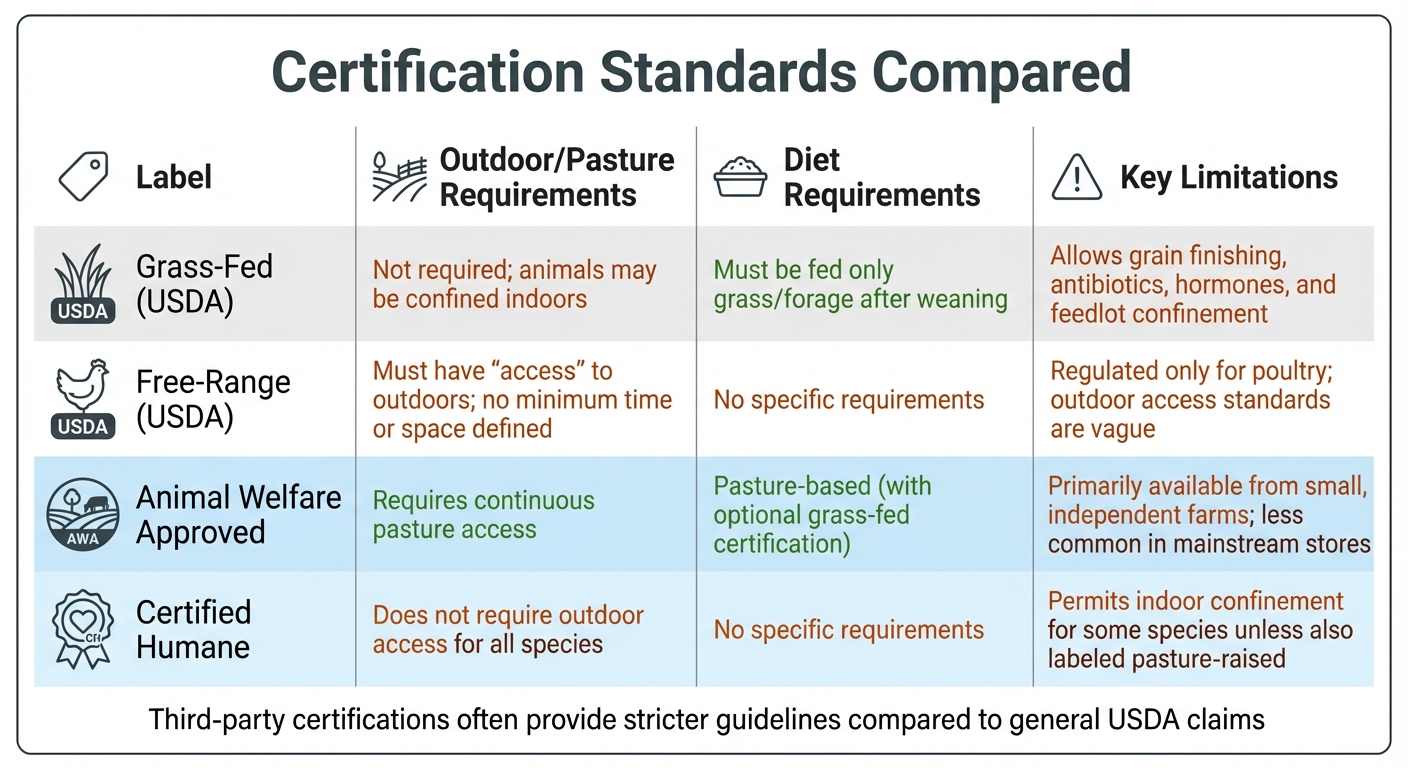
Ethical Food Label Certification Standards Comparison Chart
The terms "grass-fed" and "free-range" address different aspects of animal farming. Grass-fed focuses on an animal's diet, specifically grass and forage, but doesn’t guarantee outdoor living conditions. In fact, animals can still be confined indoors and labeled "grass-fed" as long as their diet meets the criteria.
On the other hand, free-range refers to outdoor access. In the United States, the USDA regulates this term only for poultry, and even then, the requirements are minimal. For example, chickens need access to an outdoor area, but there are no rules about how much space, time, or the quality of that outdoor area. A door leading to a small concrete porch can meet USDA standards.
It’s also important to know that "grass-fed" doesn’t always mean the animal consumed grass exclusively throughout its life. Unless explicitly labeled "100% Grass-Fed", animals may be finished on grain. Adding to the confusion, the USDA's official grass-fed standard was removed in 2016.
Here’s a breakdown of how different certification standards address these labels:
Certification Standards Compared
| Label | Outdoor/Pasture Requirements | Diet Requirements | Key Limitations |
|---|---|---|---|
| Grass-Fed (USDA) | Not required; animals may be confined indoors | Must be fed only grass/forage after weaning | Allows grain finishing, antibiotics, hormones, and feedlot confinement |
| Free-Range (USDA) | Must have "access" to outdoors; no minimum time or space defined | No specific requirements | Regulated only for poultry; outdoor access standards are vague |
| Animal Welfare Approved | Requires continuous pasture access | Pasture-based (with optional grass-fed certification) | Primarily available from small, independent farms; less common in mainstream stores |
| Certified Humane | Does not require outdoor access for all species | No specific requirements | Permits indoor confinement for some species unless also labeled pasture-raised |
This table highlights how third-party certifications often provide stricter guidelines compared to general claims. Andrew Knight, a Professor of Animal Welfare and Ethics at the University of Winchester, emphasizes:
"There's enormous potential for improving the welfare of incredibly large numbers of animals by switching to systems that are high welfare, like free-range and organic systems where the animals have much more space to move around".
How to Spot Ethical Labels While Shopping
When you're browsing the grocery aisles, ethical labels can be a mix of rigorously verified standards and mere marketing fluff. The tricky part? Telling the difference. But with a little know-how, you can spot the real deal and make choices that align with your values using a smart meal planning tool.
Reading the Fine Print
Authentic certifications come from independent third-party organizations. For example, labels might say "Certified Organic by CCOF" or reference groups like Humane Farm Animal Care or Global Animal Partnership. These names in the fine print are your cue that the product meets specific standards. On the flip side, if a product claims to be "certified" but doesn’t name the certifying body, it’s worth questioning.
Some labels can be misleading simply because they lack standard definitions. Terms like "natural", "eco-friendly", and "humanely raised" might sound great, but they don’t guarantee anything concrete. As Modern Farmer points out:
"Seeing this phrase ['all-natural'] on a food label does not inherently convey meaning or guarantee anything".
For organic claims, check for specifics. The USDA Organic seal is reserved for products with 95% to 100% organic ingredients. Those labeled "Made with Organic Ingredients" only contain 70% to 94% organic content and cannot display the USDA seal. Consumer Reports explains:
"Meanings behind even similar-sounding label claims and seals can vary widely. And not all of them are verified".
By paying attention to these details, you’re already taking a big step toward smarter, more ethical shopping.
Using Technology to Verify Labels
Tech tools are a game-changer for decoding labels. Apps like the EWG Healthy Living app and "Label Lookup" let you scan products to uncover the standards behind their claims. Consumer Reports even offers a "Food Label Decoder" that rates labels based on independent verification.
For animal welfare, specialized scorecards can provide deeper insights. The Food Industry Scorecard, for instance, tracks how well major food companies stick to their animal welfare promises. If you suspect a label might be misleading, you can report it using tools like the CCOF "Complaint Submission Form".
When it comes to vague terms like "pasture-raised" or "sustainable", take it a step further. Check the producer’s website for evidence of third-party verification. As Kiss the Ground highlights:
"It's best to assume the lowest rating unless there is a third party certification to verify its quality".
If you're still unsure, don’t hesitate to ask store staff about sourcing details. Combining these tech tools and practical steps can help you navigate the often-confusing world of ethical labels while staying true to your values.
Using Honeydew Recipe Manager for Ethical Meal Planning
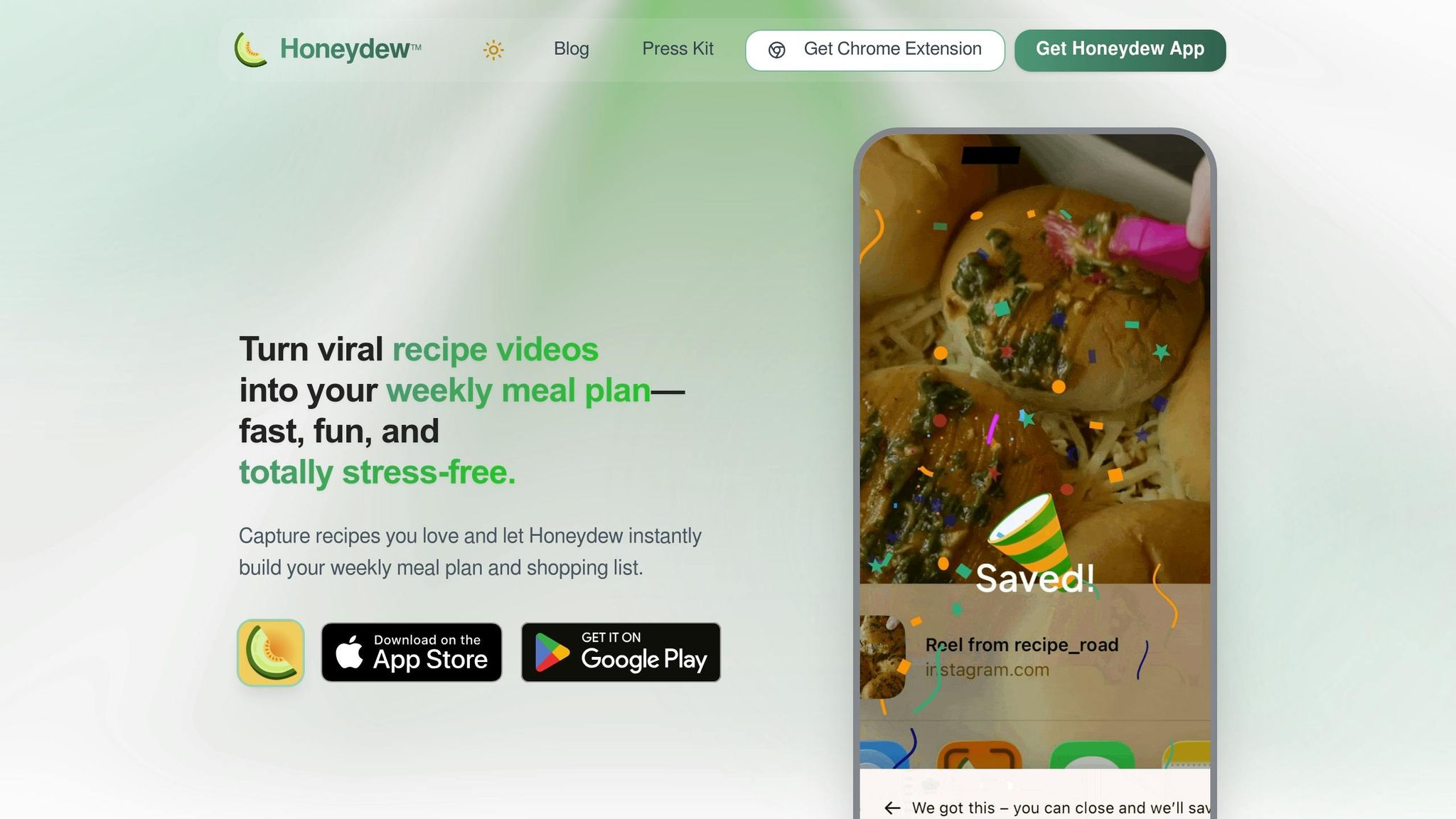
Now that you know how to identify ethical food labels, it’s time to bring those principles into your daily meals. Honeydew Recipe Manager makes this process seamless by turning your understanding of ethical labels into practical meal planning and shopping strategies. It’s the perfect tool to help you align your diet with your values, ensuring that what you eat reflects the standards you care about.
Importing Recipes with Ethical Ingredients
Finding recipes that match your ethical values doesn’t have to be a chore. Honeydew allows you to import recipes directly from social media platforms and websites, making it easy to save dishes that feature ethically certified ingredients. If you come across a meal you love, you can even snap a photo, and Honeydew will generate a copycat recipe using AI. This gives you the freedom to tweak ingredients to meet your ethical preferences. Whether you’re inspired by food bloggers, sustainability advocates, or chefs who focus on ethical sourcing, Honeydew ensures you can gather recipes from a variety of sources. These recipes form the foundation for a more organized and ethical approach to cooking and shopping.
Creating Grocery Lists for Ethical Shopping
Once you've imported your recipes, Honeydew takes the next step by creating store-section-sorted grocery lists for you. This makes shopping more efficient and ensures your list aligns with your ethical priorities. You can review the list and make smart swaps, such as replacing conventional eggs with pasture-raised ones or choosing products certified by trusted organizations like Animal Welfare Approved, Certified Humane, Global Animal Partnership, or USDA Organic. These features simplify the process of sticking to your values while shopping.
AI Meal Planning for Ethical Eating
Honeydew’s AI-powered meal planner takes your ethical eating goals to the next level. It uses your curated grocery list to create personalized weekly meal plans that prioritize ingredients with verified ethical labels - like grass-fed beef, Non-GMO Project Verified grains, or Fair Trade coffee. The planner also integrates with Pantry Mode, ensuring it uses what you already have to reduce waste while staying true to your standards. Plus, with the ability to share plans with up to six people, Honeydew makes collaborative ethical meal planning a breeze for families or groups.
Conclusion
Ethical food labels can reshape the way you shop and eat. The distinction between third-party certifications like Certified Humane or Fair Trade and vague marketing terms such as "natural" or "humanely raised" is critical. As FoodPrint explains, "A good label guarantees that the food was produced in a way that can help you lower your 'foodprint.'" Opting for verified certifications promotes fair wages, better animal welfare, and responsible farming practices.
When navigating labels, focus on those with established credibility. For example, USDA Organic ensures no synthetic chemicals or GMOs, while Pasture-Raised labels verified by third parties indicate higher standards for animal care. Certifications like Non-GMO Project Verified and Regenerative Organic Certified go even further, with the latter emphasizing soil health and sustainable practices. With over 33% of consumers willing to spend more on sustainably produced food, choosing certified products supports ethical farming and fair treatment across the supply chain.
To make ethical choices more manageable, tools like Honeydew Recipe Manager simplify the process. This app eliminates the hassle of analyzing labels in the grocery aisle by letting you import recipes with ethical ingredients, create organized shopping lists, and use AI meal planning to prioritize certified products. It’s a practical way to align your shopping habits with your values without added stress.
Start small by focusing on one or two certifications that matter most to you - whether it’s animal welfare, fair labor, or environmental responsibility. Leverage technology to decode labels and make informed decisions. Every purchase counts, and with the right tools and knowledge, ethical eating can seamlessly become part of your routine.
FAQs
Which label should I prioritize first?
When shopping, look for labels supported by third-party certifications, such as USDA Organic or Certified Humane. These certifications guarantee that the products meet verified standards for ethical treatment and responsible practices, helping you make informed and trustworthy decisions.
Can a product be ethical without being organic?
Yes, a product can be ethical without being organic. Ethical labels emphasize aspects like fair labor practices, animal welfare, and responsible sourcing. These standards go beyond the scope of organic certification. While organic products concentrate on farming techniques, ethical products ensure accountability in areas like worker rights and supply chain transparency.
How can I quickly verify a label while shopping?
To check the credibility of a label, look for certifications issued by well-known third-party organizations or government agencies, such as USDA Organic, Certified Humane, or Fair Trade. These certifications confirm that the product meets specific verified standards. Pay attention to labels that reflect your personal priorities, and always check for official certification logos on the packaging to confirm they are legitimate. This simple step can save you time and effort while ensuring you make informed choices.