How AI Adjusts Oven Temperatures for Baking
• Updated
AI ovens are transforming how we bake by using real-time sensors, machine learning, and cloud-based data to maintain precise temperatures and improve baking results. Unlike standard ovens, which can fluctuate by ±4.3°F or more, AI ovens keep temperatures steady within ±0.8°F, ensuring consistent cooking.
Key features include:
- Advanced sensors: Measure temperature, humidity, and even food placement with high accuracy.
- Dynamic adjustments: AI algorithms tweak power, fan speed, and steam every few seconds for optimal results.
- Built-in cameras: Recognize dishes and suggest the best cooking modes automatically.
- Cloud learning: Improve performance over time by analyzing data from thousands of users.
These ovens save time, reduce energy use, and make baking easier by automating settings, offering app-based monitoring, and integrating with AI meal planning tools. Whether you're baking cookies or roasting meat, AI ensures professional-level outcomes with minimal effort.
How AI Monitors and Adjusts Oven Temperatures
Sensors Track Baking Conditions in Real-Time
Precision in baking starts with accurate, real-time data collection, and AI ovens excel at this by utilizing advanced sensors. Take the Combustion Predictive Thermometer, for example - it uses 8 sensors along a single probe to measure temperatures from the food's core to its surface, achieving an impressive accuracy of ±0.4°F (0.2°C). This setup pinpoints the coldest spot in the food, something standard thermometers with a single tip can't do. Beyond temperature, some ovens employ a lambda probe - commonly used in car catalytic converters - to measure humidity by detecting oxygen displacement as moisture evaporates.
To further enhance accuracy, HD cameras are used to verify food placement, ensuring the sensors work optimally. The June Oven stands out by processing sensor data from its heating elements every second, allowing it to maintain precise control over the food's doneness. These real-time insights are the foundation for the AI's next step: making dynamic adjustments to cooking processes.
AI Algorithms Make Dynamic Temperature Adjustments
Once the sensors collect data, AI steps in to make real-time adjustments. For instance, the June Oven Pro fine-tunes power, fan speed, and even steam injection every 4.2 seconds based on the current conditions inside the oven. This is made possible by Long Short-Term Memory (LSTM) networks, a type of neural network designed to predict temperature changes and handle complex thermal variations that traditional models struggle with.
In a breakthrough study from September 2025, researchers Ui-Jin Kim and colleagues at Inha University demonstrated that an LSTM-based calibration model could improve sensor prediction accuracy by 33.563%, reducing errors from 12.451°C to 4.899°C during rapid temperature changes. AI also adapts to specific cooking challenges, such as the "stall phase" in meat roasting, where temperature plateaus. By adjusting radiant heat output and fan speed, it preserves moisture and ensures consistent results. These adjustments, powered by real-time data, are continually refined through cloud-based learning.
Cloud Learning Improves Performance Over Time
AI ovens don’t just rely on their built-in intelligence - they also learn and improve through cloud-based data sharing. By streaming anonymized sensor data to cloud servers, these ovens refine their predictive algorithms over time, drawing on data from thousands of users.
"The algorithm learns from baking processes in its oven - and from those in the ovens of all other users. The oven gets smarter over time, and the more frequently households use these smart ovens, the more accurate their predictions... will be."
– Bosch
Hoang Richter, AI Project Manager at BSH, further explains:
"Users aren't aware of any of the oven's learning processes. The only thing they notice is that the prediction is even more accurate the next time they cook the same dish".
This collective learning ensures that with every use, the oven becomes better at delivering expert-level precision. Over time, this continuous evolution means your baking results only improve, making every dish closer to perfection.
Introducing Bespoke AI Oven (AI Pro Cooking) I Samsung

Step-by-Step Guide: Using AI Temperature Controls
Using AI for temperature control can bring the precision of professional baking right into your kitchen. Follow these steps to make the most of these advanced features.
Step 1: Select a Baking Program
Begin by selecting the right program via your oven's touchscreen or companion recipe manager app. Most AI ovens provide preset categories like cakes, cookies, bread, or pies, making it easy to get started with just a tap. Some models, such as the Anova Precision Oven 2.0, even include internal cameras that can recommend optimal settings instantly.
If you're using a printed recipe or package instructions, try the "Quick Convert" feature. Simply scan the instructions with your app's camera, and the AI will suggest the appropriate mode (e.g., Air-fry), temperature, and cooking time. For online recipes, paste the URL into the app, and the AI will analyze the steps and adjust for features like steam injection if necessary.
Specialized preset modes, like "Proofing" for bread or weight-based options for roasting poultry, make decision-making even easier. Once you've chosen your program, follow the setup prompts to enable the oven's smart sensors.
Step 2: Place Food and Activate Sensors
Preheat the oven to ensure accurate sensor readings, then place your dish in the center with enough space for proper airflow.
The sensors will activate automatically. For example, GE Appliances' 2026 smart oven lineup - including 39 models from Monogram, GE Profile, and CAFÉ - features AI-powered cooking assistants with Vision AI and CookCam technology. Rachael Schwartz, Executive Director of Built-in Cooking at GE Appliances, highlights this blend of functionality and technology:
"With this new oven line-up, we're solving real, everyday challenges by blending smart design with thoughtful technology."
To maintain optimal food monitoring, ensure the camera inside the oven is clean. For tasks like roasting, use the oven's built-in temperature probe to provide precise internal data to the AI system.
Step 3: Track Adjustments and Predictions
Your oven's app will keep you informed with real-time updates on temperature changes and cooking progress. Unlike traditional timers, AI ovens use predictive analytics to assess doneness based on factors like surface color and moisture. Notifications will let you know when your food is actually ready, not just when the timer runs out.
You can also monitor the process in real-time using the HD camera feed on your phone. If you notice the food browning too quickly, you can manually adjust the temperature. The system continuously refines its predictions as it gathers data, ensuring greater accuracy with each notification.
Once you've tracked the progress, you can fine-tune the settings to suit your specific recipe.
Step 4: Customize Settings for Your Recipe
AI ovens give you the flexibility to personalize settings for your recipes. For instance, the June Oven allows users to create "Custom Presets" that automate multi-step cooking sequences tailored to unique dishes. You can set a target internal temperature, and the AI will adjust cooking modes or temperatures automatically once that target is reached.
Fine-tune your settings to achieve the desired results - whether it's increasing the temperature for a crispier crust, lowering it for a softer interior, or adjusting by up to 35°F to accommodate recipe variations or altitude.
Benefits of AI Temperature Control for Home Bakers
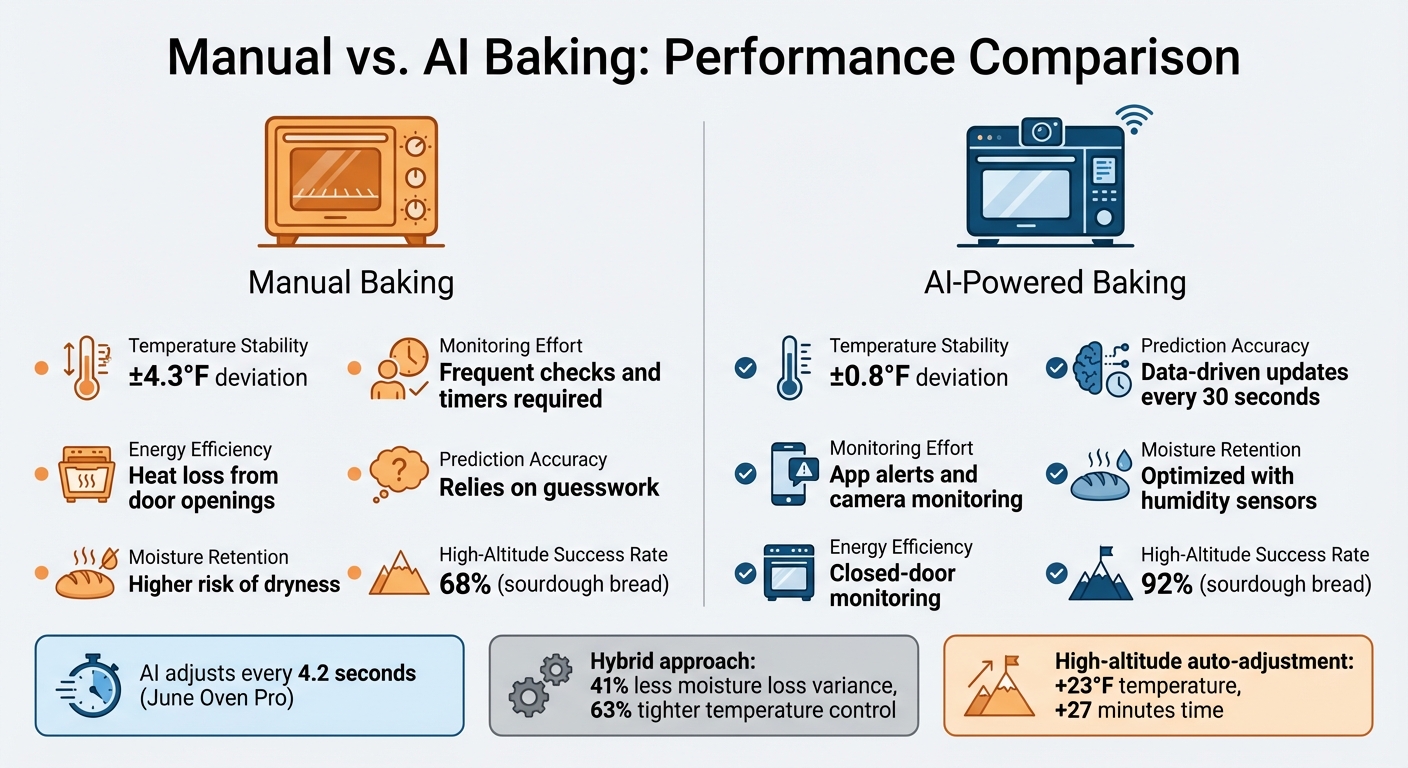
AI vs Manual Oven Baking: Temperature Precision and Performance Comparison
Better Precision and Consistency
AI-powered ovens use real-time sensor data and dynamic adjustments to deliver precise and consistent baking results. For instance, these systems can quickly counteract sudden temperature drops - like when the oven door is opened - maintaining stability within ±0.8°F compared to ±4.3°F in manual baking.
This level of precision is especially helpful in challenging environments. In high-altitude tests conducted in Santa Fe (7,199 feet above sea level), AI-driven ovens had a 92% success rate for sourdough bread, compared to just 68% with manual adjustments. The AI automatically accounted for the lower barometric pressure, adjusting the temperature by 23°F and extending the bake time by 27 minutes to account for changes in evaporation rates and yeast activity. Advanced models equipped with barometric sensors keep temperature deviations to just ±1.2°F, even at elevations ranging from sea level to 9,000 feet. All of this happens without any manual calculations or recipe modifications.
This precision not only improves the quality of baked goods but also makes the process faster and more energy-efficient.
Saves Time and Energy
AI ovens significantly reduce the hands-on effort required for baking. With built-in cameras and app connectivity, you can monitor your bake remotely, cutting down on unnecessary door openings that waste energy. The system updates its predictions every 30 seconds, providing notifications when your food is perfectly cooked.
Traditional baking often results in about 1.7% more moisture loss compared to AI-managed cycles. AI systems detect thermal plateaus early and adjust fan speeds and heating elements to retain moisture while achieving proper browning. Additionally, automated shut-off features prevent overcooking and save energy.
Manual vs. AI Baking: A Comparison
| Feature | Manual Baking | AI-Powered Baking |
|---|---|---|
| Temperature Stability | ±4.3°F deviation | ±0.8°F deviation |
| Monitoring Effort | Frequent checks and timers | App alerts and camera monitoring |
| Energy Efficiency | Heat loss from door openings | Closed-door monitoring |
| Prediction Accuracy | Relies on guesswork | Data-driven updates every 30 seconds |
| Moisture Retention | Higher risk of dryness | Optimized with humidity sensors |
Combining AI thermal management with occasional manual adjustments can lead to even better results. This hybrid approach reduces moisture loss variance by 41% and tightens temperature control by 63%. These advantages make AI a practical addition to everyday baking, with potential for further integration into smart meal-planning systems.
Integrating AI Ovens with Meal Planning Apps
Pairing AI ovens with smart meal planning apps takes precision baking to a whole new level. Apps like Honeydew Recipe Manager sync seamlessly with your oven, ensuring every recipe is executed with precision.
Adjusting Recipes for AI Ovens
Modern AI ovens work within connected ecosystems, allowing apps to send precise cooking instructions directly to your appliance. Honeydew Recipe Manager, for instance, converts imported recipes into U.S. measurement standards, ensuring they align with AI oven requirements. Its scaling feature adjusts ingredient quantities for different serving sizes, a critical step for managing thermal mass so the oven's sensors can perform accurately during baking.
Ingredient swaps often require fine-tuning oven settings. For example, replacing honey with date syrup calls for lowering the oven temperature by 25°F. Honeydew's "Ask Honey" AI assistant can make these adjustments instantly - like transforming a recipe into a gluten-free version - before sending updated instructions to your oven. With around 270,000 recipes processed monthly, the app’s AI has a wealth of data to deliver spot-on recommendations.
In addition to recipe tweaks, these apps offer practical tools that simplify meal planning and enhance your baking experience.
AI Meal Planning and Baking Tips
Honeydew's Pantry Mode is a game-changer. Snap a photo of your fridge, and the app suggests recipes based on what you already have. Its AI meal planner creates weekly menus in seconds, and with household sharing for up to six members, everyone stays on the same page about what’s baking.
Features like Cook Recall let you save optimal settings for future use, while integrated oven cameras, such as CookCam, allow you to monitor browning progress remotely. As Anova Culinary explains:
"will scan the instructions and convert them. Next, it will show you the recommended Oven cooking features, including the Cooking Mode (i.e. Air-fry), temperature, and time".
Simplifying Ingredient Shopping
Honeydew makes shopping effortless with its one-click Instacart integration, ensuring you get the exact ingredient amounts needed for your AI oven’s precise settings. The app also generates instant recipe suggestions and auto-creates grocery lists, streamlining your entire cooking process. By using AI meal planning tools, households can cut food waste by up to 40% and save approximately $125 per month. Plus, uniformly cut ingredients improve the accuracy of oven sensors, delivering consistent, professional-quality results.
These integrations make it easier than ever for home bakers to achieve reliable, high-quality outcomes every time.
Conclusion
AI-enabled ovens are changing the game for home bakers, offering professional-level results without the usual trial and error. These ovens maintain precise temperatures within ±0.5°F, a stark contrast to the larger temperature fluctuations of traditional ovens. This accuracy, once limited to commercial kitchens, ensures consistent baking results. Integrated features like built-in cameras to monitor browning, sensors that track moisture levels, and automated adjustments for factors like door openings or altitude make these ovens incredibly reliable.
When paired with smart meal planning tools, the experience becomes even more seamless. For instance, Honeydew Recipe Manager turns recipes from social media into detailed, oven-friendly instructions. It also simplifies the cooking process with instant ingredient substitutions, one-click Instacart ordering, and AI-driven meal planning. With its ability to process around 270,000 recipes monthly, Honeydew’s AI assistant ensures that your recipes align perfectly with your oven’s capabilities.
Stephen Svajian, Co-Founder of Anova Culinary, captures the essence of this shift:
"Home cooking is no longer focused on just getting dinner on the table. It is about precision, cultural connection, and smart tools that help every cook achieve professional-quality results without wasted time or an extra mess".
Thanks to AI temperature control and intelligent meal planning, baking has become more predictable and enjoyable. Whether you're tackling a high-altitude sourdough recipe or aiming for perfectly uniform cookies every time, these smart ovens and companion apps handle the technicalities. This allows you to channel your energy into creativity while consistently achieving professional-quality results.
FAQs
Do AI ovens really bake more evenly than regular ovens?
AI ovens are known for delivering more consistent baking results compared to regular ovens. Thanks to advanced sensors and machine learning, they can detect temperature changes and cold spots inside the oven. These adjustments happen in real-time, ensuring the heat stays even throughout. This feature is particularly helpful for recipes that require precise and steady temperatures to turn out just right.
Will an AI oven adjust for my altitude automatically?
Yes, certain AI ovens are equipped to automatically adjust for altitude by analyzing real-time atmospheric conditions. However, how well this feature works and whether it’s included depends entirely on the specific model and manufacturer.
What data do AI ovens send to the cloud, and can I turn that off?
AI ovens often transmit data such as temperature, humidity, sensor readings, and oven status to the cloud. This allows for monitoring and potential adjustments. If you're concerned about this, most models let you control or turn off data sharing through privacy settings or network configurations. Refer to your oven's manual or companion app for detailed steps.