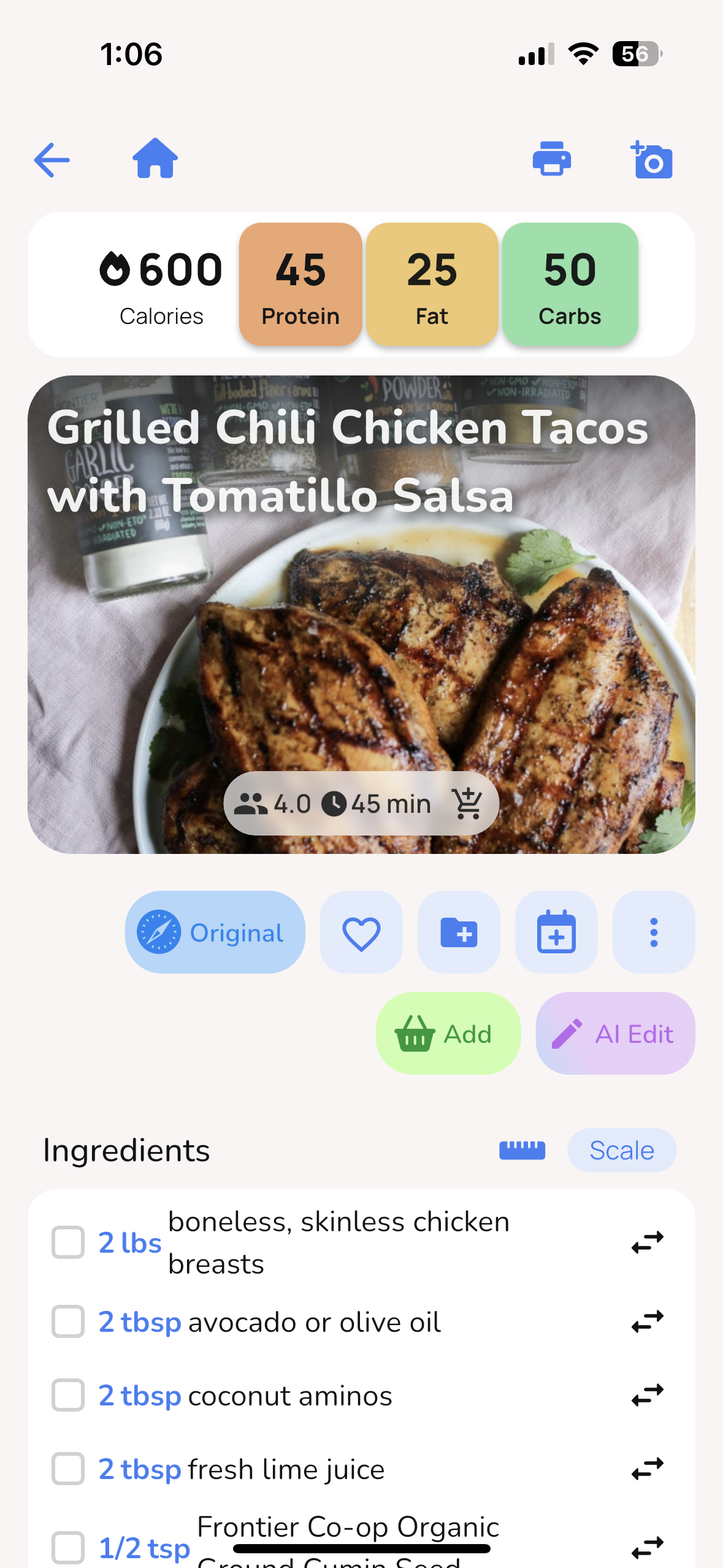
How AI Helps Analyze Nutrition Facts
• Updated
AI is revolutionizing how we understand nutrition, making meal planning faster and more personalized. By analyzing food labels, adjusting for portion sizes, and breaking down recipes, AI tools like Honeydew Recipe Manager simplify healthy eating and save time. Here's how AI transforms your kitchen:
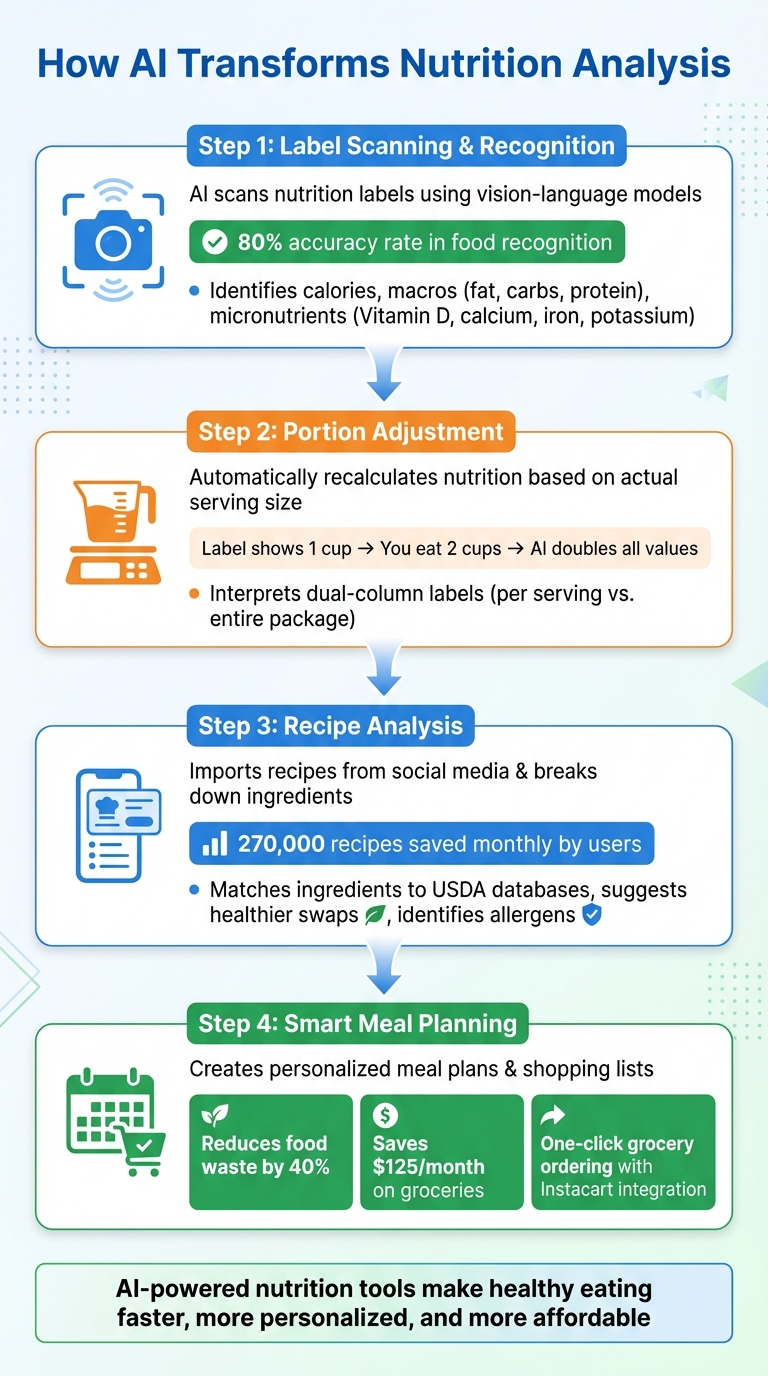
- Label Analysis: AI scans nutrition facts, identifying calories, macros, and micronutrients like Vitamin D, calcium, and iron. It even interprets dual-column labels and estimates glycemic index.
- Portion Adjustments: Automatically recalculates nutritional data based on the amount you eat.
- Recipe Analysis: Imports recipes from social media, breaks down ingredients, and suggests healthier swaps or adjustments for dietary needs.
- Meal Planning: Creates grocery lists, reduces food waste by up to 40%, and saves households about $125 per month on groceries.
AI tools don't just track what you eat - they help you plan smarter meals, save money, and meet health goals with minimal effort.
How AI Analyzes Nutrition Facts: From Label Scanning to Meal Planning
What AI Reads on Nutrition Facts Panels
Calories, Macros, and Micronutrients
AI systems are capable of scanning and interpreting the entire range of information on nutrition labels, from calorie counts to detailed vitamin content. These tools can identify key data such as total calories, calories from fat, and all major macronutrients - total fat (including specifics like saturated and trans fats), cholesterol, sodium, total carbohydrates (broken down into dietary fiber, total sugars, and added sugars), and protein.
In addition to macronutrients, AI tracks important micronutrients like Vitamin D, calcium, iron, potassium, and Vitamin C. These are nutrients many Americans often lack, so having them automatically monitored can help you meet your daily nutritional targets. With food recognition accuracy nearing 80%, these systems are becoming reliable aids for everyday tracking.
Some advanced AI models even go a step further by estimating the glycemic index of foods and analyzing heart health metrics, such as the ratio of potassium to sodium. These insights provide a more comprehensive view of how specific foods might impact blood sugar levels or cardiovascular well-being.
Serving Size and Portion Adjustments
AI doesn't just stop at identifying what's on the label - it adjusts nutritional values based on your actual portion sizes. For instance, if the label provides data for one cup but you're eating two, the AI can instantly recalculate all the figures - calories, sodium, protein, and more.
It can also interpret dual-column labels, which display nutrition details for both a single serving and the entire package. This feature is especially handy when you're snacking directly from a container and need to understand the full nutritional impact. While AI can adjust portions for you, keep in mind that it doesn't physically weigh your food, so treat these estimates as guidelines rather than exact figures.
Nutritional Insights for Individual Ingredients
AI takes label analysis further by breaking down the nutritional contributions of individual ingredients. For example, it can identify components like chicken, rice, or broccoli and match them to databases such as the USDA or FNDDS. This allows for precise nutritional breakdowns, making it easier to swap ingredients or tweak recipes to fit your goals.
This ingredient-level analysis is particularly helpful when cooking from scratch. AI can even handle specialized labels for single-ingredient items like pure honey or maple syrup, which often have unique formats for added sugars. By understanding the nutritional role of each ingredient, you can make smarter choices and tailor your meals to better suit your dietary needs. This level of detail is a perfect foundation for weekly meal planning.
How AI Scans and Analyzes Food Labels
Image Recognition for Label Scanning
AI uses advanced vision-language models to decode nutrition labels by visually processing the text, identifying ingredients, and linking nutritional values to extensive databases like the USDA's food composition tables. Cutting-edge tools, such as YOLOv8 paired with ONNX Runtime, allow for lightning-fast processing directly on a smartphone browser. In March 2025, a team from NYU Tandon School of Engineering, led by Associate Research Professor Prabodh Panindre and Professor Sunil Kumar, introduced a web-based scanner that achieved a mean Average Precision score of 0.7941. This means the system can accurately identify food items about 80% of the time, even when parts of the label are obscured.
"Traditional methods of tracking food intake rely heavily on self-reporting, which is notoriously unreliable. Our system removes human error from the equation." - Prabodh Panindre, Associate Research Professor, NYU Tandon School of Engineering
The system goes further by estimating portion sizes. It calculates the area food occupies on a plate and combines this two-dimensional data with density information to provide an accurate nutritional breakdown. For instance, when analyzing a pizza slice, the scanner calculated 317 calories, 10g of protein, 40g of carbohydrates, and 13g of fat - closely aligning with standard references. While AI can't physically weigh food, users are encouraged to manually adjust any inaccuracies for better precision.
Real-Time Recipe Import and Analysis
AI doesn't stop at scanning labels - it also simplifies recipe analysis. Tools like Honeydew Recipe Manager (https://honeydewcook.com) enable users to import recipes directly from social media or websites in real time. This system breaks down the nutritional content of each ingredient without requiring manual input. Whether it's an Instagram post or a detailed blog recipe, the tool standardizes the data, instantly calculating calories, macros, and micronutrients.
This functionality streamlines meal planning. With just one click, you can import a recipe, analyze its nutritional profile, and determine how it aligns with your daily goals. It’s a game-changer for planning dinners, managing grocery lists, and maintaining a balanced diet - all with minimal effort.
The AI Nutritionist in Your Pocket, Scan Food, Get Answers
Benefits of AI Nutrition Analysis for Home Cooks
AI-powered nutrition tools do more than just decipher food labels - they make meal planning easier and more personalized than ever.
Easier Meal Planning and Grocery Shopping
Meal planning can feel like a chore, but AI simplifies the process. Tools like Honeydew Recipe Manager (https://honeydewcook.com) create detailed shopping lists in familiar measurements like cups, ounces, and pounds, all based on your chosen recipes. Plus, with features like Instacart integration, you can order everything you need with just one click. Imagine turning a viral TikTok recipe into a structured meal plan and having the ingredients delivered to your door in minutes.
Need to swap ingredients? AI has you covered. For example, if you're following a low-carb diet but your recipe calls for rice, the system might suggest cauliflower rice as a substitute and automatically update the nutritional information. This flexibility ensures your meal plans stay aligned with your dietary goals while saving you time and effort.
Personalized Support for Health Goals
AI doesn't just make meal planning easier - it tailors it to your health objectives. Whether you're aiming to lose weight, build muscle, or maintain balanced nutrition, AI can generate meal plans that align perfectly with your calorie and macronutrient targets. Using USDA-aligned databases, it can even recommend recipes based on specific goals. For instance, someone focused on muscle building might see meal suggestions with 1.6–2.2 grams of protein per kilogram of body weight, complete with a per-serving nutritional breakdown.
The personalization doesn't stop there. AI can also identify allergens and dietary restrictions by scanning ingredient lists for hidden triggers. This feature is a lifesaver for those with sensitivities. As Emily C. shared:
"The ingredient substitution feature is a game-changer for my dietary restrictions. I can adapt any recipe easily!"
Reducing Food Waste with Smart Recipe Suggestions
AI doesn’t just help you plan meals - it also helps you make the most of what you already have. By analyzing your pantry inventory, it suggests recipes that use ingredients nearing expiration, reducing food waste and saving money. For example, if you have leftover chicken, some rice, and a few vegetables, AI might suggest a stir-fry recipe, complete with portion adjustments and nutritional details.
This smarter approach to meal planning has real-world benefits. Studies show AI-driven meal planning can cut household food waste by up to 40%, saving the average home cook about $125 per month on groceries. Mark T. summed it up perfectly:
"I used to waste so much food. Now with Honeydew's meal planning, I buy exactly what I need and save money!"
Using Honeydew Recipe Manager for Nutrition Tracking
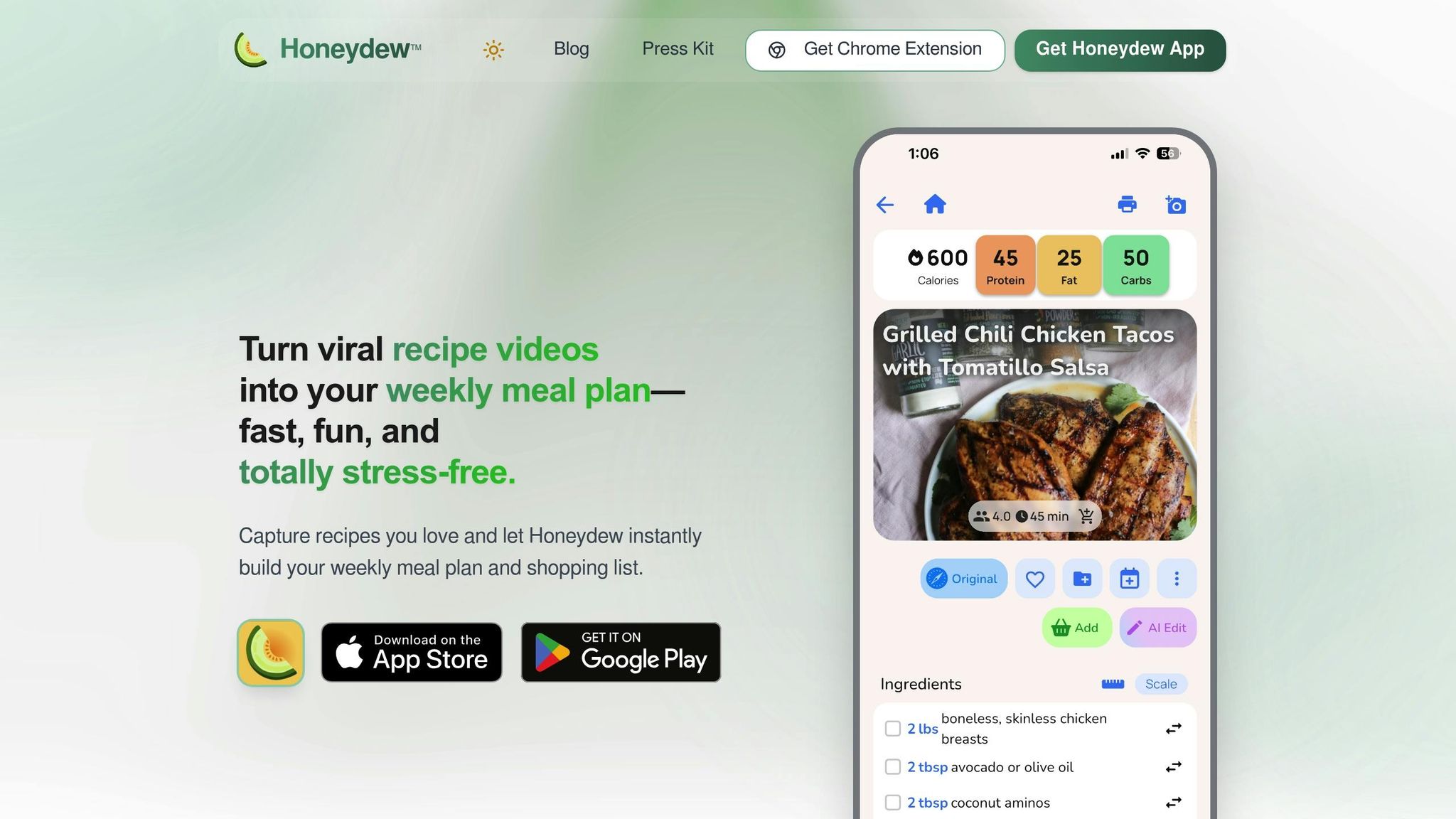
Honeydew Recipe Manager (https://honeydewcook.com) simplifies nutrition tracking and recipe organization with its AI-powered tools. It takes the guesswork out of meal planning, turning it into a smooth, accurate process.
Automatic Calorie and Macro Calculations
With the help of Natural Language Processing (NLP), the app matches your recipe ingredients to USDA databases, delivering instant calorie and macronutrient breakdowns. When you add a recipe, it automatically pulls in serving sizes and adjusts nutritional values as needed. For instance, if you scale a recipe from 4 servings to 6, the app recalculates everything in real time, using standard U.S. measurements. It also tracks your daily intake against your health goals and provides long-term trend charts, giving you a clear picture of your progress. This makes personalized meal planning both efficient and data-driven.
Instant Recipe Import from Social Media
Honeydew makes building your recipe collection effortless. Users save around 270,000 recipes every month by importing directly from platforms like TikTok, Instagram, YouTube, Pinterest, and various websites. Simply use the "Share" button in your social media app to send a recipe link to Honeydew, and the app will instantly analyze it, complete with a nutritional breakdown. You can even digitize handwritten recipe cards or cookbook pages by snapping a photo, and Honeydew will handle the rest.
"Being able to import recipes from anywhere has built my cookbook faster than I ever imagined"
AI Meal Planning and Grocery List Creation
The app takes meal planning a step further with its visual drag-and-drop calendar. You can set dietary preferences - whether keto, vegan, high-protein, or gluten-free - and the AI will suggest meals tailored to your goals. It even checks your pantry inventory to recommend recipes using ingredients you already have. Once your meal plan is finalized, Honeydew generates a categorized grocery list with exact quantities, sorted by store sections. And with one-click Instacart integration, you can order everything you need without leaving the app.
"The smart grocery lists save me hundreds of dollars a month. I love how it suggests recipes based on what I already have!"
Honeydew also supports household sharing for up to six family members, making meal planning a breeze for busy families.
Conclusion: The Future of AI in Nutrition and Meal Planning
AI is transforming how U.S. home cooks approach nutrition tracking and meal planning. Tasks like label scanning, barcode reading, and importing recipes from social media are now automated, freeing up more time for what truly matters - cooking and enjoying meals.
The future holds even more exciting possibilities. AI is on track to become more context-aware, syncing with wearables to tailor meal suggestions based on your daily activity, energy needs, and health data. Imagine smart appliances that monitor your pantry in real-time or adjust cooking settings automatically. Predictive analytics could soon flag nutritional gaps before they become issues, making meal planning not just easier but smarter.
Today's tools already hint at this future. Take the Honeydew Recipe Manager (https://honeydewcook.com), for example. With an impressive 4.8/5 star rating and a growing user base, it's a clear example of how AI simplifies nutrition without requiring technical know-how. Features like automatic macro tracking, social media recipe imports, and smart grocery lists make personalized meal planning accessible to everyone.
"The ingredient substitution finder is a game-changer for my dietary restrictions. I can adapt any recipe easily!" - Emily C.
AI isn’t here to replace home cooking - it’s here to make it smarter, faster, and more aligned with your health goals. As these tools evolve, they’re paving the way for a future where nutrition planning is as seamless as it is personalized.
FAQs
How does AI calculate nutrition facts based on portion sizes?
AI uses cutting-edge tools like image recognition, voice input, and barcode scanning to calculate nutrition facts for various portion sizes. These technologies help determine food weight and nutrient content with a high level of accuracy, reducing the mistakes often associated with manual calculations.
By automating this process, AI simplifies tracking nutritional information - whether you're cooking at home or evaluating recipes. This ensures that portion sizes align with the nutritional details, giving users dependable data for meal planning and maintaining a healthy lifestyle.
Can AI help adapt recipes for dietary restrictions and ingredient swaps?
Yes, AI can simplify the challenges of managing dietary restrictions and finding ingredient substitutions. By analyzing recipes, it can suggest alternatives for ingredients that may trigger allergies or don’t align with specific diets like keto, vegan, or gluten-free. These tools are designed to tailor meal plans to individual needs, ensuring they accommodate medical conditions, allergies, or personal lifestyle choices.
For instance, AI can identify suitable ingredient replacements, point out hidden allergens, and even generate grocery lists tailored to your dietary preferences. This streamlines meal planning and preparation, making it easier to enjoy meals that suit your needs without sacrificing flavor or nutrition.
How can AI-powered meal planning tools help reduce food waste?
AI-driven meal planning tools are changing the way we manage food, making it easier to reduce waste and streamline meal prep. These tools can keep track of what’s in your pantry and recommend recipes based on the ingredients you already have. This ensures you use up items before they go bad. Plus, they generate detailed grocery lists tailored to your meal plans, so you only buy what’s necessary - no more overstocking or unnecessary purchases.
On top of that, AI can focus on recipes that incorporate ingredients close to their expiration date. It can even analyze your long-term habits, suggesting plans that minimize leftovers and cut down on wasteful spending. The result? You save money and contribute to reducing food waste, which helps lessen its environmental impact. By bringing efficiency to your kitchen routine, these tools make meal planning easier while helping you make the most of the food you buy.