How Meal Kits Reduce Food Waste
• Updated
Meal kits are changing how people cook by reducing food waste and simplifying meal prep. Here's why they matter:
- Less Waste: Meal kits use pre-portioned ingredients, cutting household food waste by 38% compared to grocery shopping. This prevents overbuying and discarding unused food.
- Lower Emissions: Research shows meal kit dinners generate 33% fewer greenhouse gas emissions than store-bought meals, even when accounting for packaging.
- Efficient Shopping: Meal kits eliminate the need to buy items in bulk, reducing waste from unused ingredients like herbs or spices.
- Streamlined Supply Chains: Companies accurately predict demand, minimizing overstocking and waste.
Studies, like those from the University of Michigan, highlight how meal kits save resources and reduce the environmental impact of food production and disposal. They also make cooking easier while helping households save money on unused groceries.
How Meal Kits Reduce Food Waste
Pre-Portioned Ingredients Eliminate Excess
One of the most effective ways meal kits tackle food waste is by delivering just the right amount of ingredients for each recipe. Think about it: instead of buying a full 8-ounce package of butter when you only need 2 ounces, or a pack of hamburger buns when you only need two, meal kits provide exactly what’s required for your meal. This solves a common issue with grocery stores, which often sell items in bulk or standard sizes, leaving consumers with more than they can use.
The results speak for themselves. A 2016 study by Blue Apron and the nonprofit BSR examined food waste over a week of meals. With input from experts at the NRDC and World Wildlife Fund, the study found that Blue Apron users wasted just 7.6% of their food, compared to a 23.9% waste rate for people buying the same ingredients from grocery stores. Even at the production level, Blue Apron's facilities had a waste rate of only 5.5%, far below the USDA's average of 10.5% for grocery stores.
Meal kits also cut down on waste during food prep and after cooking. Pre-measured and sometimes pre-prepped ingredients mean there’s less guesswork, which reduces food preparation waste by 45% and leftovers that go uneaten by 34%. It’s a streamlined system that minimizes waste at every step.
Changes in Household Grocery Shopping
Meal kits don’t just change how we cook - they also transform how we shop. By delivering precise portions, they eliminate the need for households to estimate how much they’ll need, which often leads to overbuying. Traditional grocery shopping forces you to buy in set quantities, but meal kits sidestep these constraints entirely by doing the portioning for you.
Grocery stores, on the other hand, operate on a system designed to encourage over-purchasing. They overstock shelves to create an illusion of abundance, which often leads to impulse buys and contributes to 25 million tons of retail food waste annually in the U.S.. Meal kit companies avoid this by using subscription models that allow them to predict demand accurately. This lets them buy only what’s needed from wholesalers, cutting down on waste. Plus, they skip the losses associated with grocery stores discarding "blemished" but perfectly edible produce.
Dr. Brenna Ellison, an Associate Professor at the University of Illinois at Urbana-Champaign, highlights this issue:
"At a grocery store, they cannot easily buy two hamburger buns only and a small enough quantity of ground beef for two patties."
Transportation efficiency is another major advantage. A trip to the grocery store often involves a personal vehicle, which adds 11% to a meal’s carbon footprint through "last-mile" emissions. In contrast, meal kits are delivered as part of optimized delivery routes, reducing last-mile emissions to just 4% of the meal’s carbon footprint. This not only saves time but also reduces environmental impact.
Are meal kits environmentally friendly?
Research on Meal Kit Waste Reduction
Recent studies show that meal kits not only make cooking more convenient but also help significantly reduce waste, offering benefits for both households and the environment.
University of Michigan Study: Emissions and Waste Data

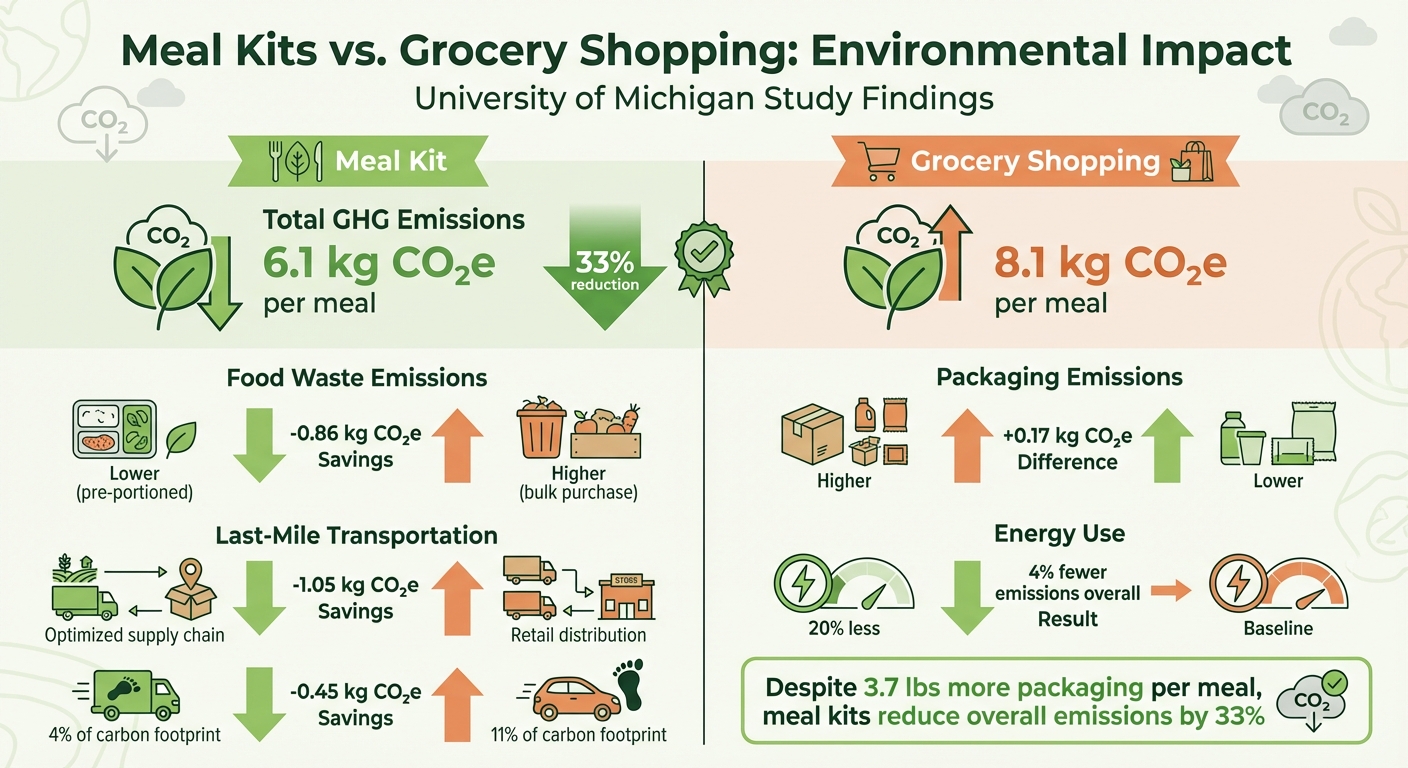
In 2019, researchers Shelie Miller and Brent Heard at the University of Michigan conducted a study comparing meal kits to traditional grocery shopping. The analysis focused on five meal types - salmon, cheeseburger, chicken, pasta, and salad. Their findings? Four out of five meal kit versions produced fewer greenhouse gas emissions than their grocery store equivalents. Published in Resources, Conservation and Recycling, the study revealed that meal kit dinners generate 33% fewer emissions on average - 6.1 kg CO₂e per meal compared to 8.1 kg CO₂e for grocery meals.
The reduced emissions were attributed to two main factors: less food waste, which saved 0.86 kg CO₂e per meal, and streamlined supply chains, which saved an additional 1.05 kg CO₂e per meal. While the extra packaging associated with meal kits added 0.17 kg CO₂e, this was far outweighed by the overall savings.
"Even though it may seem like that pile of cardboard generated from a Blue Apron or Hello Fresh subscription is incredibly bad for the environment, that extra chicken breast bought from the grocery store that gets freezer-burned and finally gets thrown out is much worse."
- Shelie Miller, Associate Professor, University of Michigan
These results align closely with USDA findings on the benefits of pre-portioned ingredients.
USDA Analysis of Pre-Portioned Ingredients
According to USDA research, pre-portioned ingredients help households cut down on food waste by avoiding over-purchasing. Meal kit facilities operate with high efficiency, minimizing waste throughout the supply chain. This is especially useful for items like specialty spices or fresh herbs, which are often sold in quantities too large for a single recipe.
When surplus food does arise, meal kit companies typically donate it to food banks, share it with employees, or compost inedible items. This approach contrasts sharply with grocery stores, which often discard produce that fails to meet aesthetic standards or is overstocked.
Customer data further highlights the waste-reduction potential of meal kits.
HelloFresh Customer Data

A 2021 HelloFresh study involving 1,400 households compared waste from meal kits to traditional meal preparation. Participants tracked leftovers, trimmings, unused ingredients, and inedible scraps, finding that meal kits reduced food preparation waste by 70%.
The study also pointed out financial benefits: the average American spends over $2,200 each year on food that ultimately gets thrown away. By 2021, HelloFresh had delivered approximately 1 billion meals to over 6 million active customers, showcasing how scalable this waste-reduction model can be. As HelloFresh puts it, "Pre-portioned ingredients down to the last ounce mean you're not only helping the planet, but also your wallet".
Waste Reduction Data Comparison
Meal Kits vs Grocery Shopping: Environmental Impact Comparison
When it comes to comparing meal kits and grocery shopping, the environmental impact becomes much clearer when viewed side-by-side. Several studies have highlighted where the real environmental benefits of meal kits lie, despite their reliance on additional packaging. The table below outlines the key findings from the University of Michigan study, offering a detailed breakdown of how these two options stack up.
Key Metrics Comparison Table
The University of Michigan study dives into the differences in greenhouse gas (GHG) emissions, food waste, and other environmental factors between meal kits and grocery store meals. While meal kits do involve more packaging, their overall carbon footprint is significantly lower.
| Metric | Meal Kit | Grocery Store | Impact Difference |
|---|---|---|---|
| Total GHG Emissions | 6.1 kg CO₂e/meal | 8.1 kg CO₂e/meal | 33% reduction |
| Food Waste Emissions | Lower (pre-portioned) | Higher (bulk purchase) | -0.86 kg CO₂e |
| Supply Chain Emissions | Optimized supply chain | Retail distribution | -1.05 kg CO₂e |
| Last-Mile Transportation | 4% each | 11% each | -0.45 kg CO₂e |
| Packaging Emissions | Higher | Lower | +0.17 kg CO₂e |
| Energy Use | 20% less | Baseline | 4% fewer emissions overall |
While meal kits produce slightly higher packaging emissions (+0.17 kg CO₂e per meal), this increase is vastly outweighed by the savings in food waste emissions (-0.86 kg CO₂e per meal). The pre-portioned nature of meal kits plays a crucial role in reducing waste, which has a significant environmental payoff.
A 2017 study further supports these findings, showing that meal kits consume 20% less energy overall, even though they generate approximately 3.7 pounds more packaging material per meal. This data highlights the trade-off between packaging and broader environmental benefits, with meal kits emerging as a more sustainable choice in terms of overall impact.
Honeydew Recipe Manager: Reducing Household Waste
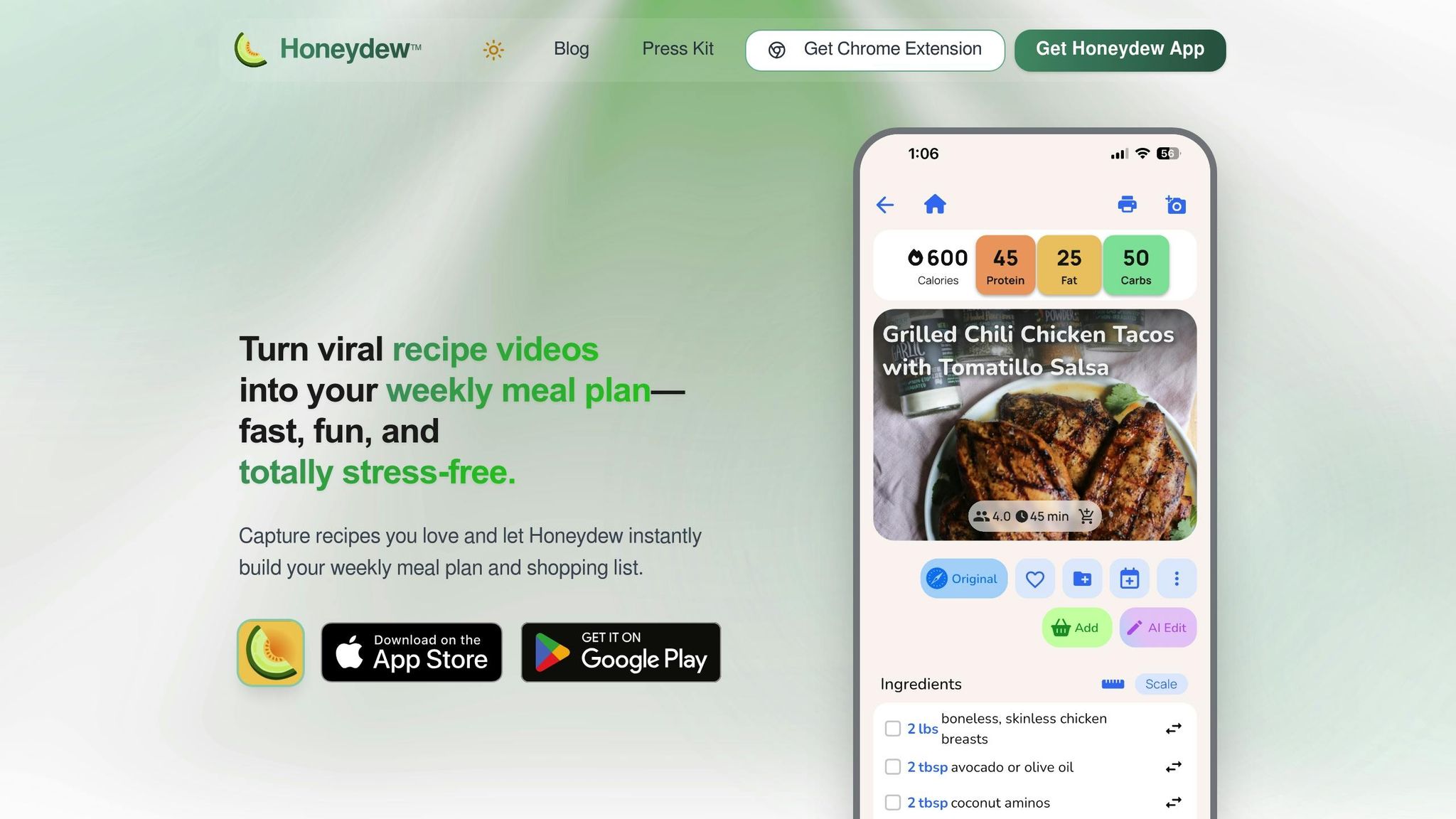
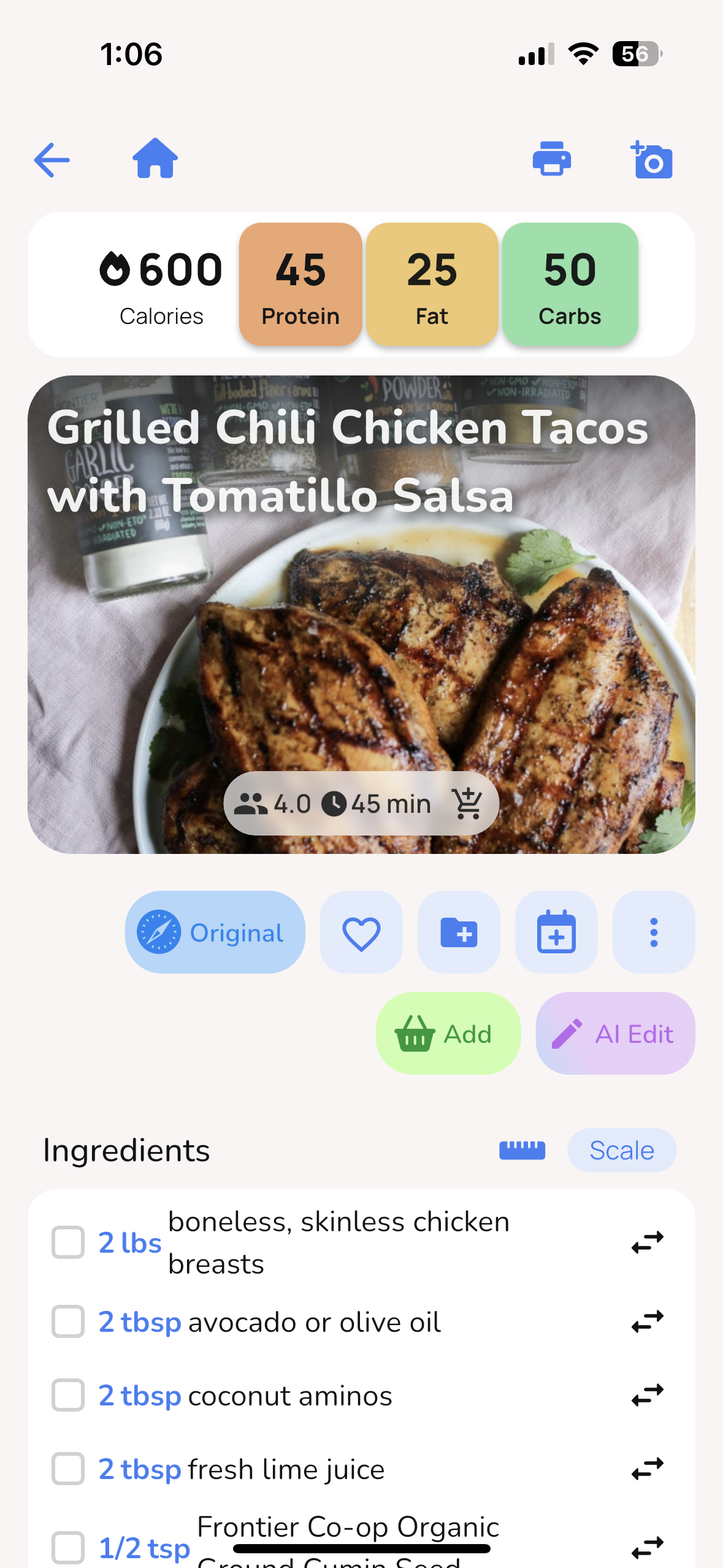
Meal kits have gained popularity for their ability to cut down on food waste by providing precisely portioned ingredients. Now, digital meal planning tools are taking that concept further, applying the same level of precision to everyday kitchen routines. By using technology, these tools aim to bring the waste-reduction benefits of meal kits into the lives of households that rely on traditional grocery shopping for most of their meals. This makes them a practical solution for reducing food waste in regular home cooking.
AI Meal Planning and Grocery Lists
Planning meals before grocery shopping is one of the most effective ways to reduce food waste. Honeydew Recipe Manager uses AI to create weekly meal plans and generate grocery lists organized by store section. With Instacart integration, users can shop efficiently, avoiding unnecessary purchases and ensuring they buy only what they need for specific recipes. This method mirrors the precision of meal kits, helping to minimize overbuying and waste. In 2010, about 31% of the available U.S. food supply went uneaten, translating to a staggering $161 billion in waste. Features like ingredient substitution further enhance this system, making it easier to achieve meal kit-like efficiency in everyday grocery shopping.
Ingredient Substitution and Pantry Mode
Items like fresh herbs or specialty produce often come in quantities larger than what recipes require, leading to waste. Honeydew Recipe Manager tackles this issue with its ingredient substitution feature, which suggests alternatives based on what’s already in your kitchen. The Pantry Mode takes it a step further - users can photograph their pantry, and the app will suggest recipes that use those ingredients before they spoil. This helps address the challenge of buying more than necessary, a key factor in the 27 million tons of food wasted by American households each year. Additionally, the app allows users to set up "Eat First" zones, digitally tracking perishables and sending reminders to use items nearing their expiration dates.
Conclusion
Meal kits play a key role in cutting household food waste by offering pre-portioned ingredients that prevent overbuying and limit preparation waste and leftovers. This approach not only reduces the amount of food heading to landfills but also highlights the practical efficiency of such systems.
Beyond simply reducing waste, meal kits contribute to lower greenhouse gas emissions by streamlining supply chains and minimizing food waste. Tools like the Honeydew Recipe Manager bring similar waste-reduction strategies into everyday cooking. By using AI-driven meal planning, the app generates precise grocery lists organized by store sections, helping shoppers avoid unnecessary purchases. Features like ingredient substitution and Pantry Mode ensure that items already in your kitchen are used before they spoil, tackling one of the biggest challenges in managing household food waste.
Both meal kits and tools like Honeydew Recipe Manager show how thoughtful planning can reduce waste, save money, and lessen environmental impact.
FAQs
How do meal kits help reduce food waste and save money?
Meal kits tackle food waste by delivering pre-measured ingredients designed for specific recipes. Unlike grocery shopping, where you're often forced to buy more than you need, meal kits provide just the right quantities. This means less food spoils and fewer leftovers end up forgotten in the fridge.
Beyond cutting waste, meal kits can actually help you save money. By avoiding over-purchasing and reducing what gets tossed, you can stretch your grocery dollars further. Plus, research shows that meal kits' efficient supply chains lead to a smaller environmental impact, offering a smarter option for your home.
How do meal kits help reduce food waste and benefit the environment?
Meal kits help cut down on food waste by giving you pre-measured ingredients, so you only use exactly what’s needed for each dish. This tackles the all-too-common problem of leftover ingredients sitting unused in your fridge until they spoil. On top of that, meal kit companies often streamline their supply chains, which helps reduce waste during production and delivery.
Now, it’s true that meal kits come with more packaging. But studies suggest their overall impact on the environment is still lower compared to traditional grocery shopping. Why? Because the combination of less food waste and more efficient logistics lowers their carbon footprint, making them a smart, greener option for many households.
How do meal kits help lower greenhouse gas emissions?
Meal kits play a role in reducing greenhouse gas emissions by addressing two major factors: food waste and transportation efficiency. Research, such as a study from the University of Michigan, reveals that meal kits have a carbon footprint that's about one-third smaller than meals made with groceries from a store. This is largely thanks to their pre-portioned ingredients, which help eliminate food waste, and their streamlined delivery systems, which cut down on transportation emissions.
While meal kits do involve more packaging, the overall environmental gains from reducing food waste and improving delivery efficiency outweigh the impact of the extra materials. By simplifying meal prep and cutting down on waste, meal kits provide a greener way to enjoy cooking at home.