How Recipe Apps Use AI for Cooking Method Tags
• Updated
Finding the right recipe has never been easier. AI-powered cooking method tags help you quickly sort recipes by techniques like grilling, baking, or slow cooking. These systems use advanced tools like Natural Language Processing (NLP) to extract cooking methods from text, achieving accuracy rates as high as 98.6%. This means less time searching and more time cooking what you love.
Key takeaways:
- AI identifies cooking methods hidden in recipe descriptions, making searches faster and more precise.
- Apps like Honeydew use these tags to create personalized meal plans, reduce food waste, and organize grocery lists.
- Multi-modal AI systems are tackling challenges like vague instructions by combining text, images, and videos for better recipe analysis.
AI tagging is reshaping how we discover, plan, and prepare meals. Whether you’re a busy home cook or a tech-savvy foodie, these tools simplify your kitchen experience.
How AI Identifies Cooking Methods in Recipes
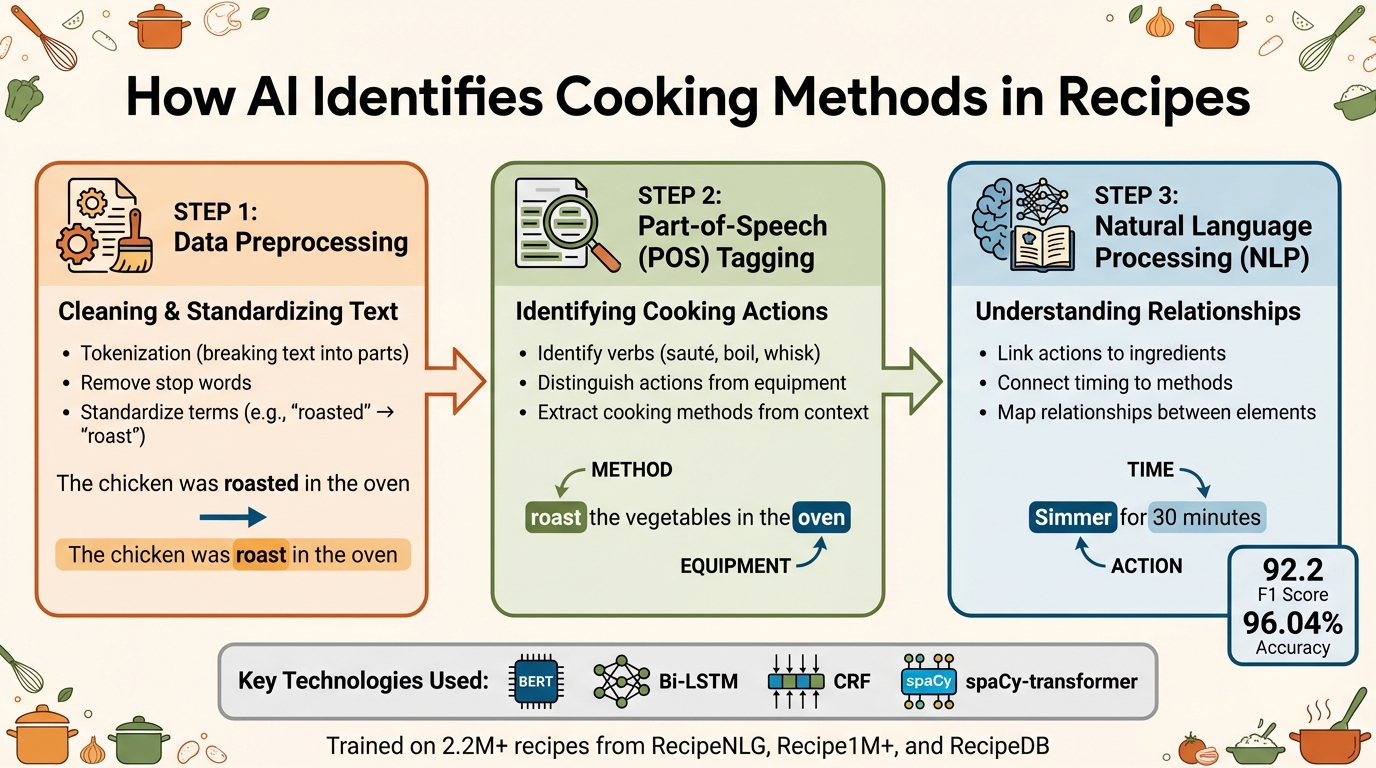
How AI Identifies Cooking Methods in Recipes: 3-Step Process
AI uses advanced techniques to extract cooking methods from recipe text. It begins with data preprocessing, where instructions are broken into smaller parts (tokenized), unnecessary words are removed (stop words), and terms are standardized (e.g., converting "roasted" to "roast"). This ensures the AI focuses on the core cooking actions.
One key technique is Part-of-Speech (POS) tagging, which identifies verbs that represent cooking actions like "sauté", "boil", or "whisk." These verbs are essential since they describe the methods used in recipes. The system can also discern context, understanding that "oven" refers to equipment, while "roast" is a cooking method. These foundational steps set the stage for more advanced natural language processing (NLP) techniques.
Natural Language Processing (NLP) for Recipe Analysis
NLP algorithms dive deeper into recipe instructions, identifying not just the actions but also their connections to ingredients and timing. For example, when a recipe says, "simmer for 30 minutes", the AI links the time directly to the action of simmering.
In July 2023, researchers Yi Fan and Anthony Hunter introduced a two-module framework that builds flow graphs from English recipes. Their system combines BERT, Bi-LSTM, and CRF models to recognize entities like ingredients and actions, then maps relationships such as which ingredient is roasted or which tool is used for whisking. This approach achieved an impressive F1 score of 92.2, far surpassing the baseline of 43.3.
In June 2024, Ganesh Bagler’s team analyzed ingredient phrases from RecipeDB, a leading recipe database. They used a fine-tuned spaCy-transformer model, which achieved macro-F1 scores as high as 96.04% for identifying named entities in recipe text. Interestingly, attempts to use few-shot prompting with Large Language Models performed poorly compared to these optimized deep learning models. These advancements enhance features like search filters and personalized recommendations for home cooks.
Machine Learning and Training with Recipe Data
To identify cooking methods effectively, machine learning models require extensive training on large datasets. Popular datasets include RecipeNLG (2.2 million recipes), Recipe1M+ (1 million recipes with 13 million photos), and RecipeDB. Another example is the 3A2M Cooking Recipes Dataset, which contains over 2 million recipes categorized using active learning techniques.
These models use various classifiers to analyze recipe titles, ingredient lists, and step-by-step instructions to detect cooking methods. To maintain data quality, expert annotators - those with trust scores above 80% - help label the training data. For instance, a 9-genre recipe dataset achieved a Fleiss Kappa score of approximately 0.56026 with this approach.
The training process often incorporates methods like "Query-by-Committee" (QBC) and "Human-in-the-loop" (HITL). In QBC, multiple classifiers vote on the correct category for each recipe, while HITL involves human experts refining the results. This semi-automated system efficiently processes massive datasets without compromising accuracy. Ganesh Bagler aptly describes recipes as:
"Recipes are cultural capsules transmitted across generations via unstructured text".
These combined techniques lay the groundwork for AI systems that can accurately identify cooking methods, making recipe apps more precise and user-friendly.
Benefits of AI-Driven Cooking Method Tagging
AI-driven cooking method tagging is changing the way we search for and choose recipes. Instead of endlessly scrolling through lists, users can now filter recipes by specific techniques like "stovetop", "one-pot", or "no-bake." This makes it easier to find recipes that match both cooking methods and dietary preferences. In fact, research shows that 78% of users find recipes faster when using AI-powered tools. A study led by N. Sakib in January 2025 demonstrated that pre-trained language models like DistilBERT and RoBERTa achieved an impressive 98.6% accuracy in classifying two million recipes based on cooking processes and heat levels extracted from recipe instructions. Below, we explore how AI enhances search filters and personalizes meal recommendations.
Better Search and Filtering Options
AI tagging uncovers details about cooking methods that are often buried in vague recipe titles or static images. This means that when you search for something like "sautéed vegetables", the AI doesn’t just look at the ingredients - it ensures the recipes involve actual sautéing.
AI-powered cross-modal retrieval takes recipe discovery a step further. Imagine snapping a photo of a dish at a restaurant. The AI analyzes the image and matches it with recipes using similar techniques and ingredients. By aligning visual and textual data, the system makes finding recipes intuitive instead of frustrating. With 91% of U.S. consumers now searching for recipes online, this automated organization eliminates the need for tedious manual sorting.
Personalized Recommendations for Home Cooks
While better filters make searching easier, AI also creates tailored suggestions based on your cooking habits. By analyzing recipe instructions, the system identifies key steps and matches them to your health goals - whether you’re aiming for muscle building (1.6–2.2 g of protein per kilogram of body weight) or weight loss.
The impact is clear. Personalized recommendations powered by AI have improved dietary compliance by 50% for users with specific health conditions. Meanwhile, users report a 45% boost in satisfaction thanks to meal suggestions that feel tailored to their needs. The technology even learns from your favorite ingredients, dietary restrictions, and cooking routines while staying updated on current food trends. AI can detect culinary trends in hours or days, speeding up recipe innovation by 35% compared to traditional methods.
AI-driven meal planning also provides practical benefits. Studies show it can reduce household food waste by up to 40%, saving the average home cook about $125 per month. As Associate Research Professor Prabodh Panindre from NYU Tandon School of Engineering explained:
"Traditional methods of tracking food intake rely heavily on self-reporting, which is notoriously unreliable. Our system removes human error from the equation."
His team’s March 2025 web-based AI scanner, built on YOLOv8, achieved a mean Average Precision score of 0.7941. It accurately identifies food items and calculates nutritional data - like estimating 317 calories for a slice of pizza - to support personalized tracking. These advancements not only enhance user experience but also align with smarter, more efficient meal planning.
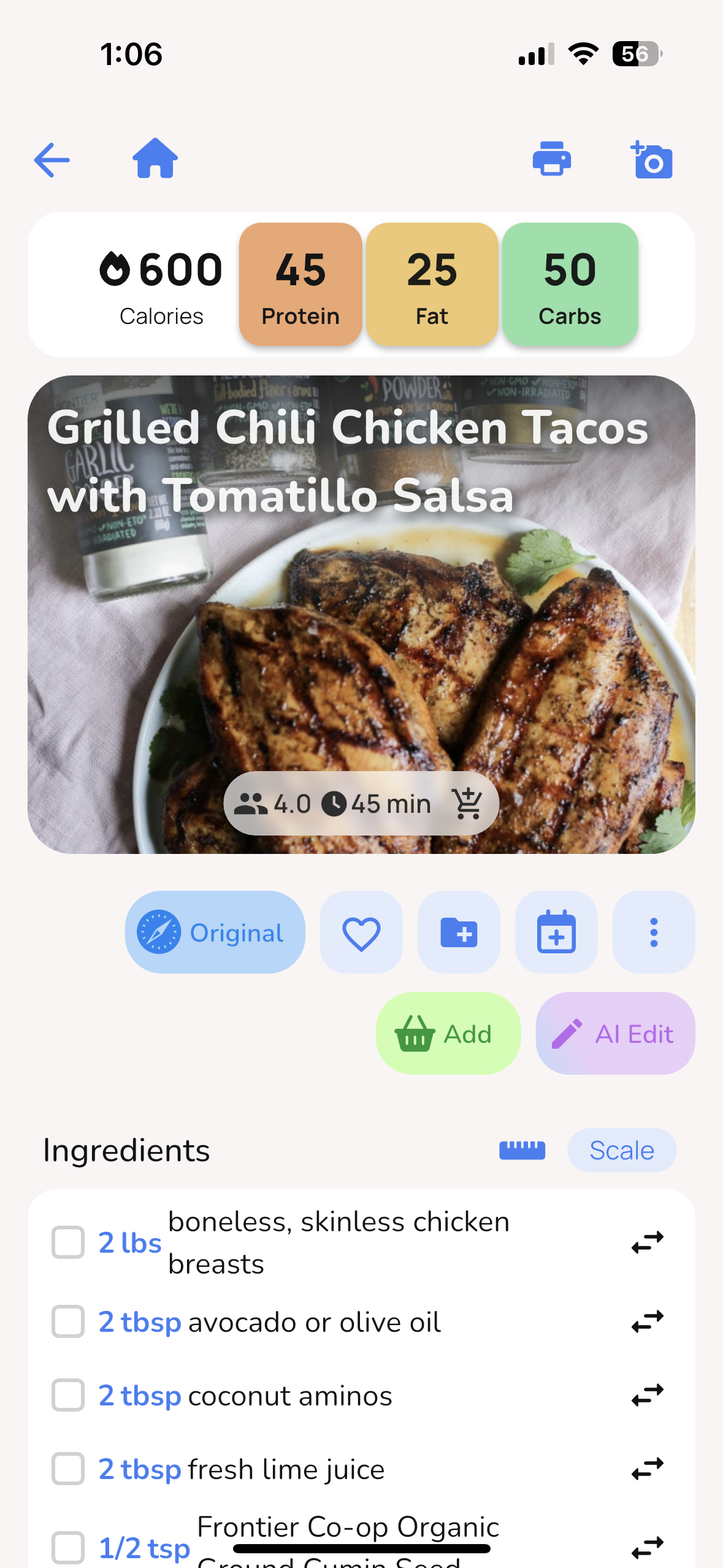
How Honeydew Recipe Manager Uses AI Cooking Method Tagging
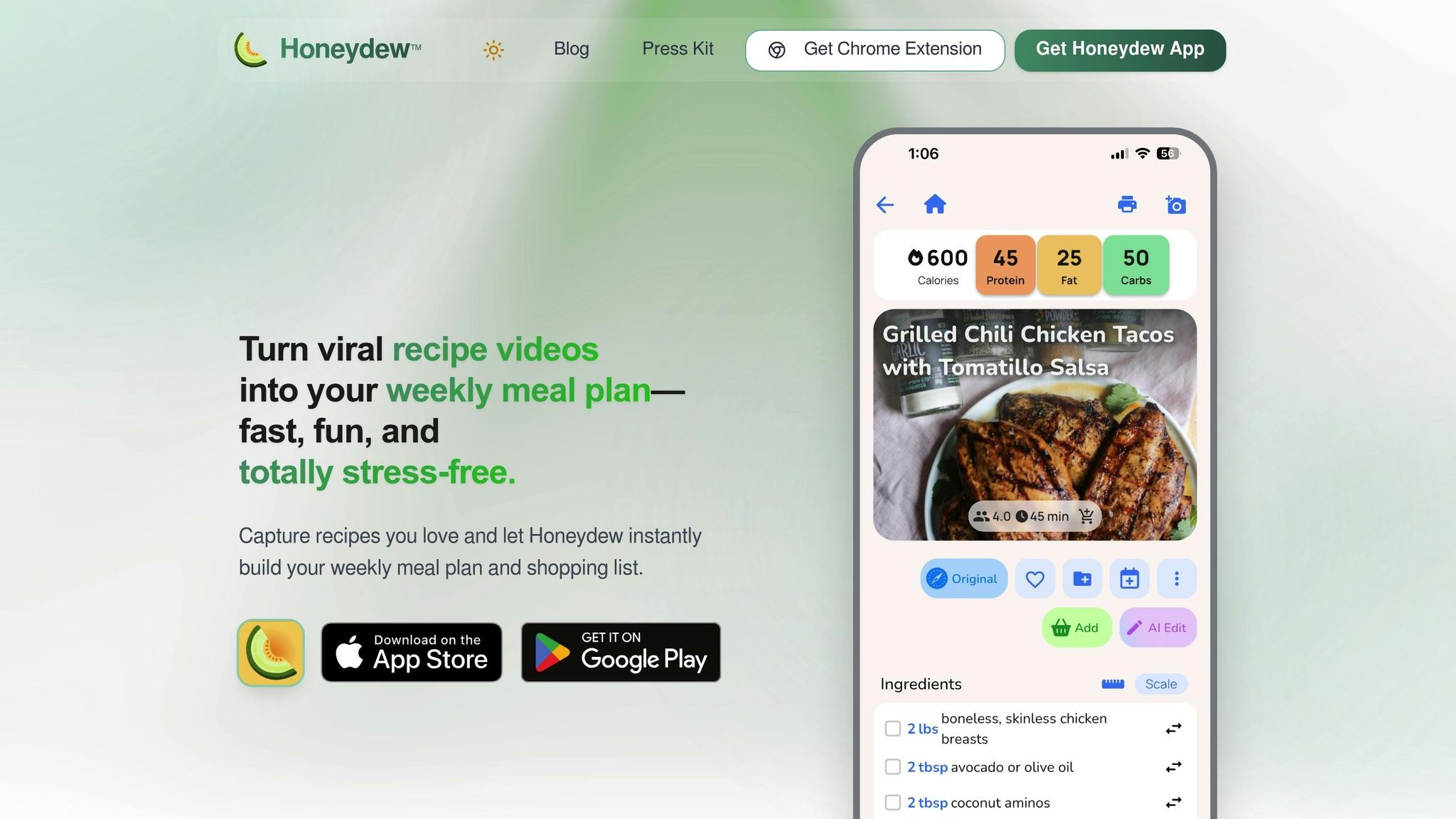
Honeydew Recipe Manager uses AI to make meal planning and kitchen management easier than ever. By leveraging AI cooking method tagging, the app identifies both the ingredients and techniques in recipes from a variety of sources - TikTok, YouTube, Instagram Reels, and even photos of handwritten notes. This feature transforms scattered recipes into a well-organized, searchable digital cookbook with tags like "Quick & Easy", "Vegetarian", or "Family Favorite".
With 270,000 recipes saved each month, Honeydew's tagging system allows users to filter recipes by cooking techniques, whether they're looking for BBQ ideas or sous vide dishes. Verified user Priya K. shared:
"Being able to import recipes from anywhere has built my cookbook faster than I ever imagined".
Tagging for AI Meal Planning
Honeydew takes AI tagging a step further by using it to create balanced meal plans with AI. The app analyzes cooking methods - like baking, grilling, or stovetop cooking - to ensure variety throughout the week. This approach avoids repetitive meals and helps you make better use of your pantry. By searching recipes based on what you already have, you can reduce waste and avoid buying unnecessary duplicates. Verified user James L. noted:
"The smart grocery lists save considerable money. I love how it suggests recipes based on what I already have!".
Improved Grocery Lists and Cooking Assistance
Once your meal plan is ready, Honeydew generates grocery lists that organize ingredients by store section or aisle, simplifying both in-store and online shopping. During cooking, the app’s "No screen lock" feature keeps recipes accessible without constant interaction, and it offers serving size scaling with seamless Imperial and Metric conversions. For precise tasks like pressure cooking, Honeydew syncs with Alexa or Google Assistant for hands-free timer management.
In January 2026, Honeydew introduced AI temperature control, which uses real-time sensors to maintain cooking accuracy within ±1.8°F, far surpassing manual methods. These tools cater to a variety of cooking styles, whether you're slow-cooking a stew or whipping up a quick stir-fry. Together, they make the cooking process smoother and more efficient.
Challenges and Future Directions in AI Cooking Method Tagging
Ambiguity in Recipe Instructions
One of the biggest hurdles for AI in cooking method tagging is interpreting vague or ambiguous recipe instructions. Recipes often rely on phrases like "cook until done" or "season to taste," which lack the precision AI systems need. As Priyadharsini Ramamurthy points out:
"Recipes are treated as text, making it challenging for machines to interpret ambiguity".
Another issue is that AI struggles to understand the cause-and-effect relationships in cooking, such as distinguishing between sautéing and caramelizing onions. On top of that, recipes often involve both sequential steps and parallel tasks - think of simmering a sauce while chopping vegetables - which adds a layer of temporal complexity that machines find hard to process. Even analyzing a photo of the finished dish doesn’t solve the problem, as the image reveals the final outcome but hides the methods used to get there.
These challenges highlight the importance of using multiple types of data to address these ambiguities.
Advancements in Multi-Modal AI
Researchers are now exploring multi-modal AI systems that combine text, images, and video to tackle these challenges. For example, in March 2025, researchers introduced OSCAR (Object Status and Contextual Awareness for Recipes), a system designed to track the transformation of ingredients - like raw chicken turning into grilled chicken - by analyzing video frames. This technology is particularly useful for those who import recipes from Instagram and TikTok, where visual cues are the primary source of information. Tests on 173 YouTube videos and 12 in-person cooking sessions showed a 20% improvement in tracking accuracy compared to traditional vision-language models.
In April 2025, another study presented the Fine-grained Modalities Interaction (FMI) framework. This framework uses a Text-Contextualized Visual Enhancing (TCVE) module to align specific parts of an image with recipe text, enabling the AI to detect visual cues like browning or texture changes. When tested on the Recipe1M dataset, this approach delivered a +17.4 R@1 improvement. By focusing on these subtle visual details, FMI helps AI identify cooking methods even when the recipe text is unclear.
These advancements suggest that combining multiple data sources could be key to overcoming the limitations of single-modality AI systems.
Conclusion
AI-powered cooking method tagging is changing how home cooks find and use recipes. By combining tools like Natural Language Processing and image recognition, these systems make it easier to locate recipes - whether you're searching for air fryer ideas, quick weeknight meals, or dishes that fit your dietary needs.
But it’s not just about faster searches. AI tagging brings added perks like personalized recipe suggestions, smarter meal planning, and more precise grocery lists. For instance, Honeydew Recipe Manager processes around 270,000 recipes each month, automatically categorizing them by cooking method and creating custom meal plans. Its 4.8/5 star rating highlights user appreciation for features like AI-driven ingredient substitutions and grocery lists that save both time and money.
The future of this technology is even more exciting. Multi-modal AI systems, which analyze text, images, and videos together, are making strides in solving challenges like vague instructions or intricate cooking techniques. Research advancements are improving how AI links visual and textual data, paving the way for better recipe comprehension. Upcoming innovations might include integrations with wearables for health-focused meal planning or deeper connections with smart kitchen gadgets. These developments highlight how AI is reshaping recipe discovery and meal prep.
As Associate Research Professor Prabodh Panindre from NYU Tandon School of Engineering explains:
"Traditional methods of tracking food intake rely heavily on self-reporting, which is notoriously unreliable. Our system removes human error from the equation".
This move toward automated, intelligent tools is transforming how we approach cooking, making it more intuitive, efficient, and enjoyable for everyone.
FAQs
How does AI distinguish a cooking method from a kitchen tool?
AI can tell the difference between cooking methods and kitchen tools by analyzing recipe instructions and their context. Using natural language processing (NLP), it identifies actions (like chopping or blending) and matches them to the tools typically used for those tasks, such as knives or blenders. By combining this understanding of language with contextual clues, AI effectively connects tools to specific cooking methods. This makes recipes easier to search and improves the overall user experience in cooking apps.
What does it mean when a recipe says 'cook until done'?
When a recipe says "cook until done," it means you should cook the food until it’s reached the right level of doneness for that particular dish. This isn’t about following a strict timer - it’s more about paying attention to visual cues, texture, or even internal temperature. The exact signs will depend on the recipe and the ingredients you’re working with.
How can cooking method tags improve meal planning and grocery lists?
Cooking method tags simplify meal planning and grocery shopping by categorizing recipes based on how they're prepared. Tags such as "baking", "grilling," or "stir-fry" make it easier to find dishes that fit your available time, tools, or cooking expertise. With AI-driven tagging, recipes become more searchable, and ingredients can be grouped by method. This not only makes shopping more efficient but also helps cut down on food waste, making the entire process smoother and more enjoyable.