5 Korean Pantry Staples and Their Substitutes
• Updated
If you’re curious about Korean cooking but don’t have access to specialty ingredients, here’s good news: you can use everyday substitutes to recreate many of the bold, layered flavors that define Korean cuisine. Below are five key Korean pantry staples and simple alternatives to get you started.
- Gochugaru (Korean Chili Flakes): Known for its smoky, fruity heat, gochugaru can be swapped with Aleppo pepper, chipotle powder, or Kashmiri chili powder. Adjust for heat as these substitutes differ in spice levels.
- Gochujang (Korean Red Pepper Paste): This sweet, spicy, and savory fermented paste can be mimicked by mixing miso paste, chili powder, and honey, though the depth of fermentation will differ.
- Doenjang (Fermented Soybean Paste): Earthy and funky, doenjang is similar to Japanese miso but stronger. Use red miso as a substitute, but reduce the quantity to balance saltiness.
- Toasted Sesame Oil: This nutty finishing oil can be replaced with perilla oil or a DIY blend of toasted sesame seeds and neutral oil.
- Soy Sauce (Ganjang): Korean soy sauces vary in saltiness and sweetness. Japanese soy sauce or tamari can work as alternatives, but note the flavor differences.
These swaps make it easier to experiment with Korean recipes while you explore authentic ingredients over time. Keep reading for detailed tips on finding, using, and substituting these staples.
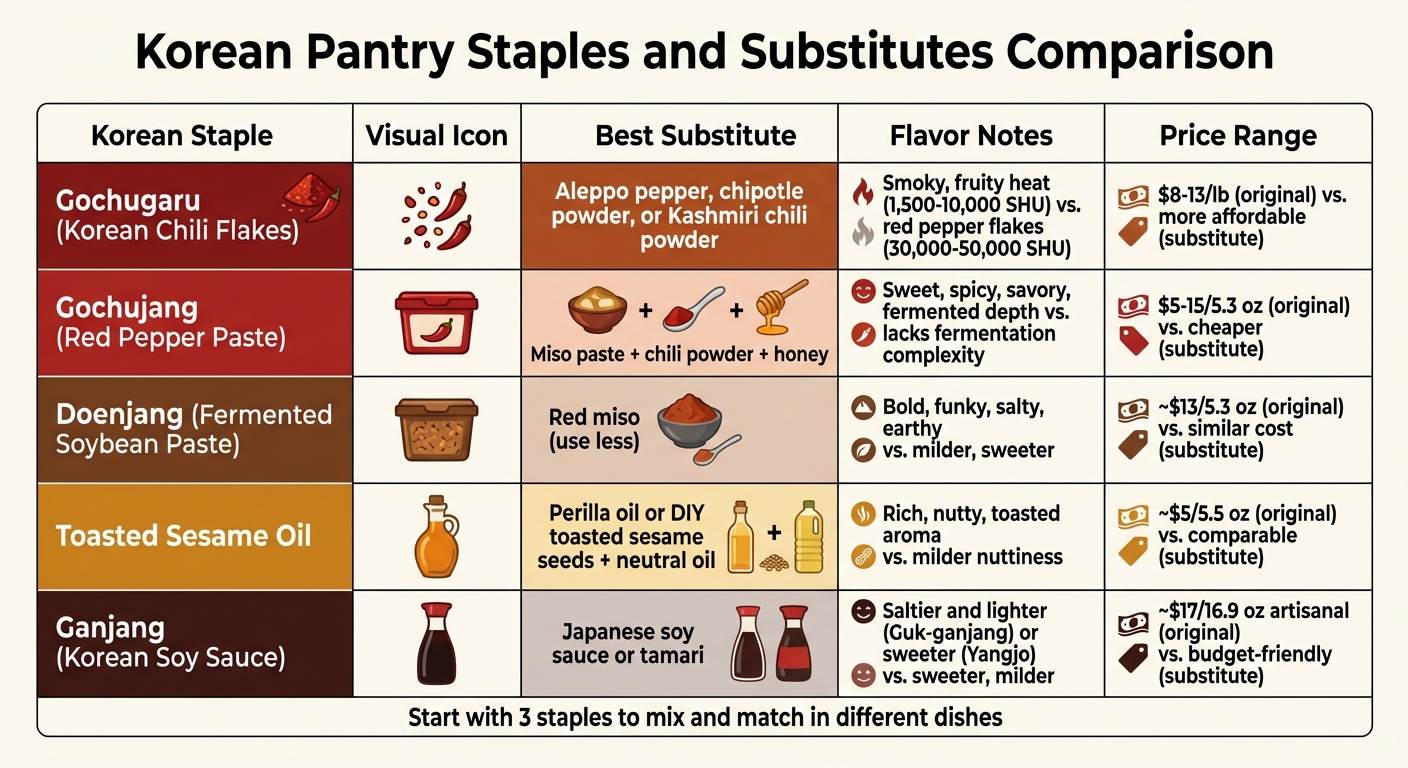
Korean Pantry Staples vs Substitutes: Quick Reference Guide
10 BEST GOCHUGARU SUBSTITUTES FOR YOUR KOREAN DISHES
1. Gochugaru (Korean Chili Pepper Flakes)
Gochugaru is a spice made from dried chili peppers that have been deseeded and ground into a texture that falls between coarse flakes and fine powder. Unlike the red pepper flakes commonly found in the U.S., gochugaru is entirely seedless, resulting in a strikingly uniform red color. Its flavor is anything but straightforward - it’s smoky, sweet, and fruity, offering a depth that goes beyond just heat. As Seoyoung Jung, a Research and Development Chef, puts it:
"It's not sharp and fiery, but it has more of a continuous, long-lasting heat with more fruity tones."[11]
This layered flavor profile makes gochugaru stand out, even when compared to potential substitutes.
Flavor Profile Comparison
With a heat range of 1,500 to 10,000 Scoville Heat Units (SHU), gochugaru is much milder than standard red pepper flakes, which pack a punch at 30,000 to 50,000 SHU. For those looking for alternatives, Aleppo pepper offers a similar mild heat with fruity undertones, chipotle powder brings a smokier dimension, and Kashmiri chili powder delivers vibrant color with a gentler heat[22]. These substitutes can help recreate Korean-inspired flavors, though they may lack gochugaru's unique balance.
Availability in U.S. Grocery Stores
In the U.S., you’ll often find gochugaru in the International Foods or Asian aisle at major grocery stores like Whole Foods, Trader Joe's, and Ralphs. For a broader selection, Korean markets such as H-Mart and Zion Market are excellent options. Well-known brands like Taekyung by Nongshim are widely available and trusted by many.
Cost Considerations
Gochugaru made exclusively from Korean-grown chilies is pricier and less common in the U.S., while more affordable options often use chilies grown in China but processed in Korea. These budget-friendly versions are perfectly suitable for everyday cooking. Prices typically range from $8 to $13 per pound, and buying in bulk can reduce the cost per pound. To maintain freshness, store gochugaru in an airtight container in the freezer.
Best-Use Scenarios
Gochugaru is available in two main grinds: coarse flakes and fine powder. Coarse flakes are ideal for dishes like kimchi, stews, and side dishes, while the fine powder works well for making gochujang or adding a smooth, vibrant touch to soups. If you’re substituting with crushed red pepper flakes, process them briefly in a food processor to better mimic gochugaru’s texture. Keep in mind that red pepper flakes are much hotter, so adjust the quantity accordingly.
2. Gochujang (Korean Red Pepper Paste)
Gochujang is a fermented paste that masterfully balances spicy, sweet, savory, and umami flavors, with a gentle, lingering heat. This complexity comes from its key ingredients: glutinous rice and fermented soybeans. Traditionally, it's aged in earthenware jars outdoors for months - or even years - allowing starches to break down into sugars, which gives it that signature sweet-spicy kick[23][24][26].
Flavor Profile Comparison
The fermentation process not only enhances its sweetness and umami but also sets it apart from standard hot sauces. Its depth and complexity make it a flavor powerhouse, best used sparingly. As Christina Chaey, Senior Food Editor at Bon Appétit, explains:
"Gochujang's sweet-hot-salty flavor shines when it's used in moderation to add depth to all kinds of dishes, from stews and braises to marinades and sauces"[24].
If you're in a pinch and need a substitute, try mixing gochugaru with miso paste and honey. While this combination mimics the sticky texture and some of the fermented depth, it won't fully capture the funky, layered taste of authentic gochujang[23][25].
Availability in U.S. Grocery Stores
Gochujang is easy to spot in the international foods or condiments aisle of well-stocked grocery stores like Trader Joe's, Whole Foods, and Albertsons. Look for the distinctive red square tubs. For more variety, including premium aged options, check out Korean markets like H-Mart or Zion Market. Prices typically range from about $5 for a standard tub to $15 for traditionally aged versions (5.3 ounces)[13][24].
Best-Use Scenarios
Gochujang shines in Korean classics like bulgogi marinades, bibimbap sauces, and tteokbokki (spicy rice cakes)[23][24][26]. Because it's so concentrated, a little goes a long way - think spoonfuls, not cups[24]. For dipping sauces or dressings, balance its boldness by mixing it with sesame oil, honey, rice vinegar, or soy sauce[24]. However, avoid using it as a dry rub substitute for gochugaru, as its moisture and sweetness can drastically alter the dish's texture and flavor[23][25].
Once opened, store gochujang in the refrigerator, where it can last for years. If it hardens over time, just stir in a little warm water to bring it back to life[29].
3. Doenjang (Fermented Soybean Paste)
Doenjang is a thick, earthy paste made from fermented soybeans, known for its bold, funky flavor often likened to aged blue cheese. It delivers a salty, sour, and deeply rich taste with a pungent aroma. As Hooni Kim, Chef and Owner of Hanjan and Danji, explains:
"People who like cheese understand doenjang right away. They know this smell. They know it's not a good smell, but they know it tastes so, so good." [30]
Although sometimes referred to as the "Korean version of miso", doenjang stands apart with its saltier, funkier, and more intense profile. Traditional doenjang is crafted using only fermented soybeans and salt, unlike miso, which often includes rice or barley. It has a coarse, chunky texture and requires at least six weeks of fermentation, though aging it for months - or even years - enhances its depth, adding layers of umami, sweetness, and a touch of bitterness.
Flavor Profile Comparison
| Feature | Doenjang | Japanese Miso |
|---|---|---|
| Flavor | Bold, funky, salty, earthy | Milder, sweeter, savory |
| Consistency | Coarse, chunky | Typically smooth |
| Ingredients | Soybeans and salt (traditionally) | Soybeans, salt, and grains |
| Fermentation | Longer, resulting in stronger flavor | Shorter, producing milder taste |
Availability in U.S. Grocery Stores
Doenjang is easy to find in Korean markets and many pan-Asian grocery stores. It's also becoming more common in mainstream retailers like Trader Joe's, Whole Foods, Ralphs, and Albertsons, where small tubs are often stocked in the Asian food section. For online shoppers, platforms like Amazon, Weee!, Seoul Mills, and Kim'C Market carry a variety of brands, including artisanal options. When shopping, look for brown or gold tubs to ensure you're getting pure doenjang - green tubs typically contain ssamjang, a pre-seasoned paste.
Best-Use Scenarios
Doenjang shines in dishes like doenjang jjigae, a hearty stew with tofu, squash, and potatoes that’s perfect for comfort food lovers. It's also a key ingredient in ssamjang, the dipping sauce for Korean BBQ lettuce wraps, made by blending it with gochujang, sesame oil, and garlic. A small amount of doenjang can elevate dressings and stews, but keep in mind its saltiness if using it as a substitute for miso. If swapping miso for doenjang, opt for a darker miso like red miso, reduce the quantity, and adjust the salt to balance the flavors.
4. Sesame Oil (Toasted)
Toasted sesame oil is a cornerstone of Korean cooking, celebrated for its rich, nutty flavor. Unlike regular sesame oil, which is pale and neutral for high-heat cooking, toasted sesame oil is made by roasting sesame seeds. This process not only gives it a deep amber hue but also creates a complex, toasted aroma thanks to the Maillard reaction [32].
As food writer Andrea Nguyen describes it:
"When it's lightly toasted, [sesame oil] can have a luscious lightness. It kind of dances. It's soft like a good cashmere sweater." [32]
Because of its low smoke point, this oil shines as a finishing touch rather than a cooking base. Drizzle it over dishes like bibimbap, japchae, ramen, or fried rice. It also enhances marinades for bulgogi or dressings for banchan. Chef Rich Wang of Minyoli offers this advice:
"Treat [toasted] sesame oil like you treat good olive oil. Of course you can cook with it, but you'll just waste the money." [32]
Availability in U.S. Grocery Stores
You can easily find toasted sesame oil in most U.S. supermarkets, typically in the international or oils aisle [33][34]. Popular Japanese brands like Kadoya, Dynasty (about $0.65 per oz), and Lee Kum Kee (around $0.82 per oz) are widely available. For a more authentic Korean flavor, look for brands such as Ottogi Premium Roasted (~$1.16/oz), CJ Beksul, or Chung Jung One [32][34]. Specialty stores like Whole Foods and Trader Joe’s also stock it. For the freshest options, Asian markets like H-Mart or Zion Market are ideal, as their high turnover reduces the chance of rancidity. Always check the label to ensure it says "100% pure sesame oil", as some products may include blended oils.
Best-Use and Storage
To preserve its bold aroma, add toasted sesame oil at the end of cooking - drizzle it over finished dishes, mix it into sauces, or whisk it into cold noodle dressings. Store opened bottles in a cool, dark place or refrigerate them to extend their shelf life up to six months. Be aware that refrigeration may make the oil cloudy, but it will return to normal at room temperature [32][33].
If you can’t find toasted sesame oil, try substituting with perilla oil or make your own blend by combining one part toasted sesame seeds with four parts neutral oil, like grapeseed or canola [38].
For more ingredient tips and Korean recipe ideas, check out Honeydew Recipe Manager.
5. Soy Sauce (Ganjang)
Korean soy sauce offers a range of options that go beyond the typical Japanese varieties. While most U.S. soy sauces are a mix of soybeans and wheat, giving them a sweeter and milder taste, traditional Korean soy sauces come in three distinct types. Each one serves a specific purpose in Korean cooking, making them an essential part of the cuisine.
Flavor Profile Comparison
Joseon Ganjang (also called Guk-ganjang or soup soy sauce) is made purely from soybeans, salt, and water. This simple recipe creates a very salty flavor and a light amber color, ideal for seasoning soups without darkening them. Yangjo Ganjang, on the other hand, includes wheat and undergoes natural fermentation for six months to a year. This process gives it a sweeter, more aromatic taste, making it perfect for dipping sauces or dressings. Lastly, Jin Ganjang is a versatile blend of naturally brewed and chemically produced soy sauces. It holds up well in long braises or high-heat cooking, making it a great all-purpose option.
Maangchi, a well-known Korean cooking expert, notes:
"I don't use gukganjang because it can always be substituted with fish sauce or a mixture of jinganjang and salt."
Availability in U.S. Grocery Stores
You can find authentic Korean soy sauces at stores like H-Mart or other Asian markets. Popular brands include Sempio (look for their 501 or 701 labels for premium quality), Chung Jung One, and O'Food. Some mainstream stores like Whole Foods also carry them, and they are widely available on Amazon. When shopping, check the T.N. (Total Nitrogen) number on the label, which ranges from 1.0 to 1.7. A number above 1.5 indicates a premium product.
Cost Effectiveness
If you’re looking for the most budget-friendly option, Jin Ganjang is your best bet due to its blended or chemically produced nature. Yangjo Ganjang, with its long fermentation process, tends to be pricier. Meanwhile, Guk Ganjang costs around $17 for a 16.9 oz bottle. For everyday cooking, Japanese-style soy sauce like Kikkoman can work as a substitute for Jin or Yangjo Ganjang in marinades and stir-fries, though it generally has a sweeter taste.
Best-Use Scenarios
- Joseon Ganjang: Excellent for soups and seasoning vegetables, but use sparingly because of its strong saltiness.
- Yangjo Ganjang: Ideal for dipping sauces, salad dressings, or recipes that need a touch of aromatic depth.
- Jin Ganjang: Perfect for bulgogi marinades, braised dishes, or recipes requiring larger amounts of soy sauce.
If you can’t find authentic Korean soy sauce, you can replicate its salty, umami profile by mixing fish sauce with a bit of salt, especially for broths where you want to avoid darkening the color.
Store your soy sauce in a cool, dark place. It can last up to two years without refrigeration. For more tips on ingredient substitutions and Korean recipes, visit Honeydew Recipe Manager at https://honeydewcook.com.
Quick Reference Table
Here’s a handy table to help you quickly compare Korean staples with their substitutes, along with insights into flavor differences, where to buy them, and price comparisons.
| Korean Staple | Substitute | Flavor Difference | Where to Buy | Price Comparison |
|---|---|---|---|---|
| Gochugaru | Red pepper flakes mixed with paprika | Substitutes are sharper and spicier. Gochugaru is seedless, smoky, and fruity (1,000–1,500 Scoville units). | H‑Mart, Amazon, Asian markets | Original: ~$10/lb; substitute: more affordable |
| Gochujang | Miso + Chili powder + Honey | Lacks the fermented depth and sticky texture of authentic gochujang. | Trader Joe's, major grocery stores | Original: ~$15/5.3 oz; substitute: cheaper |
| Doenjang | Japanese Miso (use more) | Miso is milder and sweeter, while doenjang is funkier, saltier, and more pungent. | Kim'C Market, H‑Mart, Seoul Mills | Original: ~$13/5.3 oz; substitute: similar cost |
| Sesame Oil (Toasted) | Perilla oil or untoasted sesame oil | Perilla oil is milder and nuttier. Untoasted sesame oil has a higher smoke point but less aroma. | Most supermarkets, Amazon | Original: ~$5/5.5 oz; substitute: comparable |
| Ganjang (Soy Sauce) | Tamari or Japanese Shoyu | Guk-ganjang is saltier and lighter, while Yangjo is sweeter. | H‑Mart, international aisles | Original: ~$17/16.9 oz (artisanal); substitute: more budget-friendly |
For the best quality gochugaru, check for the label "Taeyangcho", which ensures the peppers were sun-dried to enhance flavor and color.
Looking to streamline your Korean cooking? Honeydew Recipe Manager can help you organize recipes, track ingredient swaps, and plan meals effortlessly. Check it out at Honeydew Recipe Manager.
Conclusion
You don’t need a pantry full of Korean ingredients to start cooking dishes that capture the essence of these flavors. Using substitutes can make it easier to dive in without committing to specialty items that might end up gathering dust in your cupboard. For example, versatile staples like gochugaru and toasted sesame oil are great starting points. You can also use familiar ingredients, such as Japanese miso in place of doenjang, to ease into Korean cooking. As cooking instructor Shin Kim explains:
"Once you have at least three items... then there are so many ways to mix and match and use them in different dishes."
Experimenting with substitutions not only simplifies the process but also helps your taste buds adjust to the bold, fermented flavors of authentic Korean ingredients. Over time, as you discover which flavors resonate with you, you might decide to invest in high-quality options, like artisanal ganjang (around $17 for 16.9 ounces) or premium doenjang (approximately $13 for 5.3 ounces).
To make this journey even smoother, consider tools like the Honeydew Recipe Manager. This app allows you to track ingredient swaps, plan meals using both authentic and substitute ingredients, and generate grocery lists tailored to your Korean recipes. Its smart substitution feature can be a lifesaver when you’re mid-recipe and missing an ingredient. Learn more at Honeydew Recipe Manager.
FAQs
What can I use as a substitute for gochujang in Korean recipes?
If you’re out of gochujang, don’t worry - you can whip up a similar flavor profile using ingredients you probably already have. Try mixing miso paste with chili flakes for a savory and spicy combo. Another option is blending Sriracha with a splash of soy sauce, which adds a nice kick with a salty edge. For a sweeter twist, combine ketchup, chili powder, and a bit of soy sauce. While these alternatives won’t fully capture gochujang’s rich complexity, they’ll still bring a tasty mix of heat, sweetness, and umami to your recipes.
What’s the difference in flavor between doenjang and Japanese miso?
Doenjang boasts a stronger, saltier, and more intense flavor compared to Japanese miso, which tends to be milder, creamier, and slightly sweet because of added ingredients like rice or barley during fermentation. The bold, earthy, and slightly funky taste of doenjang makes it a fantastic choice for rich stews and marinades. On the other hand, miso’s gentler flavor profile shines in soups and dressings. While both are incredibly versatile, their distinct tastes add unique depth to different dishes.
Where can I buy authentic Korean soy sauce in the U.S.?
Authentic Korean soy sauce can be found at Korean grocery stores such as H Mart, which typically stock a range of high-quality options. Larger supermarkets often have an international aisle where you might find it, and specialty Asian markets are another reliable source. Prefer shopping online? Many retailers now offer delivery for Korean pantry essentials, making it simple to restock without leaving your house.