Refrigerator vs. Freezer: Best for Meal Prep Storage
• Updated
When it comes to meal prep storage, the choice between a refrigerator and a freezer depends on how long you plan to store your food and the type of meals you’re preparing. Here’s a quick breakdown:
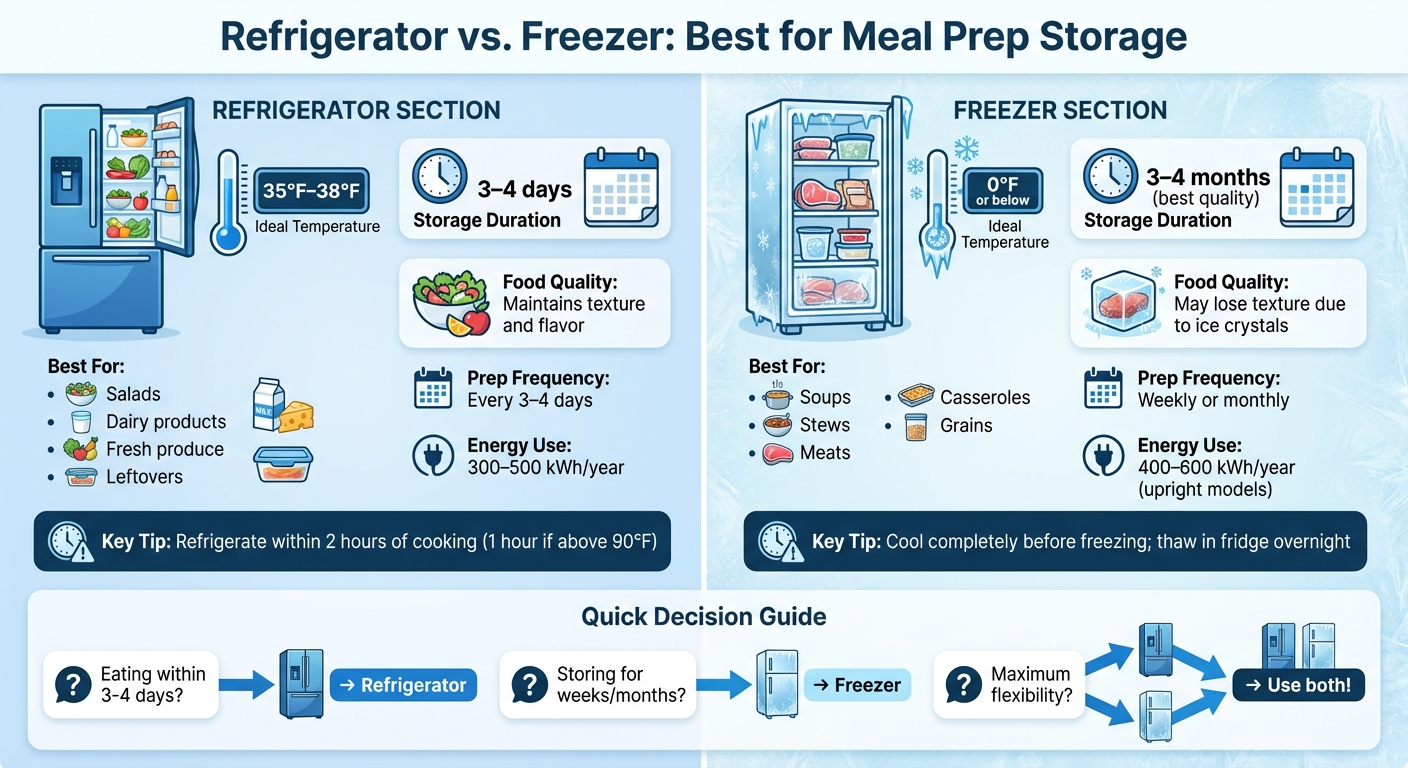
- Refrigerators (35°F–38°F): Best for short-term storage (3–4 days). They preserve texture and flavor but don’t stop bacterial growth completely. Ideal for salads, dairy, and leftovers.
- Freezers (0°F or below): Perfect for long-term storage (up to 3–4 months for best quality). They keep food safe indefinitely but may impact texture due to ice crystals. Great for soups, stews, and casseroles.
Key Tips for Safe Storage:
- Use airtight containers to prevent spoilage.
- Refrigerate cooked food within 2 hours (1 hour if it’s above 90°F).
- Label and date all items to track freshness.
- Use a thermometer to ensure accurate temperatures: below 40°F for the fridge and at 0°F for the freezer.
Quick Comparison:
| Feature | Refrigerator | Freezer |
|---|---|---|
| Ideal Temperature | 35°F–38°F | 0°F or below |
| Storage Duration | 3–4 days | Up to 3–4 months |
| Food Quality | Maintains texture | May lose texture |
| Best For | Fresh produce, dairy, leftovers | Soups, stews, meats, casseroles |
Both play vital roles in meal prep. Use the fridge for quick access and the freezer for longer storage. Together, they help you save time, reduce waste, and keep meals safe and ready to enjoy.
Refrigerator vs Freezer Storage Guide for Meal Prep
How to Use Your Refrigerator for Meal Prep
Temperature Settings and How Long Food Lasts
Keep your refrigerator set between 35°F and 38°F for the best conditions to store meal prep. According to the U.S. Department of Energy, 37°F is the ideal temperature. Temperatures below 34°F can freeze fresh items like produce and liquids, while anything above 40°F increases the risk of bacterial growth.
Cooked meals can stay fresh for about 3–4 days. To ensure safety, refrigerate these meals within 2 hours of cooking - or within 1 hour if your kitchen temperature is above 90°F. Use shallow containers for quicker and more even cooling.
"The ideal refrigerator temperature is 35º–38º F in the main part of the fridge, with the optimal temperature at 37ºF." - U.S. Department of Energy
In case of a power outage, keeping the refrigerator door closed will help maintain a safe temperature for approximately 4 hours.
You can also use AI meal planning for ingredient prep to further streamline your process. Next up, let’s dive into organizing your meal prep for maximum efficiency and freshness.
How to Organize Meal Prep in Your Refrigerator
Airtight containers are your best friend for storing food. They prevent dryness, keep odors from mixing, and help maintain freshness. Glass containers are especially handy because they don’t absorb stains or odors and seal tightly. To stay organized, label containers with masking tape and a permanent marker, noting the date and contents. For even better inventory management, consider AI meal planning with pantry integration to track what you have on hand.
Here’s a quick guide to fridge organization:
- Raw meats: Place on the bottom shelf in a rimmed tray or baking sheet to catch drips and avoid cross-contamination.
- Ready-to-eat meals: Store on the upper shelves for easy access.
- Dairy products: Keep them on the middle shelves.
- Door shelves: Use these for condiments and frequently used items since they’re exposed to temperature changes.
"Air is the enemy of most foods and can increase their rate of spoilage. By transferring them to smaller containers, you not only minimize air contact, but you also help keep your fridge organized and easy to navigate." - J. Kenji López-Alt, Culinary Consultant, Serious Eats
Avoid cramming your fridge full. Leave about 20% of the space open to allow proper air circulation. As you work through your meal prep, transfer leftovers to smaller containers to reduce air exposure and make room for new items. You can also adjust shelf heights to better fit your containers instead of sticking with the default settings.
With your fridge neatly arranged, let’s explore why it’s such a reliable tool for preserving meal prep.
Why Refrigerators Work Well for Meal Prep
Refrigerators are perfect for meal prep because they maintain the right temperature to prevent ice crystals from forming. Ice crystals can damage food on a cellular level, which often happens with freezing, so refrigeration helps preserve both texture and flavor.
Certain types of meals hold up even better in the fridge. Dishes with acidic ingredients, natural preservatives, hearty vegetables, or whole grains tend to stay fresh longer. To keep your meals at their best, store wet ingredients - like dressings or sauces - separately from dry components, such as grains or proteins, to avoid sogginess. When it’s time to reheat, make sure your food reaches an internal temperature of 165°F, and try not to reheat the same portion more than once.
How to Use Your Freezer for Meal Prep
Temperature Settings and How Long Food Lasts
Set your freezer to 0°F or below to safely store meal prep items. At this temperature, bacteria, yeasts, and molds stop growing, keeping your food safe indefinitely. That said, while safety isn't an issue, the quality of food - like its flavor, texture, and color - starts to decline after about 3 to 6 months.
For accuracy, don't just trust the freezer's digital display. Place an appliance thermometer near the front of the freezer. As food safety expert Gevork Kazanchyan explains:
"Take a quick look at the thermometer and then close the door. The thermometer should be near the front... because the deep back is going to be the coldest spot".
If the power goes out, a full freezer can stay at a safe temperature for up to 48 hours as long as the door remains closed. A half-full freezer, however, only holds for about 24 hours. To maximize efficiency, aim to keep your freezer 75–85% full.
| Meal Prep Item | Recommended Freezer Storage (for Quality) |
|---|---|
| Soups and Stews | 2–3 Months |
| Cooked Meat or Poultry | 2–6 Months |
| Casseroles | 2–3 Months |
| Cooked Fish | 4–6 Months |
| Pizza | 1–2 Months |
| Chicken Nuggets/Patties | 1–3 Months |
"Food stored constantly at 0 °F will always be safe. Only the quality suffers with lengthy freezer storage." - USDA
Next, let’s look at how to prevent freezer burn and keep your meals tasting their best.
How to Prevent Freezer Burn and Keep Food Quality High
Freezer burn happens when air dries out the surface of your food, leaving grayish-brown spots. To avoid this, use airtight packaging like vacuum-sealed bags, heavy-duty foil, or freezer-safe zip-top bags.
Before freezing, make sure food has cooled completely - ideally within 2 hours. Placing warm food directly into the freezer can create condensation, which may raise the temperature of nearby items. For liquids like soups or sauces, leave at least 1 inch of headspace in containers to allow for expansion as they freeze.
Label each package with the contents, date frozen, and quantity using masking tape or freezer tape. To keep things organized, use the FIFO (First In, First Out) method: place newer items toward the back and older ones in front. For foods like pancakes or meatballs, try flash freezing them first - spread them in a single layer on a baking sheet, freeze, and then transfer to a bag to avoid clumping.
"Freezer burn doesn't necessarily make foods unsafe to eat. However, it may cause the foods to have a strange texture or color." - A Dash of Macros
With these tips, you can keep your frozen meals in top condition. Now, let’s explore why freezers are such a game-changer for meal prep.
Why Freezers Work Well for Meal Prep
Freezers let you prepare meals far in advance, giving you the convenience of pulling out ready-made options whenever you need them. This approach not only saves time but also adds variety to your meals without requiring daily cooking by using a smart meal planning tool.
Another big advantage? Freezing reduces waste. Instead of tossing leftovers, you can store them for later. As long as food still has ice crystals or is at 40°F or below, it’s safe to refreeze, though the quality might drop slightly. Just keep in mind that certain foods - like mayonnaise, cream sauces, lettuce, or gravies thickened with cornstarch - don’t hold up well in the freezer and may separate or turn mushy when thawed.
The Ultimate Freezer Meal Prep Guide | 40 Recipes That Actually Work
Refrigerator vs. Freezer: Side-by-Side Comparison
When it comes to food storage, refrigerators and freezers each have their strengths. Refrigerators are perfect for short-term storage, keeping food fresh for a few days at temperatures between 35°F and 38°F. Freezers, on the other hand, are ideal for long-term storage, preserving food for months at 0°F or below. However, for the best quality, frozen food is typically consumed within 3–4 months.
One major difference lies in texture. According to experts, "Refrigerated meals typically taste better than frozen foods. Freezing meals causes the water molecules to expand and break as they turn into ice. The damaged cell walls compromise the texture and flavor of the food". This is why delicate items like salads, soft cheeses, and cream-based dishes are better suited for the refrigerator, while sturdier options like soups, stews, and cooked meats hold up well in the freezer.
Another factor to consider is energy efficiency. Refrigerators generally use about 300–500 kWh annually for top-freezer models. Upright freezers, which must maintain much colder temperatures, consume around 400–600 kWh per year. Chest freezers are even more efficient, using only 200–400 kWh annually, but they require more floor space.
Comparison Table: Refrigerator vs. Freezer
Here’s a quick breakdown of the key differences:
| Feature | Refrigerator | Freezer |
|---|---|---|
| Ideal Temperature | 35°F to 38°F | 0°F or below |
| Storage Duration | 3–5 days | 3–4 months (best quality) |
| Food Quality | Maintains texture and flavor | May be affected by ice crystals |
| Best Food Types | Salads, dairy, fresh produce, leftovers | Soups, stews, meats, grains, casseroles |
| Thawing | Not needed | Required (preferably overnight in fridge) |
| Prep Frequency | Every 3–4 days | Weekly or monthly |
| Energy Use | 300–500 kWh/year | 400–600 kWh/year (upright models) |
Both appliances play essential roles in meal prep. Refrigerators provide easy access to fresh ingredients and leftovers, while freezers are perfect for stocking up on meals for busy weeks or emergencies. Combining both storage methods ensures you get the best of both worlds - convenience and quality.
Food Safety and Storage Guidelines
Keeping food safe during storage is essential, especially when prepping meals in advance. According to the USDA, bacteria thrive in the "Danger Zone" - temperatures between 40°F and 140°F - where some types can double in just 20 minutes. This makes proper temperature control a key factor in avoiding foodborne illnesses like Salmonella and E. coli.
Why Independent Thermometers Matter
Relying on your fridge or freezer's built-in thermometer? You might want to reconsider. Studies show that about 40% of built-in thermometers are inaccurate. To ensure your food stays safe, invest in an independent appliance thermometer. Basic analog models, like the Taylor 5924 Large Dial Thermometer, are budget-friendly at under $10. For a more advanced option, WiFi-enabled systems like the GoveeLife Refrigerator Thermometer offer remote alerts and data tracking, typically priced between $30 and $50. Place one thermometer in the center of your fridge's middle shelf and another among your freezer's frozen items for accurate readings.
Refrigerator Safety Guidelines
Your fridge should always stay at 40°F or below. Meal-prepped dishes need to be refrigerated within 2 hours of cooking - or within 1 hour if the room temperature exceeds 90°F. Avoid overloading the fridge; leaving about 20% of the space open helps ensure proper airflow. This is crucial because bacteria can grow rapidly without altering the food's smell or appearance.
For items like soups or stews, divide them into shallow containers to help them cool evenly and quickly. Also, store raw meats, poultry, and seafood in sealed containers on the bottom shelf to prevent their juices from contaminating other foods.
Freezer Safety Guidelines
Freezers have their own set of rules to ensure food safety. Keep the temperature at 0°F or below to stop bacterial growth. However, setting the temperature lower than necessary is wasteful, as every degree below 0°F increases energy use by 2% to 3%.
Before freezing meals, make sure they’ve cooled completely - ideally within the 2-hour safety window. This prevents the freezer's internal temperature from rising. When thawing, the safest method is to let the food defrost overnight in the refrigerator. Avoid leaving it on the counter, where bacteria can quickly multiply. For quicker thawing, use a leak-proof bag in cold water (changing the water every 30 minutes) or the microwave. Just remember to cook the food immediately afterward. If you thaw something in the fridge, aim to consume it within 24 hours. While refreezing is safe, some quality may be lost.
Using Apps to Plan Your Meal Prep
Staying on top of meal prep storage is much easier with the right tools. Apps like Honeydew Recipe Manager (https://honeydewcook.com) simplify the process by generating grocery lists, organizing recipes, and planning meals based on your storage needs. Its AI-powered meal planner can create weekly plans in seconds, factoring in which foods should be refrigerated for immediate use and which can be frozen for later. Features like ingredient substitution, nutrition tracking, and shared access for up to six family members help everyone stay informed about what’s in the fridge or freezer. By keeping track of ingredients and sending storage reminders, Honeydew Recipe Manager helps you stick to these essential safety practices.
Choosing the Right Storage for Your Meal Prep
Once you've nailed down the proper temperature settings and organization, the next step is picking the right storage method to fit your meal prep routine. Many seasoned meal preppers rely on both the fridge and freezer to keep meals fresh and ready to go.
Refrigerator for Short-Term Storage
Refrigerators are the go-to for meals you'll eat within 3–4 days. Some dishes, like salads, egg-based recipes, cream sauces, and high-water-content veggies, hold up best in the fridge. Freezing these can lead to watery textures or separation, so refrigeration is key for preserving their quality.
Freezer for Long-Term Storage
When you need meals to last beyond the week, your freezer steps in as a lifesaver. At 0°F, food stays safe indefinitely, but for the best flavor and texture, aim to use frozen meals within 3 to 4 months. Freezers are perfect for hearty dishes like soups, stews, casseroles, and braised meats. Certified Nutrition Coach Jim Lopez shares his approach:
"I normally leave two days worth of food in the refrigerator and put everything else in the freezer".
This method minimizes food waste while ensuring you always have meals ready to go. Using the freezer effectively extends the usability of your meal prep without sacrificing convenience.
Using Both for Maximum Flexibility
The real magic happens when you combine both storage methods. Keep 3 to 4 days' worth of meals in the fridge for easy access, and freeze the rest as soon as they're prepped. This system works especially well for batch cooking. For example, you can cook a large batch of shredded chicken or ground beef, use some for the week, and freeze the rest for future meals. Contributing Chef Nathaniel Lee highlights the freezer's importance:
"The freezer is any avid meal prepper's best friend. It allows you to cook and store a week, even a month's, supply of meals".
To make planning and tracking easier, tools like Honeydew Recipe Manager (https://honeydewcook.com) can help. This app not only schedules which meals to refrigerate or freeze but also helps reduce food waste. Its AI meal planner creates weekly plans in minutes, and with shared access for up to six family members, everyone can see what's available in both the fridge and freezer.
FAQs
Which meal prep foods should never be frozen?
When it comes to raw meat or seafood, don’t refreeze them once they’ve been thawed. Thawing allows bacteria to become active, and freezing again won’t kill them. To keep your food safe, always handle these items carefully and plan ahead to avoid the need for refreezing.
What’s the safest way to cool food before refrigerating or freezing?
To cool food safely before storing, transfer hot food into small, shallow containers. Allow it to cool to room temperature within two hours - this helps prevent harmful bacteria from multiplying. Once cooled, immediately move it to the refrigerator or freezer to maintain safe temperatures and protect its freshness.
How can I tell if my fridge or freezer temperature is accurate?
To ensure food safety, use a thermometer to check your appliance's internal temperature. The refrigerator should stay at or below 40°F (4°C), while the freezer should be kept at 0°F (-18°C). If needed, adjust the thermostat to maintain these temperatures.