Scaling Recipes: Cups to Grams Made Simple
• Updated
Want to perfect your recipes? Start measuring by weight instead of volume. Converting cups to grams ensures accuracy, especially when scaling recipes up or down. Here's why it matters:
- Volume vs. Weight: Cups measure space, grams measure mass. Ingredients like flour or sugar pack differently, leading to inconsistent results.
- Precision Matters: A cup of flour can vary from 120g to 160g depending on how it's measured. Using grams eliminates guesswork and ensures consistent outcomes.
- Scaling Recipes: Errors multiply when adjusting recipes for more or fewer servings. Measuring by weight keeps ingredient ratios intact.
Switch to a digital kitchen scale for precise measurements. Tools like the Honeydew Recipe Manager make conversions effortless, handling servings, grams, and even recipe imports. Accurate measurements = better results every time.
Baking Conversions Chart /Weight Conversions/Cup to Gram Conversions
Cups to Grams Conversion Checklist
Having a dependable conversion guide can make scaling recipes much easier. Below, you'll find tables outlining standard conversions for some of the most commonly used kitchen ingredients. These measurements assume you're using the "spoon-and-level" method rather than scooping directly from the container.
Dry Ingredients: Standard Conversions
The weight of dry ingredients can differ based on how they're measured. For instance, a cup of all-purpose flour might weigh between 120 grams and 160 grams depending on the method. Using the "spoon-and-level" technique typically results in 120–125 grams, while scooping directly from the bag can lead to a denser cup, weighing closer to 140–160 grams.
| Dry Ingredient | 1 Cup (Grams) |
|---|---|
| All-Purpose Flour | 120g – 125g |
| Bread Flour | 120g – 136g |
| Cake Flour | 115g – 120g |
| Granulated White Sugar | 198g – 200g |
| Brown Sugar (Packed) | 213g – 220g |
| Confectioners' Sugar | 113g – 125g |
| Cocoa Powder (Unsweetened) | 84g – 90g |
| Rolled Oats | 80g – 99g |
| Chocolate Chips | 170g – 175g |
For ingredients like baking soda or salt, which typically weigh less than 10 grams, it’s best to stick with measuring spoons unless you have a highly precise scale.
Liquid Ingredients: Standard Conversions
When converting liquids, keep in mind that their weights vary based on density. For example, water has a density of 1.00 g/mL, so 1 cup (240 mL) weighs exactly 240 grams. Oils, which are less dense, weigh slightly less per cup.
| Liquid Ingredient | 1 Cup (Grams) |
|---|---|
| Water | 240g |
| Milk (Whole) | 245g – 249g |
| Vegetable Oil | 216g – 221g |
| Olive Oil | 221g |
| Heavy Cream | 238g |
"Please don't use the mL or volume button on your kitchen scale (if it has one) to measure a volume. Yes, you can weigh a volume, but the button on your kitchen scale assumes that you are weighing out water, which has a density of 1 gram per milliliter."
- Janice, Recipe Developer, The Bake School
Special Ingredients and Conversion Tips
Some ingredients, like butter, honey, and nuts, require specific handling. Butter is straightforward: 1 stick equals 1/2 cup or roughly 113–115 grams. Sticky ingredients like honey and maple syrup are much denser than water, with 1 cup weighing about 340 grams. To avoid wasting sticky ingredients, weigh them directly into your mixing bowl using the scale's "tare" function.
| Ingredient | 1 Cup (Grams) | Handling Tip |
|---|---|---|
| Butter | 227g – 230g | 1 stick = 115g or 1/2 cup |
| Honey / Maple Syrup | 340g | Weigh directly using the "tare" function |
| Nut Butters | 250g | Use dry measuring cups |
| Chopped Nuts | 115g | Weigh for accuracy; volume may vary |
Chopped nuts take up less space than whole nuts, even when they weigh the same.
Kitchen Tools for Accurate Measurements
Having the right tools can make converting cups to grams a breeze. While you might already have measuring cups and spoons in your kitchen, adding a digital kitchen scale can take your recipe accuracy to the next level. These tools help bridge the gap between traditional volume-based methods and precise weight measurements.
Digital Kitchen Scales
When it comes to precision, a digital kitchen scale is your best friend. Unlike volume measurements - which can vary depending on how ingredients are scooped or packed - weight remains constant. Stevie Stewart, a professional product tester at Food Network, emphasizes this point:
"The only way to know that your measurements are the same every single time is to use a kitchen scale".
Look for a scale with features like a tare function (to reset the weight to zero after placing a container), unit toggling (grams, ounces, pounds), and a capacity of at least 11 lbs for larger recipes. Other helpful features include a clear display, an accurate auto-shutoff, and precise measurements. Want to check your scale's accuracy? Weigh four U.S. nickels - they should total exactly 20 grams.
Digital scales are available at a variety of price points, so you can find one that fits both your needs and your budget.
Measuring Cups and Spoons
Even with a digital scale, quality measuring cups and spoons are still essential for quick measurements and smaller quantities. Dry measuring cups are built with flat rims, allowing you to level off ingredients with a knife for accuracy. Liquid measuring cups, on the other hand, have spouts and extra space to prevent spills. Using the wrong type can lead to errors, so match the tool to the ingredient.
For liquids, place the cup on a flat surface and check the measurement at eye level to account for the meniscus (the curve at the liquid’s surface). For dry ingredients, use the "dip-and-sweep" method: overfill the cup slightly, then level it off with a flat edge. Adjustable measuring cups are especially useful for sticky ingredients like honey or peanut butter - they let you push out every last bit without waste.
To double-check your measurements, weigh the contents in grams on your scale before applying your scaling factor. Combining these tools and techniques ensures consistent results, from prepping to cooking.
How to Scale Recipes: Step-by-Step Checklist
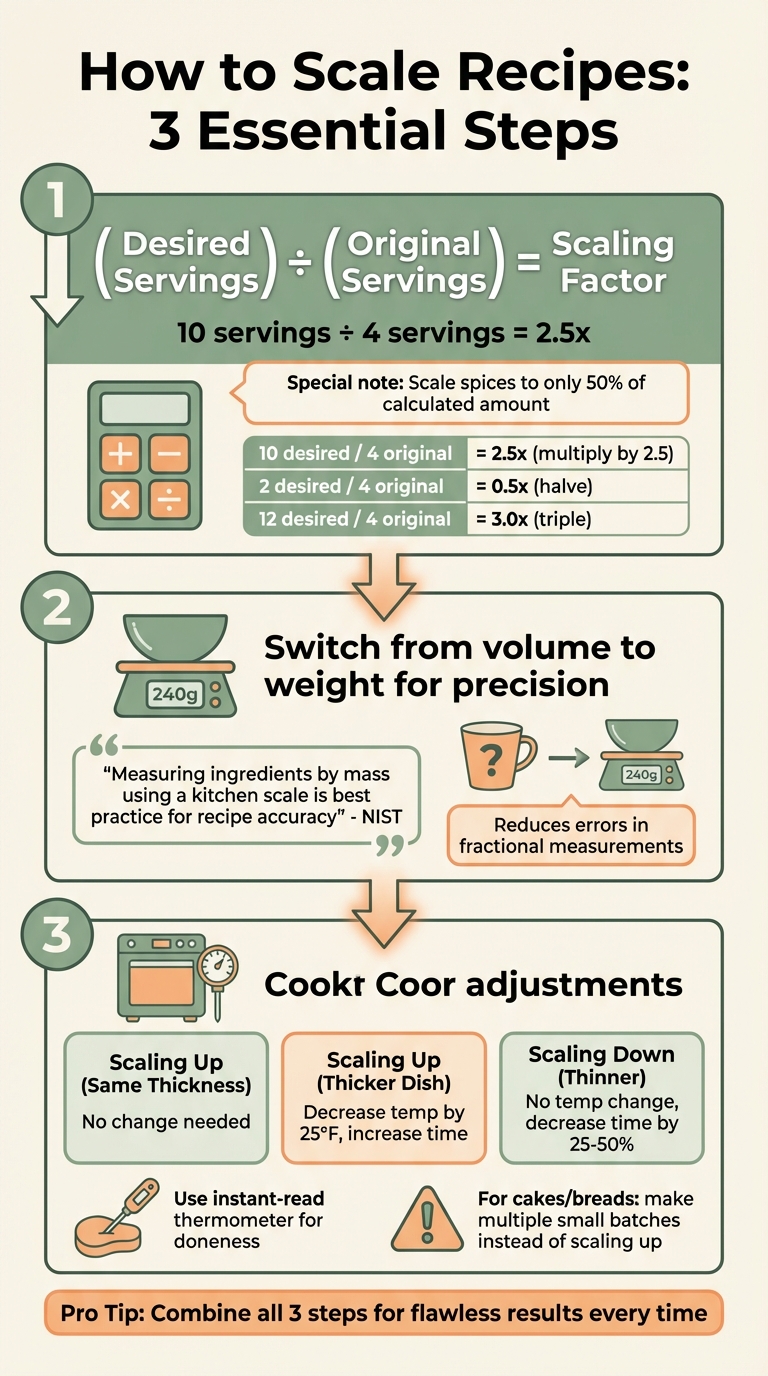
How to Scale Recipes: 3-Step Process from Cups to Grams
Scaling a recipe is more than just multiplying ingredient amounts - it’s about keeping flavors, textures, and cooking times in harmony. To ensure your scaled recipe turns out just right, follow these steps to maintain balance and accuracy.
Step 1: Calculate Your Scaling Factor
Start by determining your scaling factor with this formula: (desired servings) ÷ (original servings). For instance, if a recipe serves 4 and you need 10 servings, the scaling factor is 2.5 (10 ÷ 4 = 2.5). Use this factor to adjust each ingredient, but make sure to handle spices and leavening agents carefully - scale them to only 50% of the calculated amount, then fine-tune by taste. For baking powder or baking soda, aim for 1 to 1.25 teaspoons per cup of flour.
| Desired Servings | Original Servings | Scaling Factor | Action |
|---|---|---|---|
| 10 | 4 | 2.5 | Multiply ingredients by 2.5 |
| 2 | 4 | 0.5 | Multiply ingredients by 0.5 (halve) |
| 12 | 4 | 3.0 | Multiply ingredients by 3.0 (triple) |
Once you’ve calculated ingredient amounts, convert them to grams for better accuracy.
Step 2: Convert to Grams Before Scaling
Switching from volume to weight measurements is key for precision. Using grams ensures consistency, especially for ingredients like flour or sugar, which can vary when measured by volume. The National Institute of Standards and Technology (NIST) highlights this approach:
"Measuring ingredients by mass (weight) using an appropriate kitchen scale is a best practice to improve recipe accuracy, rather than measuring ingredients by volume using fluid or dry measuring cups".
This step reduces errors that can add up when scaling fractional measurements, like cups or tablespoons. After converting, be sure to adjust cooking parameters to fit the new recipe size.
Step 3: Adjust Cooking Times and Temperatures
Cooking times depend more on the dish’s thickness than its overall volume. If your scaled recipe results in a thicker dish, the center will take longer to cook. To address this, lower the oven temperature by about 25°F and increase the cooking time to ensure even results. For thinner, scaled-down dishes, start checking for doneness 25% to 50% earlier than the original cooking time.
| Scaling Scenario | Temperature Adjustment | Cooking Time Adjustment |
|---|---|---|
| Scaling Up (Same Thickness) | No change | No significant change |
| Scaling Up (Increased Thickness) | Decrease by 25°F | Increase time; check frequently |
| Scaling Down (Smaller/Thinner) | No change | Decrease by 25%–50% |
An instant-read thermometer can help confirm doneness, especially for baked goods or proteins. For delicate recipes like cakes or yeast breads, it’s often better to prepare multiple smaller batches rather than scaling up too much at once. This ensures consistent quality and avoids overcomplicating the process.
Using Honeydew Recipe Manager for Conversions
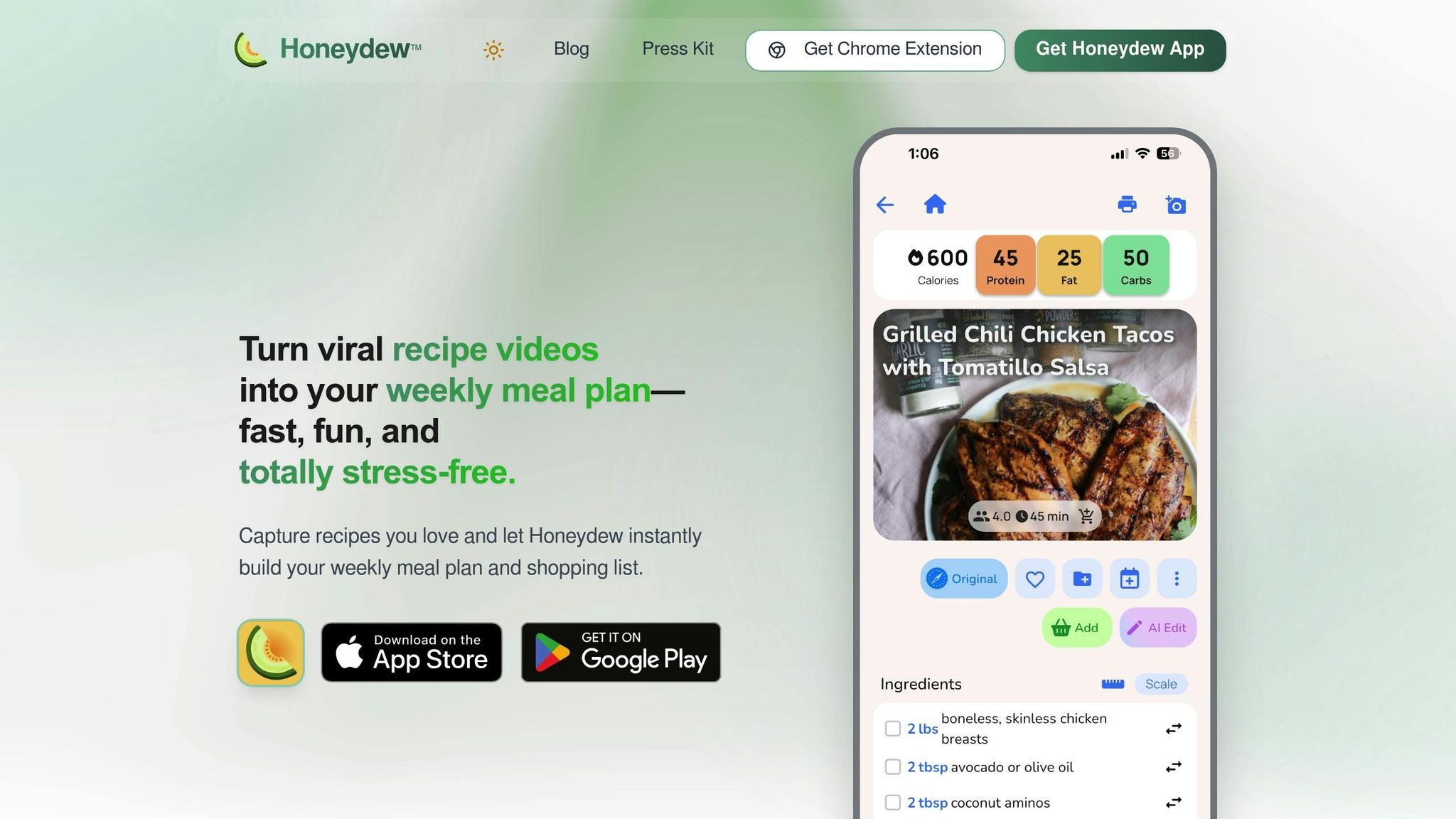
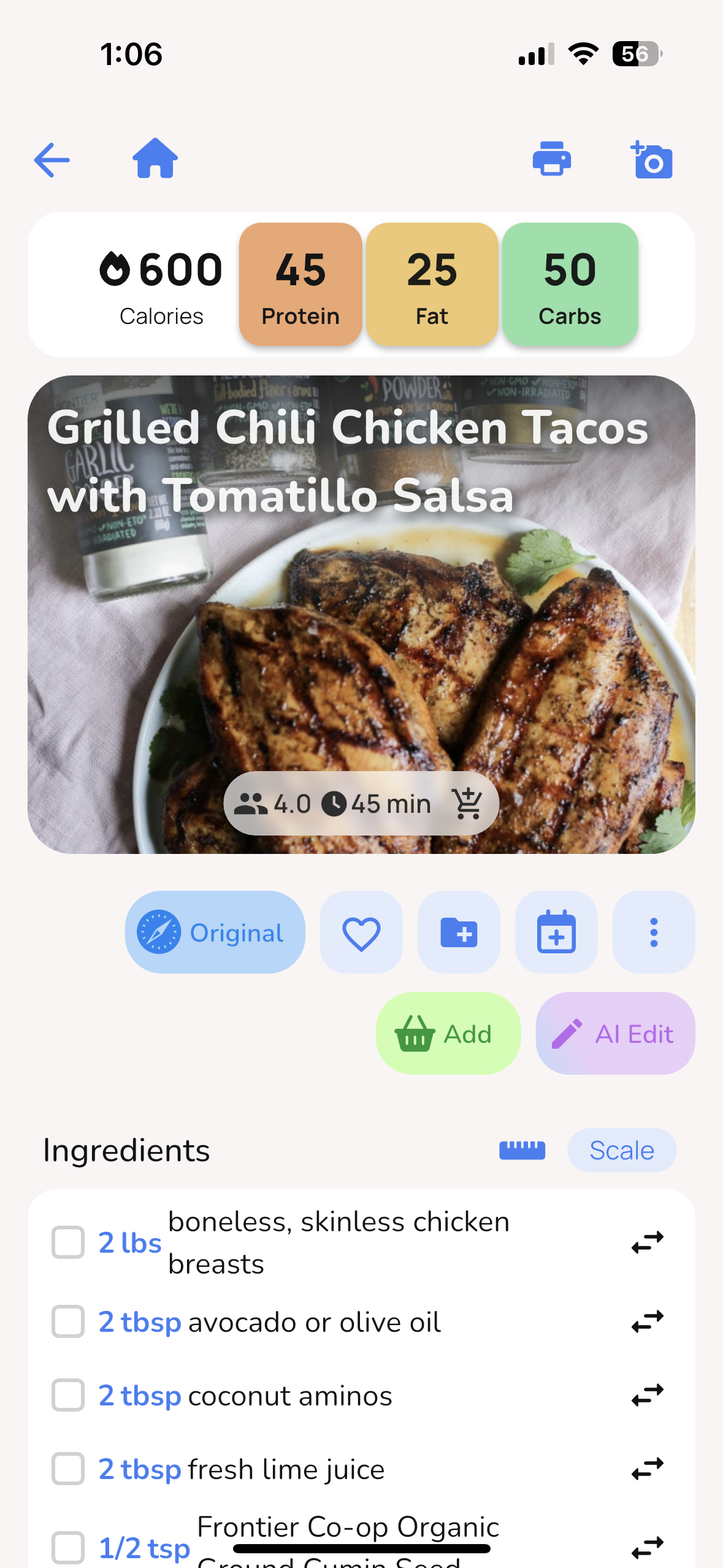
Getting recipe conversions right is essential for scaling dishes, and Honeydew Recipe Manager takes the guesswork out of the process. Instead of struggling with tedious manual conversions - like figuring out how many grams are in a cup - Honeydew handles it all for you, so you can focus on cooking.
Automatic Serving Size Scaling
Honeydew uses AI-powered portion adjustments to automatically tweak ingredient amounts based on the number of servings you need. It even factors in ingredient density. For example, if you're scaling a recipe requiring 2 cups of all-purpose flour (roughly 240 grams), the app ensures the conversion remains accurate by considering the unique properties of each ingredient.
The app also offers an instant toggle between Imperial and Metric systems, allowing you to switch between cups and grams with a single tap. This feature is ideal for cooks who prefer different measurement systems or are working with recipes from other countries. With around 90,000 recipes saved by users every month, Honeydew has become a trusted tool for home cooks. Its 4.8-star rating on both the App Store and Google Play highlights how much users appreciate its precise measurement conversions.
This smart automation paves the way for even more helpful features within the app.
Recipe Import and Meal Planning Features
Beyond scaling recipes, Honeydew simplifies how you organize and plan your meals. The app's AI extracts ingredients, instructions, and cooking details from sources like social media, websites, or even photos of handwritten recipes. Plus, its recipe translation feature allows you to convert recipes into your preferred measurement system, making it easier to experiment with dishes from all over the world.
"Honeydew's recipe translation feature lets me try recipes from around the world. It's like having a personal chef!" - Lisa H.
Once your recipe is scaled and converted, Honeydew creates a smart grocery list that organizes ingredients by store aisle. You can even sync this list with Instacart for quick online ordering, ensuring you get exactly what you need - whether it's 450 grams of flour or 2 pounds of chicken. For those focused on reducing waste, Honeydew’s AI meal planning tools can cut food waste by up to 40% and save households about $125 per month.
The app offers a free version with basic features on iOS and Android. For those who want more, Honeydew Plus ($4.17/month) unlocks perks like unlimited recipe storage, photo capture for physical cookbooks, and household sharing for up to six members.
Conclusion
Switching from cups to grams ensures consistent results in your recipes. Using weight measurements instead of volume removes the guesswork caused by varying ingredient densities and packing methods. This is especially crucial in baking, where precision can make or break the texture and rise of your creations.
Following a clear process can make all the difference. Start by converting your measurements to grams before scaling your recipe. Use a digital scale for ingredients over 10 grams, and stick to measuring spoons for smaller quantities like baking soda or salt. This approach minimizes errors and keeps your recipe on track.
For an even easier experience, technology can take the hassle out of conversions. Tools like Honeydew Recipe Manager handle serving size adjustments and Imperial-to-Metric conversions automatically. This means less time spent with conversion charts and more time focusing on your cooking.
Accurate conversions protect the balance of your recipe and keep your ingredient ratios spot on. Stick to the checklist, rely on a dependable kitchen scale, and let tools like Honeydew do the heavy lifting for flawless results every time.
FAQs
Why is weighing ingredients more reliable than measuring by cups?
Weighing ingredients is a smarter approach because it eliminates the uncertainty that comes with how ingredients are measured. Take flour, for instance - a cup of flour can weigh more or less depending on how firmly it’s packed. But 120 grams of flour? That’s always consistent. A kitchen scale guarantees accuracy every single time, which is crucial when baking or working with recipes that demand precision.
How can I scale recipes while keeping the flavors and textures just right?
Scaling recipes isn’t as simple as multiplying every ingredient by the same number. To keep the flavor and texture intact, you’ll need to make some thoughtful adjustments. For instance, spices, liquids, and leavening agents like baking powder often require more precise tweaking. Doubling a recipe doesn’t always mean doubling the salt or baking soda - sometimes, smaller adjustments are needed to avoid overpowering or altering the dish.
Precision also plays a huge role, especially in baking. Converting measurements - like switching from cups to grams - can make a big difference in consistency. Reliable conversion tools or charts can help you get it just right. And don’t forget, certain ingredients like flour or butter come with their own quirks. Their density or moisture content can impact the final result, so it’s worth paying extra attention to these details. By focusing on these nuances, you can scale recipes successfully without compromising their original charm.
What should I look for in a digital kitchen scale to ensure accurate measurements?
When picking a digital kitchen scale, accuracy is key. Look for one that can measure in small increments, like 0.1 grams or 1 gram, to ensure precise measurements, especially for smaller ingredients. A tare function is another must-have - it lets you subtract the weight of bowls or containers, so you're only measuring the ingredients themselves.
Scales with unit conversion options are super handy, allowing you to switch between grams, ounces, and other units effortlessly. This is especially useful when adjusting recipes or converting measurements like cups to grams. For added convenience, opt for a model with a clear, easy-to-read digital display and a durable surface that's simple to clean. Compact designs save storage space, and some even come with smart features like app integration to make meal prep even smoother.
By focusing on these features, you’ll set yourself up for accurate and hassle-free cooking and baking every time.