How Smart Containers Track Food Freshness
• Updated
Every year, one-third of all food worldwide is wasted - a massive issue that impacts wallets and the planet. Smart containers are tackling this problem by using sensors to monitor food freshness in real time. These containers measure temperature, humidity, and gases like ammonia or ethylene to detect spoilage early. Unlike static expiration dates, they provide real-time data on food quality, helping reduce waste and save money.
Here’s what makes them stand out:
- Temperature & Humidity Sensors: Keep food in safe conditions and detect cold chain breaches.
- Gas Sensors: Spot spoilage compounds like ammonia or hydrogen sulfide before food goes bad.
- IoT Connectivity: Sync with apps for alerts, pantry inventory tracking, and meal planning.
- Practical Benefits: Cut household food waste by up to $2,400 annually with smarter storage.
While smart containers reduce waste and simplify meal prep, challenges like high costs, sensor maintenance, and food-type compatibility remain. However, their potential to improve food management and reduce waste is promising.
Smart Food Containers | The Henry Ford's Innovation Nation
How Smart Containers Track Food Quality
How Smart Container Sensors Monitor Food Freshness in Real-Time
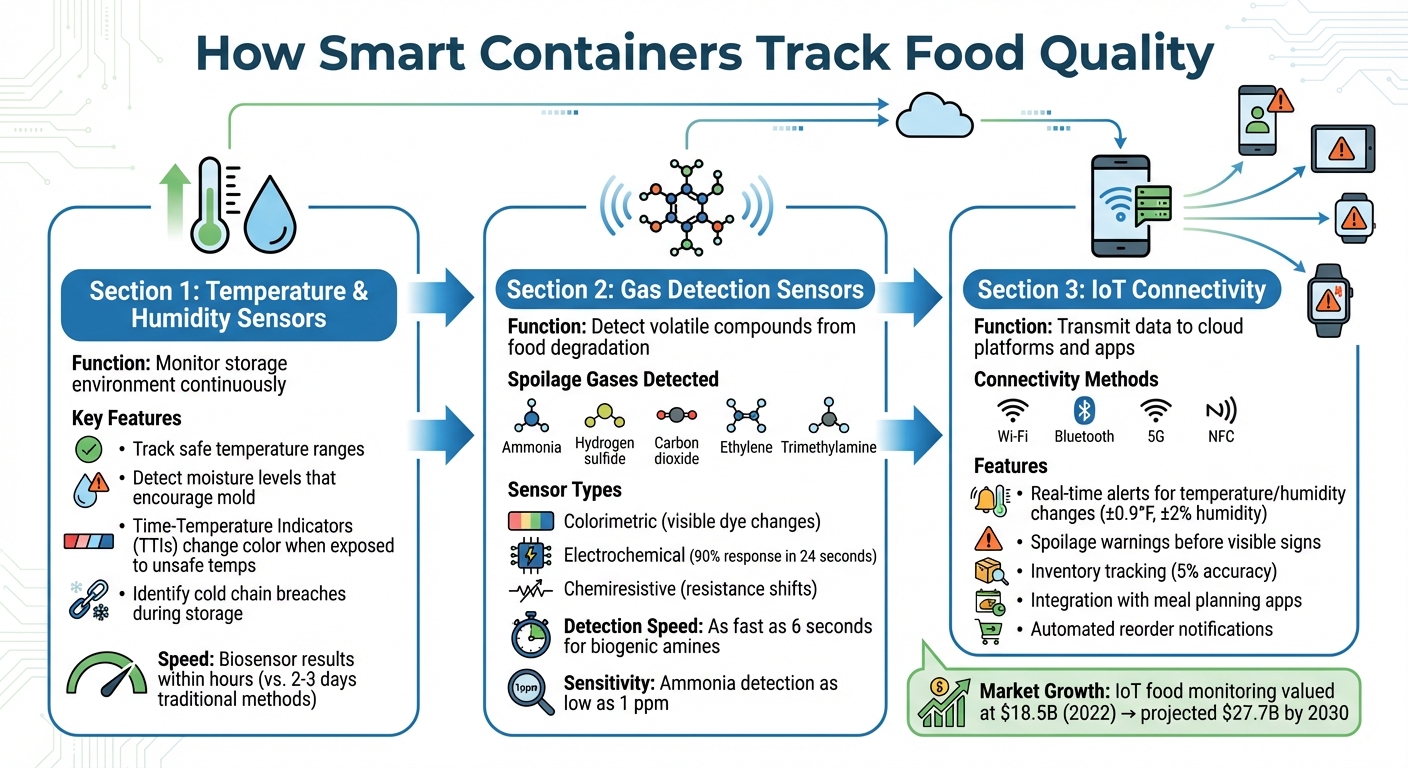
Smart containers are equipped with sensors that monitor environmental conditions like temperature and humidity, as well as gases that signal spoilage. These tools go beyond simple expiration dates, offering a real-time view of food freshness. Let’s break down how these sensors work to ensure food quality.
Temperature and Humidity Sensors
Temperature and humidity sensors continuously monitor the environment inside the container. Temperature sensors ensure that food remains within safe ranges, while humidity sensors track moisture levels that could encourage mold growth, especially on fresh produce.
Advanced systems use time–temperature indicators (TTIs), which change color irreversibly when exposed to unsafe temperatures. This provides a visual cue for cumulative heat exposure. Some modern refrigerators even incorporate technology to maintain uniform temperatures, eliminating hot spots that could compromise food safety.
"Intelligent packaging monitors the state of food and its surrounding environment, providing real-time information about food quality through indicators, sensors, and data carriers." – Food Safety Institute
These sensors are particularly useful for identifying cold chain breaches during loading, unloading, or storage. This allows for quick action to prevent spoiled products from reaching consumers. Additionally, biosensors integrated into smart packaging can deliver results within hours - far faster than traditional detection methods, which often take two to three days.
While these sensors are essential for maintaining safe storage conditions, gas sensors offer another layer of protection by detecting signs of spoilage.
Gas Detection for Spoilage
Gas sensors provide an early warning system for spoilage by identifying volatile compounds released as food begins to degrade. These compounds include ammonia, hydrogen sulfide, carbon dioxide, ethylene, and trimethylamine, each associated with specific types of spoilage.
Different types of sensors are used for this purpose:
- Colorimetric sensors: Detect spoilage through visible dye changes.
- Electrochemical sensors: Respond rapidly to changes in gas concentrations, achieving a 90% response rate in just 24 seconds for gases like ammonia and hydrogen sulfide.
- Chemiresistive sensors: Measure resistance shifts to identify spoilage gases.
The gases emitted vary depending on the food type. For instance, meat and seafood release ammonia, hydrogen sulfide, and biogenic amines as proteins break down. Fruits and vegetables, on the other hand, emit ethylene during ripening, ethanol during fermentation, and carbon dioxide through respiration.
A fascinating innovation came in December 2024, when researchers at Tongji University, led by Alituniguli Maimaiti, developed a bionic "visual-olfactory" sensor. This device, which syncs with smartphones, uses a gel-embedded organic framework to react to biogenic amines, detecting spoilage in chicken and prawns in under six seconds.
Commercial tools like Ageless Eye™ can detect oxygen levels as low as 0.5%. Similarly, some colorimetric indicators can sense ammonia concentrations as low as 1 ppm, enough to identify bacterial growth in beef within 10 hours at room temperature.
IoT Connectivity in Smart Containers
Smart containers combine sensors with IoT technology to wirelessly send data to cloud platforms and apps. Common connectivity methods include Wi-Fi, Bluetooth, 5G, and Near-Field Communication (NFC), enabling these devices to transmit critical information like temperature, humidity, and gas detection levels. This means you can keep an eye on your food storage conditions from virtually anywhere - whether you're at work or out shopping.
To minimize delays, edge computing processes data locally and can trigger instant alerts for sudden changes, such as temperature spikes. Take TrasTec, for example: they use battery-free RFID sensor stickers paired with an AI-driven cloud system that calculates real-time shelf life using the Q10 model. This setup delivers predictive alerts for spoilage risks and temperature fluctuations.
The IoT market is growing rapidly, valued at $18.5 billion in 2022 and projected to hit $27.7 billion by 2030. For home use, products like CoolBot Pro let you transform standard air conditioners into smart cold storage units, complete with remote monitoring via a mobile app.
Real-Time Alerts and Notifications
IoT-enabled containers don’t just collect data - they act on it, sending alerts to your smartphone when conditions in your storage become unsafe or food nears spoilage. These notifications help bridge the gap between sensor data and actionable decisions, making meal planning much easier. You can even customize thresholds, like setting an alert for when your container reaches 25% capacity or when the temperature shifts by just 1°F.
Alerts for environmental changes are especially useful, notifying you if temperature or humidity levels stray from safe ranges. High-precision sensors can detect deviations as small as ±0.9°F or ±2% humidity. Gas sensors add another layer of protection, spotting spoilage compounds like ammonia or hydrogen sulfide and alerting you before any visible signs of spoilage appear. Some systems even use infrared sensors to track inventory levels with about 5% accuracy, ensuring staples like flour or rice don’t run out unexpectedly.
"Real-time telemetry helps provide actionable insights that are easily consumed by operations. A customizable alert system notifies teams when readings exceed thresholds, enabling rapid decisions without manual checks." – Alexandra Blake, GetTransport
Users of smart containers such as Freshnox praise these alerts for eliminating "last-minute store runs" and simplifying household supply management through shared app access. Some containers even sync with retailers like Kroger, offering manual reorder notifications or triggering automatic refills when supplies run low. These features integrate seamlessly with meal planning tools, helping you act on freshness data right in your kitchen.
Connecting with Meal Planning Apps
Smart containers go beyond alerts by connecting directly with meal planning apps, making kitchen management more proactive. By syncing freshness data, these containers help you track ingredients nearing expiration and prioritize them in your weekly menu. This not only reduces waste but also streamlines meal prep by suggesting recipes that use items before they spoil.
For example, when your smart container detects that produce or dairy is nearing its freshness limit, the Honeydew Recipe Manager app can recommend recipes featuring those ingredients. Its AI meal planner prioritizes flagged items in your weekly menu while generating grocery lists synced with real-time inventory data to prevent overstocking. You can even use the app's search-by-ingredient feature to find recipes tailored to what needs to be used up.
For households juggling various dietary needs, this tech proves invaluable. Pet owners, for instance, can track kibble levels and get reordering alerts through their meal planning app. By integrating IoT containers with platforms like Honeydew Recipe Manager, you create a seamless system where food tracking, meal planning, and shopping lists work together to cut waste and keep your ingredients fresh.
Benefits of Smart Containers
Reducing Food Waste
Smart containers play a key role in cutting down on food waste, which costs the average American household about $1,500 annually due to food expiring before use. By using real-time data to monitor spoilage, these containers help prevent premature disposal.
With machine learning models capable of predicting the freshness of perishable goods with over 90% accuracy, smart containers alert users well before food goes bad. For example, RFID-enabled smart labels can monitor temperature continuously, reducing dairy product waste by as much as 20%.
"Unlike traditional expiration-date labels that communicate only time, food packaging innovations use advanced sensors and artificial intelligence to measure spoilage indicators such as pH balance, bacterial growth and biogenic amines." – Tohid Didar, Associate Professor, McMaster University
The savings are significant: households can save up to $2,400 annually by reducing waste, avoiding duplicate purchases, and improving shopping habits. Take the Rodriguez Family, for instance. In July 2025, they slashed their monthly food waste from $150 to under $30 by using smart tracking and automated expiration alerts, achieving an 80% reduction and saving approximately $1,440 per year.
This smarter approach not only minimizes waste and costs but also simplifies meal planning, making daily life a little easier.
Better Meal Planning
Smart containers also take meal planning to the next level by offering real-time inventory and freshness updates, which integrate directly with meal planning tools.
For instance, when connected to apps like Honeydew Recipe Manager, smart containers allow the AI-powered planner to prioritize ingredients nearing expiration in weekly menus. Users can search for recipes based on what they already have, ensuring nothing goes to waste. Automatically generated shopping lists, tailored to your current inventory, also prevent overbuying. This system makes it easier to use high-value items like red meat (which can stay fresh 7 to 14 days longer) and fresh produce (which can last an extra 3 to 7 days) before they spoil.
For households that rely on batch cooking, these containers are a game-changer. They track staple ingredients in real time, preventing mid-recipe shortages. Custom refill alerts - such as notifications when rice or flour stocks dip below 25% - ensure you’re never caught off guard. By seamlessly combining meal planning, food tracking, and shopping, smart containers create a kitchen environment that reduces waste while maximizing both convenience and efficiency.
Limitations and Challenges
Smart containers bring plenty of promise in reducing food waste and improving meal planning, but they also come with their fair share of hurdles. These challenges often make it difficult for them to gain widespread acceptance.
One major obstacle is cost. The use of pricey biodegradable materials and the need for sensors tailored to specific food types make these containers expensive. For instance, sensors have to be calibrated to detect precise spoilage markers like biogenic amines in fish or lactic acid in dairy. This level of customization drives up production costs, especially for small and medium-sized producers .
"Food-type specificity offers high customization but limits versatility. Each sensor must be engineered to identify specific spoilage metabolites pertinent to a particular food category." – ScienceDirect
Maintenance is another challenge. Natural pigments like anthocyanins, often used in sensors, degrade when exposed to light or heat. High humidity can also affect the materials, causing polymers to swell or dyes to dissolve, which may lead to inaccurate readings. Unlike traditional containers that require virtually no maintenance, these smart containers demand protective barriers to keep sensors stable.
Compatibility issues further complicate things. Sensors designed for one type of food might not work well with another, meaning consumers may need different containers for different items. Additionally, integrating these sensors into existing industrial packaging processes requires specialized equipment and rigorous quality control, adding another layer of complexity.
Lastly, there’s a trade-off between affordability and precision. Optical sensors are battery-free and relatively inexpensive, but they don’t offer the same level of quantitative accuracy as electrochemical sensors. This forces manufacturers to choose between cost-effectiveness and reliable performance.
Overcoming these challenges is critical to unlocking the full potential of smart containers in the fight against food waste.
Conclusion
Smart containers are reshaping how we manage food storage. By delivering real-time insights into temperature, humidity, and spoilage indicators, these systems play a key role in reducing food waste. Considering that up to 40% of the U.S. food supply is wasted - 31% of which occurs at the retail and consumer levels - this technology addresses a pressing issue. For context, the average household throws out about 174 pounds of food annually. These tools not only provide accurate data but also pave the way for digital integration in managing kitchen resources.
In October 2025, FoodTusker introduced a $29 smart container equipped with E-Ink display trackers and a companion mobile app for real-time notifications. Features like expiration countdowns and temperature alerts aim to help families minimize food waste. As Steven Hong, Founder and CEO of FoodTusker, explained:
"Food waste is a global crisis. Our goal... is to give families an easy, reliable way to track what they already have, so good food doesn't end up in the trash".
The true advantage lies in how these containers integrate with broader systems. Paired with the Honeydew Recipe Manager, they create a seamless kitchen experience: AI recommends recipes based on available ingredients, generates grocery lists, and prioritizes perishables for meal planning. Multi-user synchronization ensures everyone in the household knows what’s in stock and when items will expire, reducing duplicate purchases and forgotten leftovers. This combination of smart sensors and intelligent software transforms kitchens into efficient, waste-reducing ecosystems that also help save money.
FAQs
How accurate are smart containers at predicting spoilage?
Smart containers excel at predicting spoilage with the help of cutting-edge sensors and AI. These devices keep track of critical elements like temperature, humidity, and gas levels, offering real-time updates and forecasts. By moving past basic expiration dates, this technology helps extend food freshness and minimizes waste.
Do I need different smart containers for different foods?
Most smart containers are designed to handle a wide range of foods, whether they're stored in the fridge or at room temperature. Equipped with sensors, these containers track key factors like temperature and humidity, making them adaptable to different food types. That said, some high-end models are tailored for specific items, such as meat or dairy. For everyday household needs, a single smart container is generally sufficient for managing various foods.
How do smart containers connect to Honeydew Recipe Manager?
Smart containers leverage IoT technology, such as wireless RFID sensors, to keep track of food freshness. These sensors monitor key quality indicators and transmit the data wirelessly to the Honeydew Recipe Manager. This provides real-time updates on the condition of your food, making it easier to manage ingredients efficiently.