How Smart Ovens Improve Baking Accuracy
• Updated
Smart ovens solve one of the biggest baking frustrations: inconsistent results caused by poor temperature control. Unlike older ovens, which can miss their target temperature by 25–50°F (or more), smart ovens use advanced sensors and AI to maintain precise heat, often within ±0.5°F. This accuracy ensures better baking outcomes, from evenly cooked cakes to perfectly crusty bread.
Key Features of Smart Ovens:
- Temperature Precision: Advanced sensors and real-time adjustments keep heat stable.
- Humidity Control: Adjustable steam levels improve dough rise and crust quality.
- AI Integration: Recognizes food, suggests settings, and adjusts for perfect results.
- Multi-Stage Cooking: Automates complex recipes with seamless transitions between phases.
- Recipe App Syncing: Automates oven settings based on imported recipes.
These features make smart ovens a game-changer for home bakers, delivering consistent, professional-quality results with minimal effort.
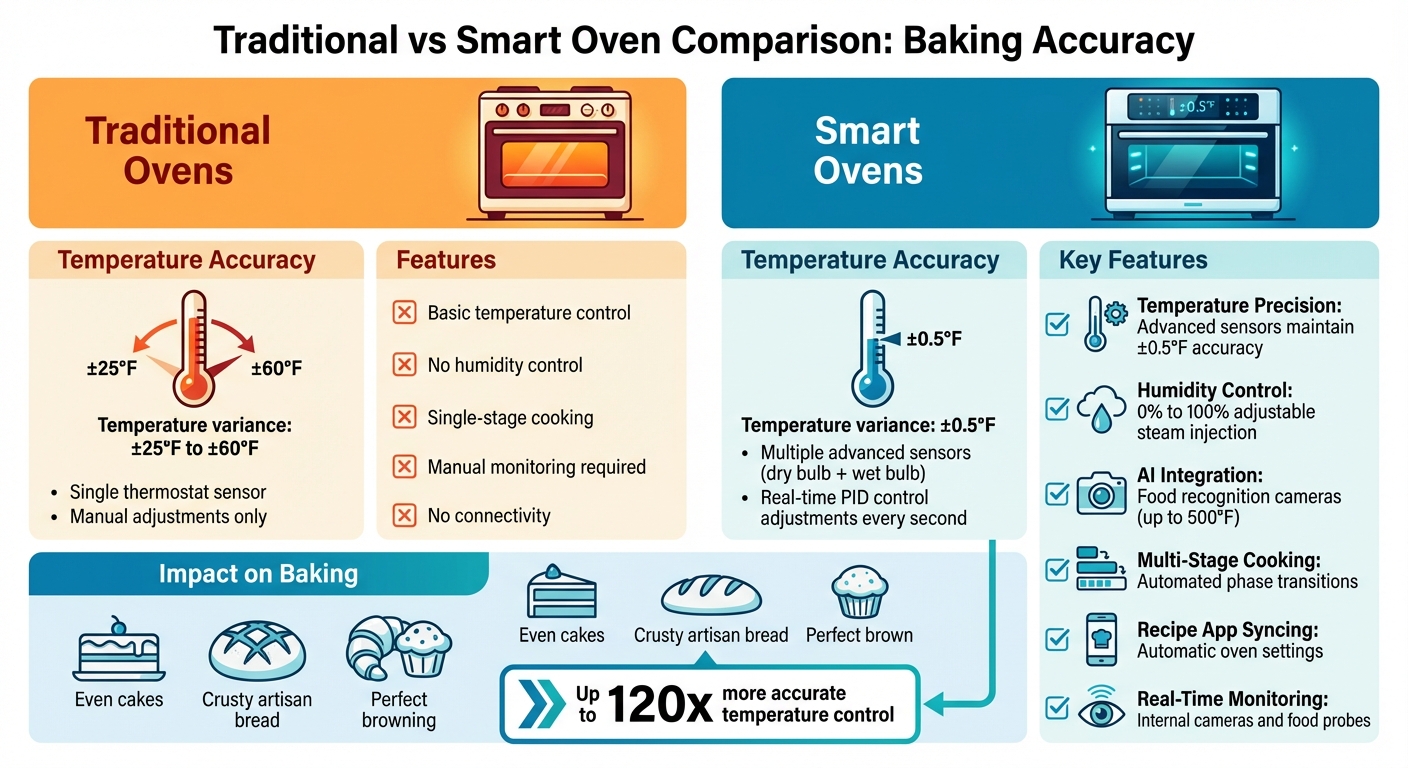
Traditional vs Smart Oven Temperature Accuracy Comparison
Smart or Not? | Breville vs Ninja vs June Ovens REVIEWED (Ep#4)

Smart Oven Features for Precise Baking
Smart ovens bring together cutting-edge sensors, humidity control, and AI to deliver consistently perfect baking results. Let’s dive into the standout features that make this possible.
Temperature Control with Advanced Sensors
Unlike traditional ovens that rely on a single thermostat and can experience temperature swings of 25°F to 60°F from the set point, smart ovens use a combination of sensors to maintain steady heat. A dry bulb sensor measures the air temperature, while a wet bulb sensor factors in humidity to determine the actual heat affecting your food. These readings are processed every second by PID control loops, which adjust the heating elements in real time. The result? Smart ovens can maintain temperatures within an impressively tight range of ±0.5°F. For even greater precision, a food probe monitors the internal temperature of your dish and tweaks the cooking process once the target temperature is reached.
Humidity and Steam Management
Moisture is crucial for professional-quality baking, and smart ovens take this seriously. They offer adjustable steam injection, allowing you to control humidity levels from 0% to 100%. For example, during the first few minutes of baking, higher humidity keeps dough moist and elastic, helping it expand before the crust sets. This technique creates bread with better volume and a shiny, artisan-style crust. When a crisp finish is needed, dry air inlets and variable-speed extraction fans remove excess moisture from the oven cavity. The Anova Precision Oven 2.0 is a standout model, combining convection and steam injection for precise humidity control.
AI-Driven Food Recognition
Smart ovens also integrate AI for next-level convenience. Equipped with cameras that can withstand temperatures up to 500°F, these ovens capture images of your food and use neural networks to identify it instantly. For instance, if you place a bagel in the June Oven (priced between $899 and $1,299), it will recognize the item and recommend an ideal cooking program. Beyond that, the AI can scan recipe URLs, cookbook pages, or even frozen food packaging to translate standard instructions into precise settings, including temperature, time, and steam levels. Some models even monitor food browning in real time and stop cooking when the perfect color is achieved. As Jennifer Waldera explains:
"The oven's functionality improves over time as it learns how to cook specific foods, benefiting both from its own cooking and baking experience as well as from data collected by other AI ovens."
Automated Timing and Multi-Stage Cooking
Real-Time Adjustments for Better Results
Smart ovens are designed to actively monitor your food and make real-time adjustments to improve cooking outcomes. Take the June Oven, for example - it collects data from multiple heating elements and convection fans every second to track temperature and food doneness. This continuous feedback helps the oven identify and address potential issues before they affect your meal.
A food probe adds an extra layer of precision, providing exact temperature readings that trigger automatic changes in cooking modes, temperature settings, and even notify you when your dish is done. Imagine roasting poultry: the oven might start with a lower temperature to ensure even cooking, then automatically crank up the heat to create a perfectly crispy exterior once the internal temperature is just right.
Machine learning powers these ovens to analyze both current and past data, allowing them to predict cooking completion times with impressive accuracy. This means no more worrying about overcooking your meals.
These real-time adjustments also set the stage for advanced multi-stage cooking, a game-changer for recipes requiring different cooking conditions.
Multi-Stage Cooking for Complex Recipes
Smart ovens take things a step further with multi-stage cooking, making it easier to tackle recipes that demand varied cooking environments. Unlike traditional ovens, which rely on a single temperature and time setting, these advanced appliances let you program multiple cooking phases that run automatically.
Take artisan bread, for instance. You can program the oven to proof the dough at 85°F with full humidity, follow it with a steam bake for optimal oven spring, and finish with a dry convection phase to create a perfectly crisp crust. The oven seamlessly transitions between these stages based on time or temperature triggers. Some models even feature a Sous Vide Express option, which slightly increases the temperature to cut cooking time by up to 50% while using the probe to ensure flawless doneness.
With these features, smart ovens make it easier than ever to execute complex recipes with precision and ease.
Integration with Recipe Apps for Better Accuracy
Import Recipes and Scale Servings with Ease
Smart ovens are all about precision, and when paired with recipe apps, they take baking to a whole new level. Apps like Honeydew Recipe Manager let you import recipes straight from social media or websites in seconds. Using AI, the app pulls in all the details - ingredients, measurements, and instructions - automatically.
"Our AI automatically extracts ingredients, instructions, and cooking details, saving them to your recipe collection in seconds." - Honeydew
Honeydew organizes recipes in U.S. Imperial units and can instantly adjust ingredient quantities when you scale servings. Whether you're baking for two or twenty, the app ensures every ratio stays on point. Plus, it uses OCR (optical character recognition) to convert recipes into a structured format, making substitutions and shopping a breeze.
Smart Ingredient Substitutions and Grocery Management
Running low on an ingredient? No problem. Honeydew’s AI suggests alternatives based on what you have in your pantry or your dietary preferences, all while maintaining the recipe’s integrity. Need to shop for missing items? With one click, Honeydew integrates with Instacart to create a grocery list tailored to your recipe. The list is even sorted by store sections, so you can grab what you need quickly.
For families, Honeydew Plus offers real-time recipe and list sharing for up to six members. This means everyone can stay on the same page, whether they're shopping or cooking together.
Syncing with Smart Ovens for Seamless Cooking
Honeydew doesn’t just stop at recipes - it takes full advantage of smart oven technology. The app can automatically set your oven’s temperature, mode, and cooking time based on the recipe. Compatible ovens from brands like Bosch, Thermador, and Siemens connect through platforms like Home Connect, ensuring every bake aligns perfectly with the recipe’s requirements.
High-tech models, like the Anova Precision Oven 2.0, go even further. They use AI to analyze recipes and recommend advanced settings, such as steam injection levels and precise temperatures. And if your hands are covered in dough, you can pair your oven with Amazon Alexa or Google Home for hands-free operation. Many ovens now even come with internal cameras, allowing you to monitor your bake in real time through your phone - no need to open the door and risk losing heat.
Conclusion
Smart ovens have changed the game for home baking. Unlike traditional ovens, which can swing wildly by up to 60°F, smart ovens keep temperatures steady within an impressive ±0.5°F range. This level of precision matters because baking is all about chemistry - consistent heat ensures proper starch gelatinization for a crisp crust and protein coagulation for the structure of cakes.
Beyond temperature control, smart ovens bring advanced features like humidity regulation, AI automation, and multi-stage cooking. Steam injection, for instance, helps create a bakery-quality crust while keeping the inside moist. Real-time monitoring ensures your baked goods are perfectly done without losing heat in the process. As Martin Earl, Culinary Editor at ThermoWorks, puts it:
"Oven accuracy will greatly affect the outcome of your cooking, especially when it comes to baked goods".
These innovations also integrate seamlessly with tools like the Honeydew Recipe Manager. This platform allows you to import recipes, scale servings, and even make AI-powered ingredient swaps. Plus, with Instacart integration, you can organize grocery lists and have everything you need delivered to your door. When paired with a smart oven, this system ensures every bake turns out just right.
Whether you're new to baking or a seasoned pro, smart ovens take the guesswork out of the process. With features once reserved for professional kitchens, these tools make precise, high-quality baking accessible to everyone. If you're ready to elevate your baking, a smart oven with intelligent recipe management might just be the upgrade you need.
FAQs
How do smart ovens ensure accurate temperature control?
Smart ovens achieve precise temperature control by leveraging advanced sensors like platinum-wire or glass-bead thermometers. These sensors continuously track the oven's internal temperature, feeding data to on-board processors. In turn, these processors work with quick-response heating elements to make real-time power adjustments - often within mere seconds.
Some models take it a step further with AI-powered cameras. These cameras monitor both the food and the oven's interior temperature, ensuring even greater accuracy and consistency during baking. The result? Perfectly baked dishes, thanks to the seamless integration of real-time adjustments and cutting-edge technology.
How does AI in smart ovens make baking more accurate?
AI is turning smart ovens into baking powerhouses by combining advanced sensors with machine-learning algorithms. These ovens keep a close eye on critical factors like temperature and humidity in real time, tweaking heat distribution and timing as needed to deliver consistently perfect results. What’s even better? The AI gets smarter over time, fine-tuning its presets based on past baking experiences and shared data, which means fewer chances of those dreaded under- or over-baked disasters.
Some models take it a step further with AI-powered cameras that can actually identify the type of food inside and automatically recommend the best settings. And if that’s not enough to impress, apps like Honeydew Recipe Manager can sync recipes directly with compatible ovens. This means precise bake profiles are just a tap away, taking all the guesswork out of the process. With this level of precision and convenience, even home bakers can create treats that rival those from a professional kitchen.
Can smart ovens adjust recipes based on the ingredients you have?
Smart ovens aim to make cooking easier and more precise by automatically managing key elements such as temperature, cooking mode, and timing to deliver better results. That said, they fall short when it comes to tweaking recipes based on the ingredients you have on hand. If you're looking for help with personalized recipe adjustments, meal planning apps might be a better fit.