How Smart Ovens Regulate Temperature
• Updated
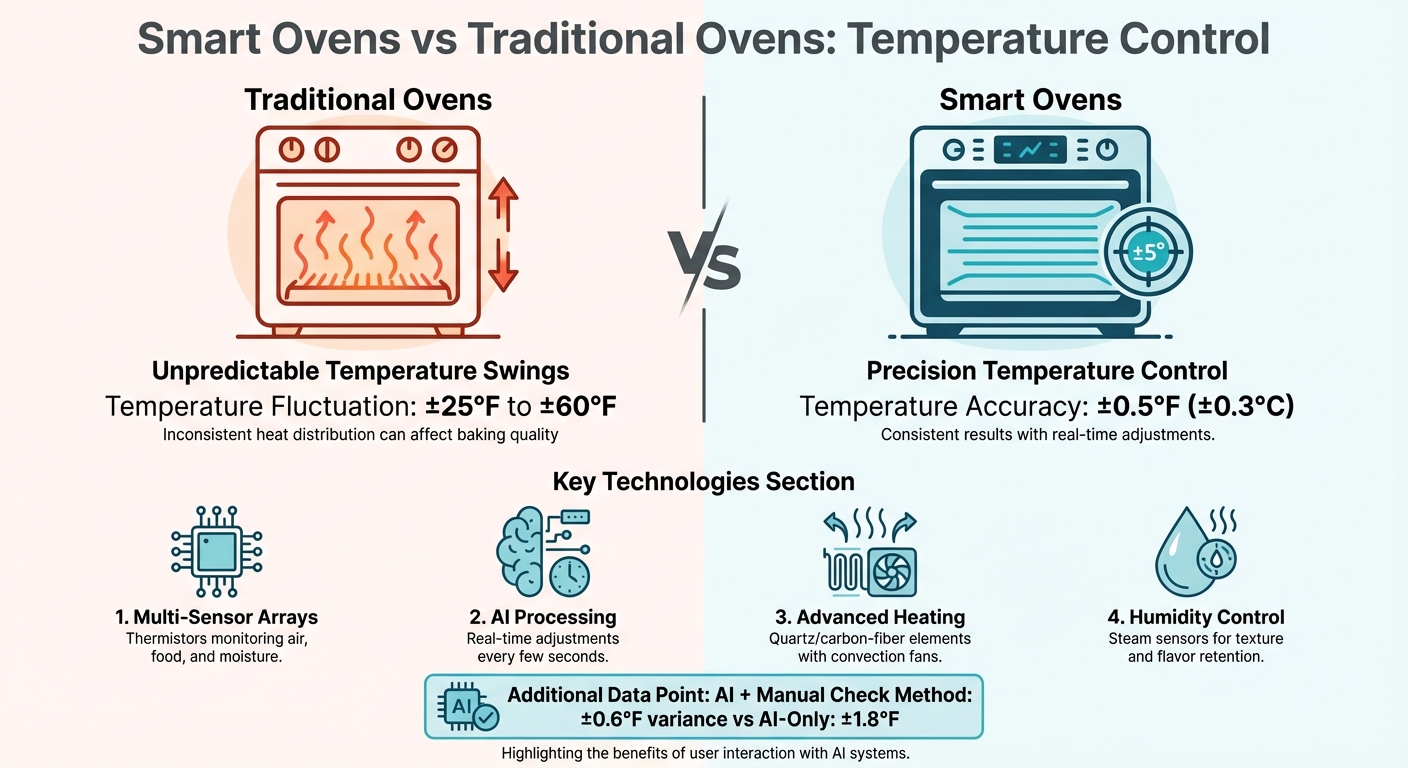
Smart ovens use advanced sensors, AI, and precise heating systems to maintain consistent temperatures and improve cooking results. Unlike older models that fluctuate by 25°F to 60°F, smart ovens adjust temperatures in real-time, often within ±0.5°F. They feature:
- Temperature Sensors: Thermistors and multi-sensor arrays monitor air, food, and moisture levels.
- Humidity Control: Steam and moisture sensors help retain food texture and flavor.
- Heating Elements: Quartz or carbon-fiber elements paired with convection fans ensure even heat distribution.
- AI and Connectivity: AI adjusts settings based on real-time data, while apps enable remote control and recipe integration.
These features simplify cooking, reduce food waste through pantry integration, and deliver consistent, high-quality meals. Read on to learn how they work.
Smart Ovens vs Traditional Ovens: Temperature Accuracy Comparison
How Smart Ovens Monitor Temperature
Temperature Sensors
Smart ovens rely on thermistors - specialized resistors that change resistance with temperature. High-end models often use platinum wire sensors, which provide highly stable and accurate readings, even at extreme temperatures. Ideally, these sensors measure resistance between 1,080 and 1,100 ohms at room temperature (70°F).
Some advanced ovens take it further by incorporating multi-sensor arrays. These systems use a combination of dry bulb and wet bulb sensors, along with food probes, to monitor both the air inside the oven and the food’s core temperature simultaneously. Here’s how they work:
- Dry bulb sensors measure the ambient air temperature in the oven cavity.
- Wet bulb sensors account for the cooling effect of moisture evaporating from the food.
- Food probes, such as glass bead or needle thermometers, track the food’s internal temperature in real time to ensure perfect cooking results.
Stephen Svajian, Co-Founder and CEO of Anova Culinary, highlights the importance of this dual-sensor approach:
"The temperature of the air is referred to as the 'dry bulb temperature.' The temperature that the food experiences is lower because water evaporating off the food cools it off. This temperature is called 'wet bulb.' To achieve the best results, the oven needs to understand both."
With this data, the oven’s AI system dynamically adjusts heating to maintain ideal cooking conditions, similar to how AI meal planning tools optimize ingredient use. Beyond temperature, these systems also monitor humidity to further refine the cooking process.
Humidity and Environmental Monitoring
Smart ovens don’t just stop at temperature - they also regulate humidity levels to improve cooking outcomes. Using capacitive sensors to detect water vapor changes, these ovens can saturate the cavity with steam, locking in moisture.
Anova Culinary explains the impact of this process:
"If we saturate the air with humidity by generating steam, the water content of your food has nowhere to go. It stays put, keeping your vegetables vibrant and your meats juicy."
Humidity control also plays a big role in determining the final texture of your dishes. For example:
- High humidity can prevent burning and produce lighter crusts.
- Low humidity encourages a crispier, more golden-brown finish.
AI algorithms continuously process this environmental data - sometimes as often as once per second - to make real-time adjustments to heating elements, steam levels, and fan speeds. This precision allows smart ovens to maintain temperature accuracy within ±0.5°F (0.3°C).
How Smart Ovens Maintain Even Heat Distribution
Heating Elements
Smart ovens are equipped with advanced heating technologies like quartz or carbon-fiber elements that heat up faster and respond instantly to sensor data. Take the June Oven, for instance - its six carbon-fiber heating elements adjust every second based on real-time sensor feedback.
Premium models, such as the Breville Smart Oven Pizzaiolo, priced at $999.95, use Element iQ technology to independently direct power where it's needed most, ensuring efficient browning and crisping. Meanwhile, some ovens, like the Sage Smart Oven Pro, utilize parabolic reflectors above their top heating elements to focus radiant heat directly on the food, delivering results that rival professional kitchens. This model also features five quartz elements to intelligently distribute heat and maintain temperatures up to 446°F (230°C).
These precise heating systems are paired with AI-driven algorithms that process sensor data in real time. Using PID control, they make micro-adjustments to maintain temperature accuracy within ±0.5°F. While these elements create targeted heat zones, proper air circulation is just as essential for consistent cooking.
Convection Fans and Air Circulation
Convection fans play a critical role in eliminating uneven heat distribution by constantly circulating hot air throughout the oven cavity. This ensures that food cooks evenly, regardless of its position - whether it's near a heating element or tucked into a corner.
Some smart ovens take this a step further with true convection systems. These systems include an additional heating element behind the fan to actively warm the circulating air. Features like adjustable fan speeds and integrated exhaust systems, such as the twin-fan setup in the June Oven, enhance heat distribution. The fans process temperature data every second, ensuring consistent cooking and perfect browning every time.
AI-Powered Temperature Regulation
Real-Time Data Analysis
AI-driven ovens use data from various sensors - like dry bulb (air temperature), wet bulb (evaporative cooling effect), and core probes - to make precise adjustments every few seconds. For instance, the June Oven Pro analyzes infrared thermography and humidity data every 4.2 seconds, while Bosch's AI recalibrates every 7 seconds.
These systems excel in adaptive recovery. Imagine opening the oven door and causing a 15°F drop in temperature. The AI immediately compensates by increasing power, maintaining cavity temperatures within an impressive ±0.8°F range. Some high-end models even factor in barometric pressure to adjust for altitude, crucial for baking at higher elevations where water boils at lower temperatures. A fascinating example: in February 2026, a baker in Santa Fe (elevation 7,199 ft) tested the June Oven Pro for sourdough. The oven detected 31% relative humidity and 785 hPa pressure, automatically extending the bake time by 27 minutes and lowering the temperature by 23°F. Over 12 weeks, this resulted in a 92% success rate, compared to just 68% with manual adjustments on a standard oven.
AI also identifies the "stall phase" in meats - when collagen breakdown temporarily slows temperature increases - and adjusts radiant heat and fan speed to retain moisture. Bosch's AI recalculates cooking time every 30 seconds based on continuous sensor feedback, while the Anova Precision Oven 2.0 ($1,299.00) keeps temperature deviations within ±0.5°F. Traditional ovens, by contrast, can fluctuate wildly, with swings of 25°F to 60°F. These real-time refinements elevate the cooking experience to a whole new level.
Learning User Preferences
AI-powered ovens don’t just adapt in real-time - they also learn from your habits to create a personalized cooking experience with expert tips. Over time, they develop custom profiles tailored to your preferences. For example, the Samsung Bespoke AI Oven needs you to cook the same dish at least five times before it can reliably save and recommend personalized settings. Its AI camera can even recognize up to 80 recipes and automatically optimize the settings for each one.
Many models feature "Cook Recall," which saves your favorite settings for recurring meals, so you don’t have to manually adjust the temperature and time every time. You can speed up this learning process by giving feedback - like "thumbs up" or "thumbs down" on suggested settings - through the companion app. This feedback helps the AI fine-tune its recommendations to better match your tastes. Some ovens also use "crowdsourced learning," where anonymized data from thousands of users helps refine the algorithm for everyone.
"The oven continuously monitors the food's progress and, by extension, the remaining baking time. This is important because every dish is unique." - Hoang Richter, AI Project Manager, BSH
Remote Temperature Control Features
Wi‑Fi and App Connectivity
Smart ovens connect to your home Wi‑Fi network and dedicated apps like Home Connect, June, or SmartHQ. These apps let you adjust the temperature, preheat, and switch cooking modes remotely - all from your smartphone. Real-time updates keep you informed about cavity and food temperatures, as well as the remaining cooking time. Push notifications alert you when your oven reaches the desired temperature or when your meal is ready. Some models even include internal HD cameras that can handle temperatures up to 500°F, streaming live footage of your cooking progress straight to your app.
"The Home Connect® app revolutionizes the way you interact with your Thermador appliances... from preheating and adjusting settings to sending recipe instructions directly to your Oven." – Thermador
For added safety, many smart ovens require manual activation of a "Remote Enable" feature before remote operation. However, newer GE models produced after late 2021 have removed this step, allowing you to start cooking remotely without extra setup. Another handy feature is barcode scanning - some ovens, like the Tovala Smart Oven (around $299), can recognize over 750 frozen food items by scanning their packaging with your phone.
Voice-Assisted Controls
Smart ovens also integrate with voice assistants like Amazon Alexa and Google Assistant, enabling hands-free control. With simple voice commands, you can preheat or adjust the oven's temperature instantly. Here's how it works: the voice assistant relays your command to the oven manufacturer’s cloud platform, which then communicates with your appliance.
"Alexa doesn't directly power a heating element. It hands off your command to the oven maker's cloud and app... If the oven is online, paired to your account, and remote control is armed, the oven accepts a request." – Mo Maruf, Founder, Kitchprep
To use voice commands, make sure your oven’s app is linked to your smart assistant in its settings. For safety reasons, voice control is limited to the oven cavity - it won’t light gas burners or activate the broiler. If you own a double oven, you’ll need to specify which cavity to control. For example, say, "Alexa, preheat the upper oven to 350", to avoid any mix-ups.
Using Honeydew Recipe Manager with Smart Ovens

Recipe Import and Temperature Guidance
Honeydew Recipe Manager combines recipe discovery with precise oven instructions, making cooking smarter and more efficient. Using AI, it pulls ingredients, measurements, and step-by-step instructions from websites, social media, and even cooking videos. These details are then converted into instructions that are compatible with smart ovens.
For recipes shared in video format, Honeydew uses OCR (Optical Character Recognition) to capture ingredient lists from screenshots and transcribes spoken steps. This ensures that critical temperature and timing details aren't overlooked, even in fast-paced cooking tutorials. Impressively, the app processes 270,000 recipes every month.
The "Ask Honey" AI assistant takes it a step further by allowing users to tweak recipes for dietary preferences - like making a dish vegetarian or dairy-free. When paired with smart ovens like the Anova Precision Oven 2.0, Honeydew simplifies the process even more. According to Anova Culinary:
"Anova Intelligence will scan the instructions and convert them. Next, it will show you the recommended Oven cooking features, including the Cooking Mode (i.e. Air-fry), temperature, and time."
With such precise guidance, Honeydew ensures your smart oven delivers spot-on results, making cooking easier and more reliable.
Meal Planning and Grocery Integration
Honeydew doesn’t stop at providing precise cooking instructions - it also simplifies meal planning and grocery shopping. Its meal planning feature works seamlessly with smart ovens, helping you schedule meals and generate detailed grocery lists. The app calculates exact ingredient amounts based on servings, ensuring proper heat distribution and cooking times. This is especially helpful when scaling recipes up or down.
Once your recipes are ready, Honeydew’s Instacart integration lets you send your shopping list to the delivery service with a single click. The app also syncs with your digital pantry, automatically removing items you already have. As one satisfied user, James L., shared:
"The smart grocery lists save me hundreds of dollars a month. I love how it suggests recipes based on what I already have!"
the Smart Oven™ Pro | Achieve an ideal temperature with the Warm and Reheat functions | Breville NZ
Conclusion
Smart ovens have reshaped how we cook at home by combining multi-sensor technology, AI, and app-based controls to maintain temperature accuracy within ±0.5°F. This is a notable leap from the unpredictable temperature swings of traditional ovens. By monitoring multiple temperature metrics, these devices achieve a detailed understanding of the cooking process. As Stephen Svajian, Co-Founder and CEO of Anova Culinary, puts it:
"Home cooking is no longer focused on just getting dinner on the table. It is about precision, cultural connection, and smart tools that help every cook achieve professional-quality results without wasted time or an extra mess."
With vision technology and app integration, you can now monitor browning progress and make adjustments directly from your smartphone. Pairing these ovens with tools like Honeydew Recipe Manager - which handles around 270,000 recipe saves each month - streamlines the entire cooking process. From importing recipes off social media to creating grocery lists and syncing optimized oven settings, these tools work together to simplify your workflow. And all of this is backed by rigorous testing.
Tests reveal that the best results come from combining AI presets with manual checks at the 75% mark. This hybrid approach achieves a temperature variance of just ±0.6°F, compared to ±1.8°F for AI-only methods. By blending technology with human intuition, these ovens help deliver consistent, professional-quality results - whether you’re roasting chicken or baking sourdough at high altitudes. The goal isn’t to replace your skills but to handle the technical details, so you can focus on creativity and flavor.
FAQs
Do I still need an oven thermometer with a smart oven?
Yes, an oven thermometer is still handy even if you have a smart oven. While smart ovens come with advanced features like precise sensors, they can still sometimes run hotter or cooler than the temperature you set. This can affect your cooking or baking results. Using a thermometer ensures your oven's temperature is accurate and keeps your dishes consistent.
How does humidity control change baking and roasting results?
Humidity control in an oven plays a crucial role in baking and roasting by influencing how moisture is retained, the development of crust color, and essential chemical processes like the Maillard reaction. These elements directly affect the texture, flavor, and overall appearance of your food, ensuring better results in your cooking endeavors.
Can Honeydew Recipe Manager send temperature and time settings to my smart oven?
Yes, Honeydew Recipe Manager is compatible with smart ovens that allow remote control of temperature and time settings. This feature lets you send these settings straight to supported devices, making your cooking process easier and more convenient.