5 Tips for Saving Money on Gluten-Free Groceries
• Updated
Eating gluten-free can be expensive - gluten-free products are often 2-3 times pricier than regular items. But with a few smart strategies, you can cut costs by up to 40%. Here's how:
- Focus on whole foods like rice, potatoes, and vegetables instead of costly packaged substitutes.
- Shop the store perimeter for naturally gluten-free items and buy seasonal produce to save even more.
- Compare unit prices and check multiple stores or apps for the best deals.
- Buy in bulk for staples like rice, oats, and gluten-free flours - but avoid open bulk bins to prevent cross-contamination.
- Stock multi-use ingredients like beans, quinoa, and almond flour to create a variety of meals without overspending.
Switching to these practices can help you save money while maintaining a gluten-free diet, making it easier to manage both your health and your budget.
How to save money when you’re gluten free
1. Choose Whole Ingredients Instead of Packaged Gluten-Free Products
The real expense of a gluten-free diet often comes from packaged substitutes, not the diet itself. Pre-made gluten-free products tend to cost more due to small-batch production and extensive testing. On the other hand, naturally gluten-free whole foods like rice, potatoes, eggs, and fresh vegetables are priced the same for everyone, no matter their dietary needs.
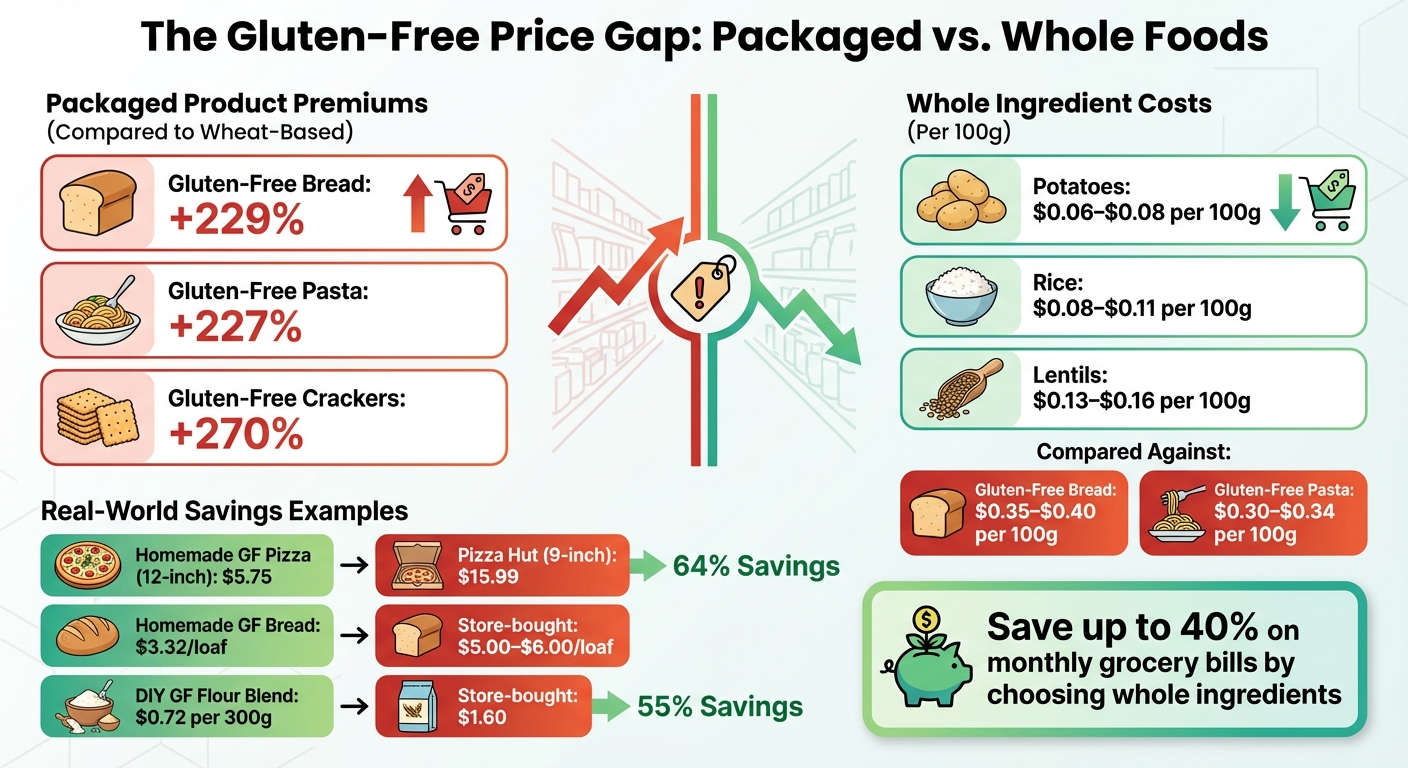
Let’s break it down. Potatoes cost roughly $0.06–$0.08 per 100g, while premium gluten-free bread can set you back $0.35–$0.40 per 100g. Similarly, rice costs about $0.08–$0.11 per 100g, and lentils are around $0.13–$0.16 per 100g. In contrast, gluten-free pasta averages $0.30–$0.34 per 100g. Clearly, opting for whole ingredients is a smarter financial choice.
"If you focus your diet on whole, fresh naturally gluten‐free foods, you pay the same price as everyone else."
– Patricia Maguire, Naturally Gluten-Free
Cooking from scratch also gives you more control over what goes into your meals, especially when using AI meal planning with pantry integration to track your ingredients. Many packaged gluten-free products are loaded with extra sodium and sugar to improve flavor and texture. By using ingredients like beans, quinoa, sweet potatoes, and fresh produce, you can create meals that are both nutritious and satisfying. For example, beans and lentils are excellent for bulking up dishes like tacos, soups, and stews, while also adding fiber and protein .
You can save even more by making simple swaps at home. For instance, creating your own gluten-free flour blend costs about $0.72 per 300g, compared to $1.60 for the store-bought version - a savings of 55%. Similarly, buying whole vegetables instead of pre-cut ones can cut your costs in half.
2. Shop the Store Perimeter and Buy Seasonal Produce
If you're looking to cut costs while sticking to a gluten-free diet, start by shopping the store perimeter. This is where you'll find fresh produce, meats, dairy, and eggs - all naturally gluten-free options. On the other hand, the center aisles are often stocked with specialty gluten-free products, which can be up to 183% more expensive than their wheat-based counterparts.
"What they say about shopping the perimeter of grocery stores is true - it's where you'll find all the whole ingredients and the cheaper prices as well as avoid the more processed/less healthy foods." – Cindy Rice, GFF Magazine
Once you've covered the essentials along the perimeter, focus on buying seasonal produce to stretch your budget even further. Seasonal fruits and vegetables not only taste better but also cost less because they're more abundant and don't carry additional shipping fees. For instance, strawberries might cost around $4.00 per pound in summer but can soar to $7.00 per pound in winter. Similarly, fresh carrots average about $0.30 per cup, while canned carrots cost nearly double at $0.59 per cup. Depending on the season, you can save by choosing items like:
- Summer: Berries, tomatoes, corn
- Fall: Apples, squash, sweet potatoes
- Winter: Citrus fruits, root vegetables
When fresh seasonal produce isn’t available, frozen vegetables can be a smart alternative. They’re often cheaper and just as nutritious because they’re flash-frozen at peak ripeness. For example, frozen corn costs about $0.64 per cup, compared to $1.50 for fresh, and frozen spinach is roughly $1.10 per cup, while fresh spinach can cost $1.77 per cup.
"Since all forms of fresh produce are free of wheat, rye, barley, and oats, the entire produce department is gluten free. It should be the primary section that you shop in." – Mary Ellen Phipps, MPH, RDN, LD, Milk & Honey Nutrition
3. Check Unit Pricing and Compare Prices Across Stores
Sticker prices can sometimes be deceiving. To uncover the best bargains on gluten-free groceries, focus on the unit price - the cost per unit of measurement. This figure, typically found on the shelf tag below the total price, lets you compare brands and package sizes more effectively. It’s a simple yet powerful way to ensure you’re getting the most value for your money.
"The single most useful skill I taught the kids was how to read unit labels on retail shelf price tags. Sounds super nerdy, but it's one of the best ways to get your money's worth in the aisles." – Ivy Manning, Food Writer
Be cautious, though - larger packages don’t always mean better savings. For instance, at Walmart, a 28-ounce container of rice was 10.3¢ per ounce, while a 42-ounce container cost slightly more at 10.4¢ per ounce. Similarly, at Costco, a $15.99 bottle of avocado oil was $15.99 per liter, but a $19.99 bottle worked out to just $9.99 per liter, making it the better deal.
Since only nine U.S. states require unit pricing on shelf tags, you might need to calculate it yourself. Simply divide the total price by the quantity to find the unit price. This extra step ensures that every gluten-free purchase is a smart one.
You’ll also want to compare prices across various stores. Apps like Flipp can help you browse weekly ads, while store-specific apps for Walmart, Target, and Aldi let you check prices before heading out. Warehouse clubs like Costco often shine when it comes to bulk pricing on gluten-free staples. For example, a 5-pound bag of Namaste gluten-free flour blend costs about $13–$15, significantly cheaper per pound than smaller 1-pound bags at traditional grocery stores.
Don’t overlook ethnic grocery stores either. Asian, Indian, and Mexican markets often carry naturally gluten-free staples like rice flour, chickpea flour, and corn tortillas at prices far lower than those in specialty gluten-free aisles.
Next, discover how buying in bulk can stretch your gluten-free grocery budget even further.
4. Buy in Bulk for Items You Use Often
Smart unit pricing is great, but bulk buying takes savings to the next level.
For gluten-free staples, buying in bulk can significantly cut costs. For example, purchasing certified gluten-free oats in 11-pound bags can save you about 40% compared to smaller retail packages. Similarly, buying rice in 22-pound bags and quinoa in 11-pound quantities can save approximately 35% and 30%, respectively.
Some of the best items to buy in bulk include:
- Naturally gluten-free grains like rice, quinoa, and millet
- Certified gluten-free oats
- Dried legumes such as beans, lentils, and split peas
- Gluten-free flours like rice, almond, tapioca, and sorghum
Warehouse clubs like Costco offer great deals, such as a 5-pound bag of Namaste Organic Gluten-Free Flour Blend for $13–$15, which works out to be cheaper per pound than smaller packages. Online retailers like Vitacost and Nuts.com are also excellent sources for affordable specialty flours and pantry essentials.
That said, if you have celiac disease, you’ll want to exercise caution with bulk purchases. Avoid open bulk bins entirely, as they pose serious cross-contamination risks. Instead, stick to large, pre-packaged sealed bags from wholesalers or online stores.
"Stay away from bulk bins, but you can buy bulk quantities of pre-packaged items. Gluten-free and gluten-containing ingredients are often side-by-side... they are rife with cross-contamination risks." – Heather King, Go Gluten Freely
Proper storage is just as important as buying in bulk. To avoid waste and keep your items fresh with digital recipe organization:
- Store gluten-free flours and nuts in airtight containers in the fridge or freezer to prevent rancidity. Nuts can last 3–6 months in the fridge.
- Transfer grains and dried beans to glass jars to protect them from moisture.
- For gluten-free bread, slice it first and freeze it, taking out only what you need. Using AI meal planning for ingredient prep can further optimize how you use these bulk purchases.
With gluten-free food prices rising by about 12% since 2024, bulk buying is becoming an increasingly practical way to save money.
5. Stock Your Pantry with Multi-Purpose Ingredients
Your pantry can be a game-changer when it comes to saving money while eating gluten-free. By focusing on versatile staples instead of pricey, single-use items, you can stretch your budget and create a variety of meals with ease.
Affordable staples like brown rice, quinoa, and potatoes are incredibly adaptable. They work well in stir-fries, grain bowls, soups, and more. For example, quinoa delivers about 8 grams of protein and 5 grams of fiber per cooked cup, making it both nutritious and filling. Dried or canned beans - such as black beans, chickpeas, and lentils - are another budget-friendly option, adding protein to countless dishes.
When it comes to baking and cooking, almond flour, cornstarch, and cornmeal are must-haves. Almond flour is rich in protein and works across recipes, from muffins to breading. Cornstarch stands out for its efficiency - it thickens twice as much as regular flour at a fraction of the cost.
"Corn starch... has twice the thickening power of flour and is very inexpensive." – Heather King
Other pantry essentials include canned tomato products, broths, and canned proteins like tuna, chicken, or salmon. These items are perfect for quick, flavorful meals and help you avoid the expense of pre-packaged gluten-free products. By centering your meals around naturally gluten-free whole foods, you’ll save money and enjoy healthier options.
Stocking these multi-purpose ingredients not only reduces costs but also simplifies meal prep. For an even smoother experience, consider using tools like Honeydew Recipe Manager (https://honeydewcook.com) to generate grocery lists and explore creative recipe ideas.
Cost Comparison: Packaged Products vs. Whole Ingredients
Gluten-Free Cost Comparison: Packaged Products vs Whole Ingredients
Let’s take a closer look at how packaged gluten-free products compare to whole ingredients when it comes to cost.
Packaged gluten-free products often come with a hefty price tag compared to their wheat-based counterparts. For example, gluten-free bread is 229% more expensive, gluten-free pasta costs 227% more, and gluten-free crackers carry a staggering 270% premium over standard versions. These numbers highlight how much more you pay for processed gluten-free alternatives, often referred to as the "gluten-free tax."
"The cost increases associated with eating gluten‐free are related to packaged substitutes for products traditionally made from wheat." – Lola O'Rourke, Registered Dietitian and Education Coordinator, Gluten Intolerance Group
Switching to homemade options can make a big difference. A 12-inch homemade gluten-free pizza costs about $5.75, while a 9-inch version from Pizza Hut is priced at $15.99 - that’s a 64% savings. Baking your own gluten-free bread costs roughly $3.32 per loaf, compared to $5.00–$6.00 for store-bought alternatives. By focusing on whole ingredients and using smart meal planning to prepare your own food, you could potentially slash your monthly grocery bill by up to 40%.
This shift not only saves money but also gives you greater control over what goes into your food, making it a win-win for your wallet and your health.
Conclusion
Cutting costs on gluten-free groceries is absolutely doable. By focusing on naturally gluten-free whole foods like rice, beans, and potatoes, you can lower your grocery bill by as much as 40%. The secret lies in developing smart shopping habits - comparing unit prices, buying in bulk, and centering meals around versatile, budget-friendly staples.
Take Sarah, for example. She managed to reduce her monthly gluten-free grocery expenses from $400 to $250 by adopting these strategies. Her approach included opting for store brands instead of pricier premium labels, batch cooking to save on convenience costs, and sticking to a well-thought-out weekly meal plan.
Tools like the Honeydew Recipe Manager make this process even easier. This app generates organized shopping lists and suggests budget-friendly gluten-free recipes. It can even recommend meals based on ingredients you already have, helping you avoid duplicate purchases and minimize waste. Plus, you can import recipes from social media, adjust serving sizes, and share lists with family members - all designed to streamline meal planning and keep expenses in check.
Considering that 78% of people on a gluten-free diet cite cost as their biggest obstacle, these strategies can make a real difference. By prioritizing whole foods, planning ahead, and leveraging digital tools, you can enjoy satisfying, gluten-free meals without stretching your budget.
FAQs
What are the cheapest naturally gluten-free staples to buy?
Affordable, naturally gluten-free staples are a fantastic choice for meal planning. Options like rice, potatoes, beans, lentils, quinoa, sweet potatoes, corn, amaranth, arrowroot, cassava, chia, and flax offer both nutrition and budget-friendly versatility. These ingredients can easily form the base of a wide range of satisfying meals without breaking the bank.
How do I avoid cross-contamination when buying in bulk?
To keep your gluten-free foods safe when buying in bulk, it's important to prevent cross-contamination. Start by storing gluten-free items in dedicated airtight containers or bins and clearly labeling them. Place these foods on separate pantry shelves or designated areas to avoid accidental mix-ups with gluten-containing products. These simple precautions can go a long way in maintaining the safety and integrity of your gluten-free foods.
How can I calculate unit price if my store doesn’t show it?
To figure out the unit price, simply divide the total price by the quantity, weight, or volume. For instance, if a package is priced at $4.00 and contains 16 ounces, the unit price would be:
$4.00 ÷ 16 oz = $0.25 per ounce
This method makes it easier to compare prices between various package sizes and choose the most cost-effective option.