Translating Recipes: Metric vs Imperial Measurements
• Updated
Struggling with recipe conversions? Whether you're baking with grams or cooking with cups, switching between metric and imperial measurements can be tricky. Here's the key takeaway: precise measurements matter, especially in baking, where even small errors can ruin a dish.
The challenge:
- U.S. and British measurements differ (e.g., a U.S. gallon is 3,785 ml, while a British gallon is 4,546 ml).
- Ingredient density affects weight - 1 cup of flour (128g) vs. 1 cup of sugar (201g).
- Manual conversions often lead to rounding errors and inaccuracies.
The solution:
- Manual conversion charts work but are time-consuming and prone to errors.
- Digital tools like the Honeydew Recipe Manager automate conversions, adjust for ingredient density, and simplify scaling recipes.
For precision and ease, a kitchen scale paired with a tool like Honeydew can transform how you cook. Manual methods are fine for simple recipes, but for accuracy and efficiency, digital tools are the way to go.
| Feature | Manual Conversion | Honeydew Recipe Manager |
|---|---|---|
| Accuracy | Rounding errors, density issues | AI-powered, precise adjustments |
| Ease of Use | Time-consuming, interruptions | Simple, one-tap conversions |
| Complex Scenarios | Struggles with mixed units | Handles density, substitutions, scaling (or finding an ingredient substitution) |
Choose what works best for your cooking style, but for hassle-free precision, Honeydew offers a streamlined solution.
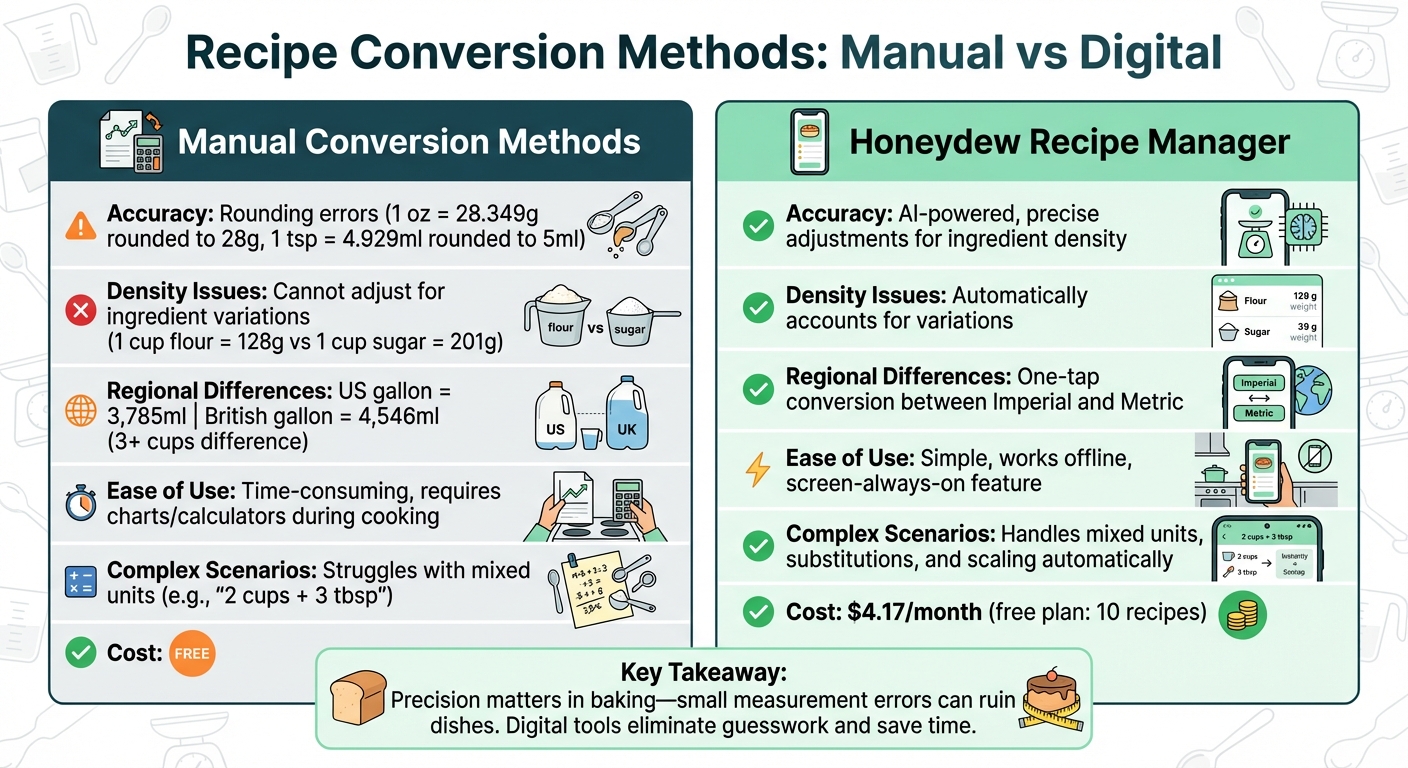
Manual vs Digital Recipe Conversion: Feature Comparison Chart
1. Manual Conversion Methods
Accuracy of Conversions
Manual conversion charts offer a handy reference, but they come with built-in limitations. As America's Test Kitchen points out:
All conversions are approximate and have been rounded up or down to the nearest whole number.
This rounding introduces slight inaccuracies. For instance, 1 ounce equals 28.349 grams, but it's often rounded to 28 grams. Similarly, a teaspoon's actual value of 4.929 ml is typically rounded to 5 ml. While these discrepancies might seem trivial, they can add up in larger recipes or when precision is critical - especially in baking, where exact measurements are crucial.
An even bigger issue arises with density. Manual charts can’t adjust for the varying densities of different ingredients without providing separate tables for each one. As the Exploratorium notes:
The correct conversion depends on the density of the item you're measuring.
Regional differences in measurement standards further complicate things. For example, a US gallon equals 3,785 ml, while a British gallon holds 4,546 ml - that’s more than 3 US cups of difference. Even teaspoons vary slightly: the US version measures 4.93 ml, whereas the British Imperial teaspoon is 5 ml.
These accuracy challenges are compounded by the practical difficulties of using manual methods in the kitchen.
Ease of Use
Besides the accuracy issues, manual conversions can be a hassle during cooking. Imagine trying to juggle printed charts or online calculators while your hands are covered in flour. The Exploratorium captures this scenario well, describing the frustration of being "up to your elbows in a recipe".
Manually converting measurements means finding the right conversion factors, performing calculations, and rounding - all of which interrupt the cooking process. Mixed units, like "1¾ cups of flour", make things even more tedious, as they require multiple steps to calculate accurately.
To improve precision, NIST suggests the "measure and weigh" method: measure the ingredient using standard tools (like a cup), then weigh the amount on a kitchen scale to get the exact gram count. While this approach increases accuracy, it also adds extra steps and requires owning a reliable kitchen scale.
Handling of Complex Scenarios
Things get even trickier when a recipe uses multiple measurement units. For example, converting "2 cups plus 3 tablespoons" requires separate calculations for each unit before combining them - adding complexity to the process.
Using the wrong tools can make matters worse. If you use dry measuring cups for liquids, or vice versa, you can introduce errors that manual charts can’t fix. The NIST Office of Weights and Measures emphasizes:
Measuring ingredients by mass (weight) using an appropriate kitchen scale is a best practice to improve recipe accuracy, rather than measuring ingredients by volume.
Experienced cooks might rely on visual cues and instincts to compensate for these inaccuracies. But for beginners, manual conversions demand extra attention to detail - and even then, mistakes are common. More complex recipes only amplify these challenges, making manual methods less reliable.
These hurdles highlight the need for digital tools that can streamline and simplify ingredient prep through automated conversion.
My problem with metric recipes
2. Honeydew Recipe Manager
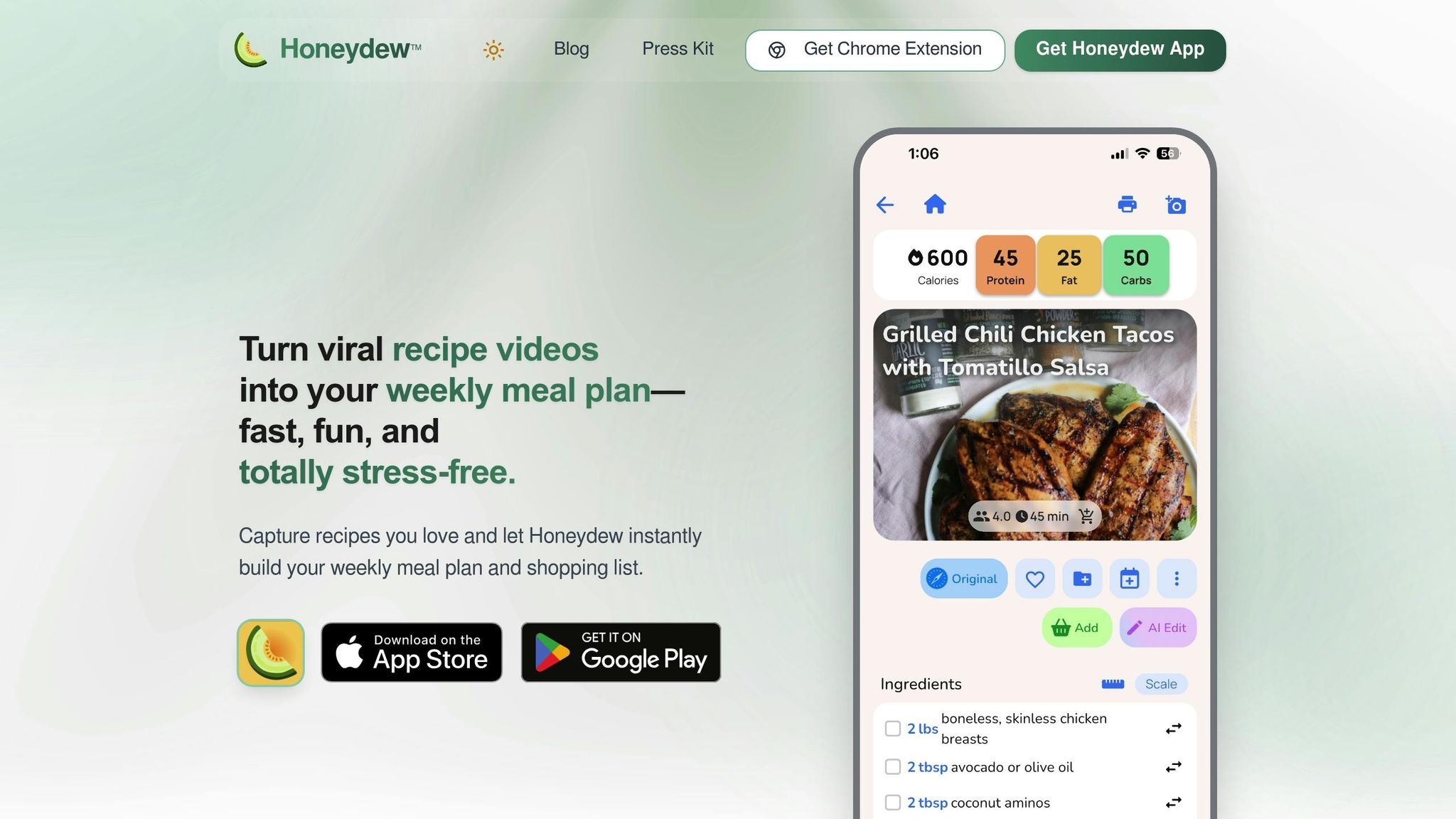
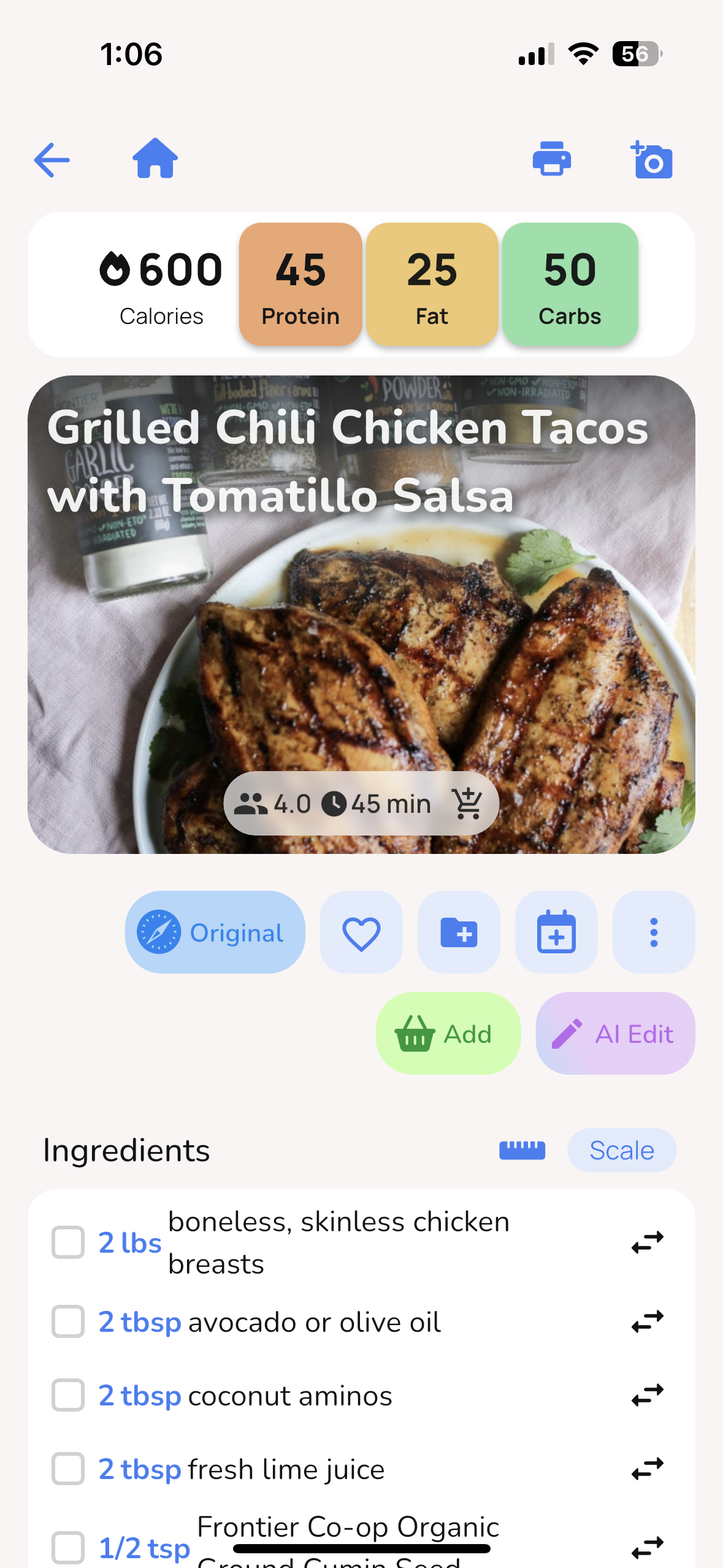
Honeydew Recipe Manager simplifies recipe management by automating processes that are often prone to human error, like measurement conversions and ingredient scaling.
Accuracy of Conversions
This tool stands out by automating conversions between volume, weight, and temperature units. Whether you're working with cups, grams, or Celsius, Honeydew's automated converter ensures precise measurements. Its AI-driven system standardizes ingredients and measurements, ensuring consistency across recipes.
The Ingredient Portion Converter is particularly handy, allowing you to scale individual ingredients for any serving size while accounting for variations in ingredient density. When you import a recipe, the app categorizes ingredients automatically and generates detailed grocery lists with exact quantities - no guesswork required.
Ease of Use
Forget fumbling with conversion charts in the middle of cooking. Honeydew's smart serving size scaling makes switching between Imperial and Metric systems as simple as a tap. The app stays active on your screen and works offline, so it’s always ready when you need it.
Planning for a crowd? The AI-powered portion scaling adjusts ingredient amounts, cooking times, and grocery lists seamlessly for larger serving sizes. Plus, its pantry tracking feature integrates with the conversion tools, offering recipe suggestions based on what you already have at home.
Handling of Complex Scenarios
Complicated measurements like "2 cups plus 3 tablespoons" are no challenge for Honeydew's automated system. The Ingredient Substitution Finder offers alternatives for common ingredients, such as butter or flour, while recalculating measurements to account for differences in properties. This makes it easy to adapt recipes for dietary needs or ingredient availability.
For meal prep enthusiasts, the Meal Prep Time Estimator calculates cooking times for up to five dishes at once, helping you manage scaled portions and measurements across multiple recipes. If you're tackling international recipes, the app’s one-tap translation feature not only converts the language but also adjusts measurements to your preferred system - metric or imperial. It’s a seamless way to handle recipes from around the world without missing a beat.
Pros and Cons
To better understand the strengths and weaknesses of each approach, let's break it down in the table below and explore a detailed summary.
| Feature | Manual Conversion Methods | Honeydew Recipe Manager |
|---|---|---|
| Conversion Accuracy | Relies on rounded equivalency charts (e.g., 1 teaspoon rounded from 4.929 mL to 5 mL); requires manual adjustment for ingredient density | AI-powered system automatically adjusts for ingredient density and provides precise conversions for volume, weight, and temperature |
| Ease of Use | Free and doesn’t require an account; depends on having conversion charts or calculators handy | One-tap conversions between Imperial and Metric; works offline with a screen-always-on feature; requires a subscription for unlimited access at $4.17/month |
| Handling Unusual Ingredients | Struggles with density variations - e.g., a cup of flour can vary by up to 50% in weight | Automatically adjusts for density differences; offers smart ingredient substitutions with precise measurement adjustments |
| Extra Features | Limited to basic conversions | Includes meal planning, nutrition tracking, automatic grocery list creation with Instacart integration, household sharing for up to 6 users, and a Pantry Mode for better inventory management |
This comparison underscores why automated tools like the Honeydew Recipe Manager are such a game-changer for cooking enthusiasts. Manual methods may work for occasional, straightforward conversions, but they often fall short when precision is needed. For instance, the reliance on rounded equivalency charts and manual adjustments can lead to inaccuracies, especially with ingredients like flour, where weight can vary significantly.
On the other hand, the Honeydew Recipe Manager eliminates the guesswork entirely. Its AI-driven system handles density calculations automatically and scales recipes with ease. The free plan allows users to import up to 10 recipes and access basic conversion tools, while the Honeydew Plus subscription unlocks unlimited storage and advanced features. Beyond conversions, it offers a suite of tools like meal planning and grocery list generation. As one user, James L., put it: "The smart grocery lists save me hundreds of dollars a month".
These features go beyond simplifying measurements - they streamline the entire cooking process, making it easier to manage everything from pantry inventory to meal prep. This comparison highlights how a digital solution can transform daily cooking into a more efficient and enjoyable experience.
Conclusion
Adjusting international recipes for a U.S. kitchen often comes down to balancing precision and convenience. While manual conversion charts might work for simpler dishes like soups or stews, they can falter when it comes to baking. For instance, a cup of all-purpose flour weighs about 128 grams, while a cup of granulated sugar comes in at roughly 220 grams. These small variations can lead to noticeable inaccuracies, especially when scaling recipes up or down.
Digital conversion tools, on the other hand, take the guesswork out of the equation. For home cooks diving into international cookbooks or blogs, ingredient-aware systems handle tricky regional differences effortlessly. Whether it’s determining if a British "pint" equals 473 ml (U.S.) or 568 ml (Imperial), or converting oven temperatures from Celsius to Fahrenheit, these tools streamline the process. They even adjust pan dimensions from centimeters to inches, saving time and reducing errors.
Take the Honeydew Recipe Manager, for example. It factors in the specific densities of different ingredients, offering one-tap conversions between Imperial and Metric systems. With offline access, automatic grocery list creation, and meal planning features, it simplifies your digital recipe organization. The free version allows you to try the conversion tools with up to 10 recipes, while the Honeydew Plus plan - priced at $4.17 per month - unlocks unlimited storage and advanced features.
For those committed to precision, a kitchen scale remains the most reliable way to measure ingredients, especially when converting recipes from grams to cups or milliliters to fluid ounces. Even with advanced digital tools, visual cues - like dough forming into a cohesive ball - are invaluable, as ingredient behavior can vary by region. For anyone serious about perfecting international recipes, automated conversion tools provide a level of accuracy and convenience that manual methods simply can’t match.
FAQs
Why is accuracy so important when measuring ingredients for baking?
Accuracy is key when it comes to baking because it leans more toward science than art. Even slight adjustments to ingredients like flour, sugar, or leavening agents can completely alter the outcome of your baked goods. For instance, using too much flour might leave you with a cake that's dry and heavy, while too little could result in a cake that collapses.
In the U.S., recipes typically use imperial measurements like cups and teaspoons, while many other countries rely on metric units such as grams and milliliters. This difference makes careful recipe conversion essential to keep everything precise. For the best results, weight-based measurements - like grams or ounces - are your safest bet for consistency. Tools such as Honeydew Recipe Manager can simplify this process by automatically converting recipes between metric and imperial systems without losing the original balance, making it easier to bake successfully no matter where your recipe originates.
How do digital tools make recipe measurement conversions easier and more accurate?
Digital tools make recipe conversions a breeze by using pre-set conversion factors to switch between measurements like cups, ounces, pounds, and Fahrenheit to their metric counterparts. These tools take the guesswork out of the process, ensuring precision by factoring in ingredient-specific details like density - because, let’s face it, 1 cup of sugar isn't the same as 1 cup of flour.
Many of today’s tools go a step further with smart detection. They can automatically identify units, recognize synonyms, and handle fractions, all while keeping the formatting consistent. When paired with platforms like Honeydew Recipe Manager, these tools don’t just handle conversions - they also create accurate grocery lists and calculate nutrition facts. This makes meal planning easier for users worldwide, all while preserving the recipe’s original essence and accommodating U.S. preferences like imperial measurements and Fahrenheit temperatures.
What’s the difference between U.S. and British recipe measurements?
The U.S. relies on customary units, whereas Britain primarily uses the metric system, though some older imperial units still linger. In American recipes, ingredients are often measured by volume - think cups, tablespoons, and teaspoons - or by weight, using ounces and pounds. Oven temperatures are typically listed in °F.
In contrast, British recipes tend to measure ingredients by weight (grams or kilograms) and liquid volume (milliliters), with oven temperatures in °C. For instance, a U.S. recipe might say “1 cup of flour,” while a British recipe would specify “120 g of flour.” These differences make it crucial to convert measurements accurately when working with recipes from different regions.