Why Cups, Ounces, and Grams Keep Tripping Up Good Recipes
The confusing part is not the arithmetic. It is knowing whether the recipe is talking about space in a cup or weight on a scale.
 By Chris HabibUpdated 7 min read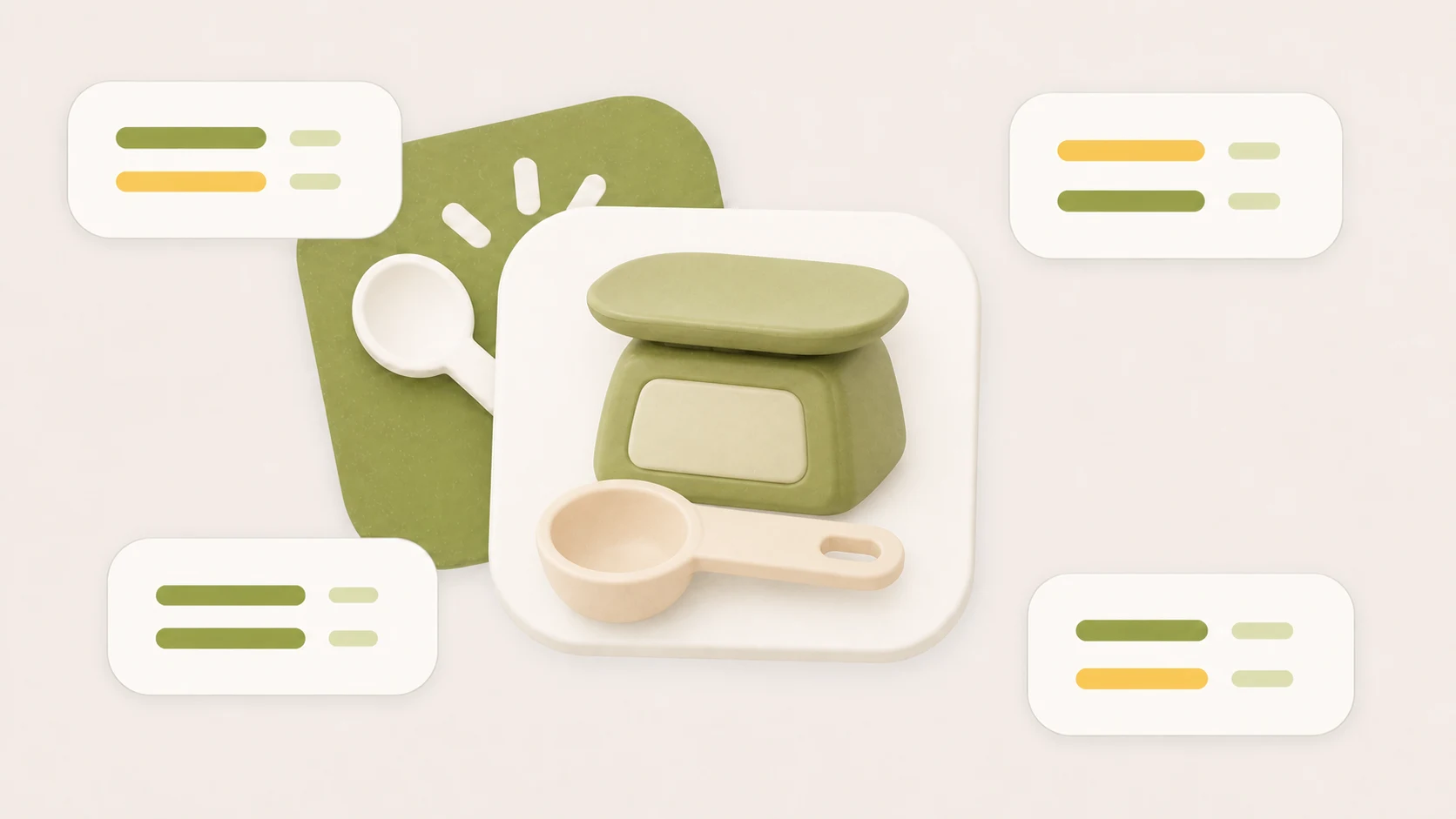
Recipes often place cups, ounces, and grams beside one another as if they all describe the same thing. They do not. Some measure the space an ingredient fills, while others measure how heavy it is.
Once you know which kind of measurement you are looking at, the conversions become much clearer and your results become more consistent.
Two kinds of ounces share one name
Put a measuring cup beside a kitchen scale. One tells you how much space an ingredient fills. The other tells you how heavy it is.
A fluid ounce is a volume unit, so it converts directly to cups. Eight US fluid ounces equals one US cup. An ordinary ounce is a weight unit, so it converts directly to grams. One ounce equals 28.35 grams.
That is why an ounces and cups calculator needs to ask whether you mean fluid ounces or weight ounces.
Density is the missing number
A cup has a fixed volume, but the weight of what fills it changes. Honey packs much more mass into that space than rolled oats.
The conversion is simple once the ingredient weight is known:
cups = grams divided by grams per cup
For all-purpose flour at 125 grams per cup, 100 grams is 0.8 cup. For granulated sugar at 200 grams per cup, the same 100 grams is 0.5 cup. One number cannot answer both ingredients honestly.
When the scale wins
Use the recipe's grams when it gives them. You avoid differences caused by scooping, packing, and the shape of the ingredient pieces. This matters most for flour, powdered sugar, chopped nuts, and sticky ingredients.
Volume still has a place. A tablespoon is quick for oil. A cup is convenient for stock. The goal is not to replace every measuring cup. It is to keep the unit the recipe chose when that unit carries useful precision.
Three examples worth remembering
1. Water
Eight US fluid ounces of water fills one US cup. The direct volume relationship is the useful fact here.
2. All-purpose flour
Eight ounces of flour by weight is 226.8 grams. At 125 grams per cup, that is about 1.81 cups. Technique can still change how much flour fits into a physical cup.
3. Butter
One US cup of butter is commonly treated as 227 grams, or 8 weight ounces. This happens to make the numbers look tidy, but it does not turn weight ounces into fluid ounces.
Use the grams and cups converter for ingredient math, or keep the full kitchen conversion chart nearby for exact volume relationships.
Sources and method
We use the NIST approximate conversion tables for US volume and mass constants. Flour and rolled oat weights come from the USDA Food Buying Guide. FDA household measure guidance provides the rounded values used on US food labels.
Ingredient density is a practical estimate, not a physical constant. Our calculators show the assumed grams per cup next to every weight-to-volume result. Last checked August 25, 2026.
Keep every recipe and conversion together.
Save recipes from anywhere, organize your cookbook, and keep the measurements you need close at hand.
 Grocery List for One Person
 High Protein Grocery List
 Pantry Inventory Template
 Grocery List Ideas